Gelfman Russell, Ingraham Brenden S, Sandhu Gurpreet S, Lerman Amir, Lewis Bradley, Gulati Rajiv, Pellikka Patricia A, Higgins Steven D, Singh Mandeep
Department of Physical Medicine and Rehabilitation, Mayo Clinic and Mayo Foundation, Rochester, Minnesota.
Department of Cardiovascular Diseases, Mayo Clinic and Mayo Foundation, Rochester, Minnesota.
J Soc Cardiovasc Angiogr Interv. 2024 May 2;3(5):101353. doi: 10.1016/j.jscai.2024.101353. eCollection 2024 May.
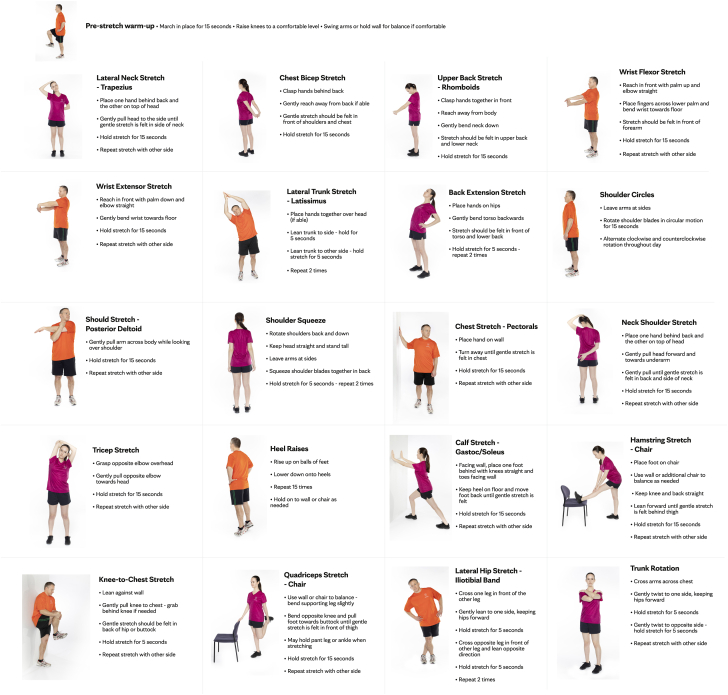
Stretching improves range of motion and changes the viscoelastic properties of muscle-tendon units. We hypothesized that a regular stretching program would reduce the functional consequences of pain for employees working in echocardiographic, ultrasound, and interventional laboratories. This exploratory, proof-of-concept study was meant to inform expectations for future randomized, controlled studies.
In this unblinded, nonrandomized, observational study, we enrolled 196 health care professionals working in the interventional and echocardiographic laboratories in the departments of cardiology and radiology at Mayo Clinic and Mayo Clinic Health System to perform 15-minute neck, upper extremity, low back, and lower extremity stretches for 1 year. The functional consequences of pain were self-reported by using the Disability of Arm, Shoulder, and Hand; Neck Disability Index; and Roland-Morris Questionnaire, which was administered at baseline and at 1 year to measure response to stretching. Monitoring with an assessment plan for injuries was undertaken. Employees who were pregnant, unable to do exercises, or under active orthopedic treatment, were excluded.
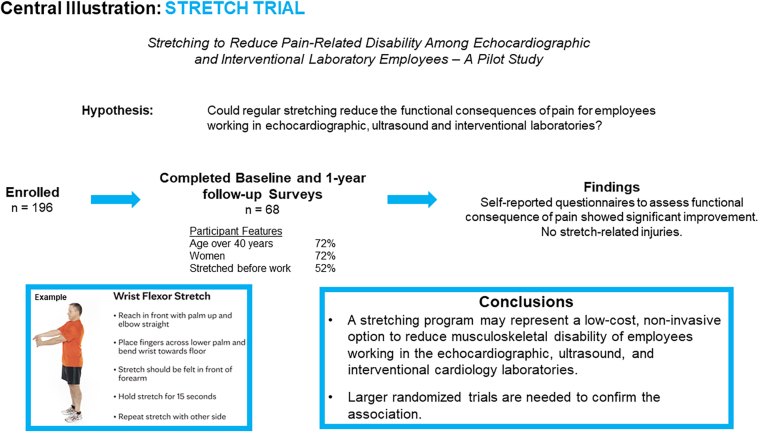
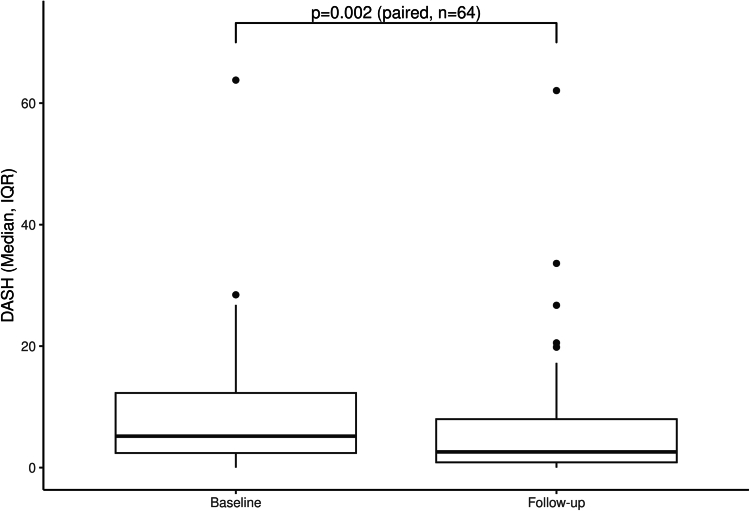
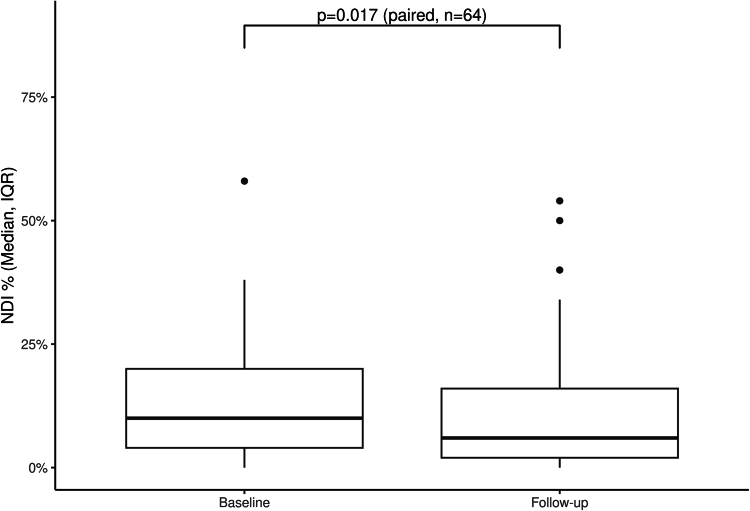
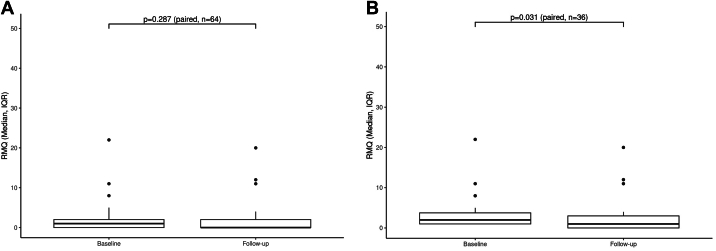
Of the 196 enrolled, 68 (35%) provided complete data at both baseline and follow-up. The majority of participants were over 40 years (n = 51; 72%) and female (n = 51; 72%). Participants performed stretches for 120.5 (IQR, 52-184) days over the year. The number of days of doing the stretches was well distributed across the study period with median quarters 1, 2, 3, and 4 of 32 (19-51), 32 (20-51), 31 (17-45), and 32.5 (12-47) days, respectively. The majority of participants (52.3%) stretched before, 18.9% stretched during and 28.8% stretched after work. Self-reported upper extremity disability improved in the treatment group with a significant decrease in the median Disability of Arm, Shoulder, and Hand score (5.2 to 2.6; = .002). There was an absolute 4% decrease in the Neck Disability Index score, between baseline and 1-year follow-up (10% to 6%, = .017). There was not a significant change in the Roland-Morris Questionnaire from baseline to follow-up (1 to 0; = .287). No participant reported any stretch-related injuries.
A routine stretching program may represent an attractive, low-cost, noninvasive option to reduce upper extremity musculoskeletal disability of employees working in the echocardiographic, ultrasound, and interventional laboratories. Larger randomized trials are needed to confirm the association.
拉伸可改善关节活动范围,并改变肌肉 - 肌腱单位的粘弹性特性。我们推测,定期进行拉伸训练可减轻在超声心动图、超声及介入实验室工作的员工因疼痛导致的功能障碍。这项探索性的概念验证研究旨在为未来的随机对照研究提供预期依据。
在这项非盲、非随机的观察性研究中,我们招募了196名在梅奥诊所及梅奥诊所医疗系统的心脏病学和放射学部门的介入和超声心动图实验室工作的医护人员,让他们进行为期1年的15分钟颈部、上肢、下背部和下肢拉伸。通过使用手臂、肩部和手部功能障碍量表、颈部功能障碍指数以及罗兰 - 莫里斯问卷来自我报告疼痛的功能后果,这些问卷在基线和1年时进行填写以评估拉伸效果。同时采用损伤评估计划进行监测。排除怀孕、无法进行锻炼或正在接受积极骨科治疗的员工。
在196名入组人员中,68名(35%)在基线和随访时均提供了完整数据。大多数参与者年龄超过40岁(n = 51;72%)且为女性(n = 51;72%)。参与者在这一年中进行了120.5(四分位间距,52 - 184)天的拉伸。拉伸天数在整个研究期间分布良好,第1、2、3和4季度的中位数分别为32(19 - 51)、32(20 - 51)、31(17 - 45)和32.5(12 - 47)天。大多数参与者(52.3%)在工作前拉伸,18.9%在工作期间拉伸,28.8%在工作后拉伸。治疗组中自我报告的上肢功能障碍有所改善,手臂、肩部和手部功能障碍量表的中位数得分显著降低(从5.2降至2.6;P = .002)。颈部功能障碍指数得分在基线和1年随访之间绝对下降了4%(从10%降至6%,P = .017)。从基线到随访,罗兰 - 莫里斯问卷没有显著变化(从1降至0;P = .287)。没有参与者报告任何与拉伸相关的损伤。
常规拉伸计划可能是一种有吸引力、低成本、非侵入性的选择,可减少在超声心动图、超声及介入实验室工作的员工的上肢肌肉骨骼功能障碍。需要更大规模的随机试验来证实这种关联。