Cushing Cody A, Lau Hakwan, Kawato Mitsuo, Craske Michelle G, Taschereau-Dumouchel Vincent
Department of Psychology, UCLA, Los Angeles, CA, USA.
RIKEN Center for Brain Science, Wako, Saitama, Japan.
medRxiv. 2024 Aug 1:2023.04.25.23289107. doi: 10.1101/2023.04.25.23289107.
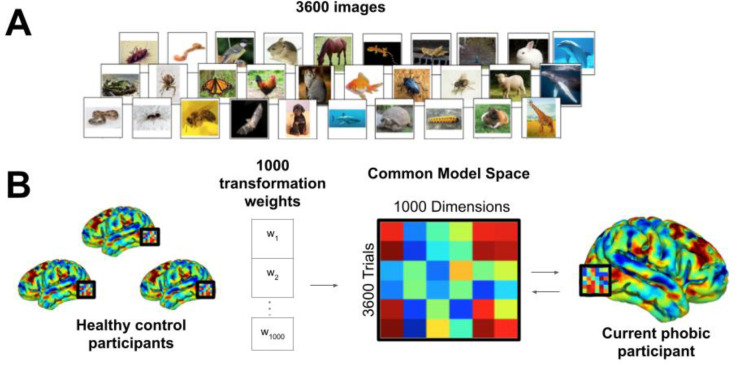
A new closed-loop fMRI method called multi-voxel neuro-reinforcement has the potential to alleviate the subjective aversiveness of exposure-based interventions by directly inducing phobic representations in the brain, outside of conscious awareness. The current study seeks to test this method as an intervention for specific phobia.
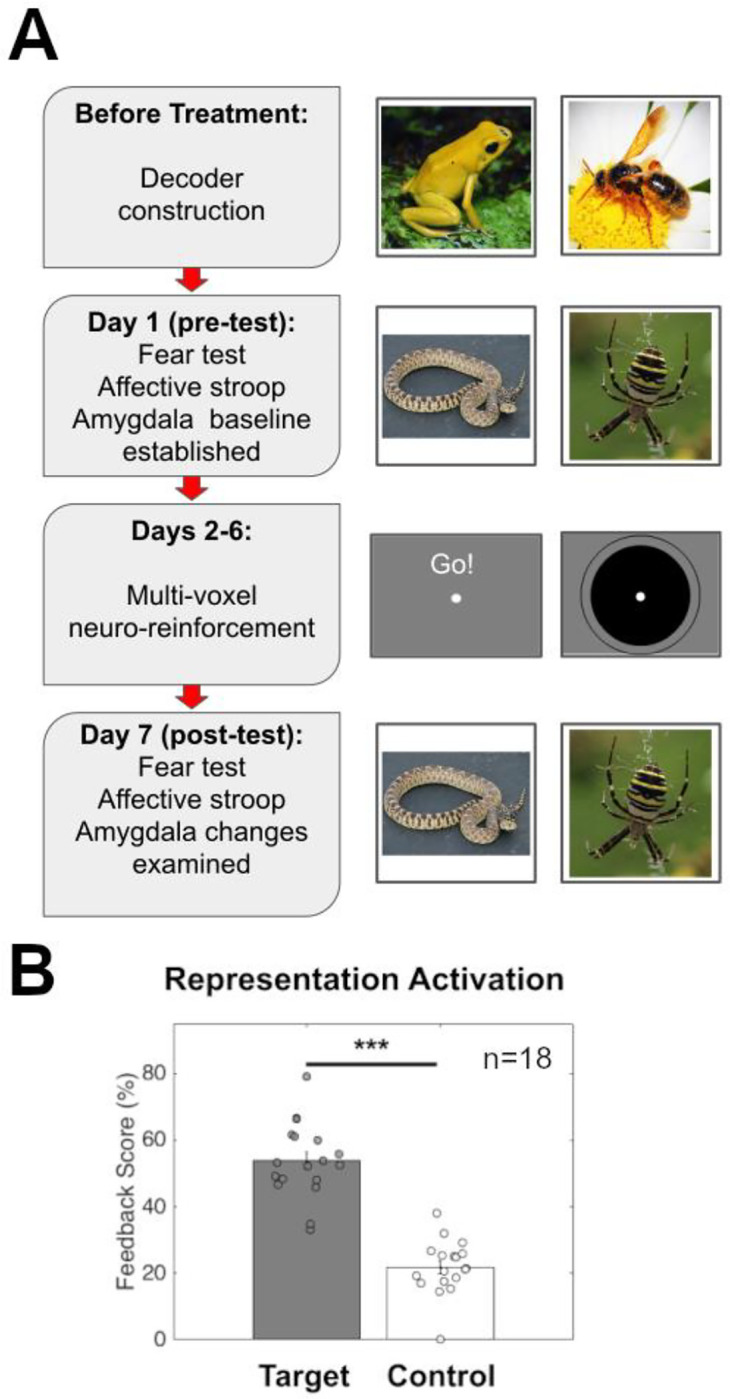
In a randomized, double-blind, controlled single-university trial, individuals diagnosed with at least two (1 target, 1 control) animal subtype specific phobias were randomly assigned (1:1:1) to receive 1, 3, or 5 sessions of multi-voxel neuro-reinforcement in which they were rewarded for implicit activation of a target animal representation. Amygdala response to phobic stimuli was assessed by study staff blind to target and control animal assignments. Pre-treatment to post-treatment differences were analyzed with a 2-way repeated-measures ANOVA.
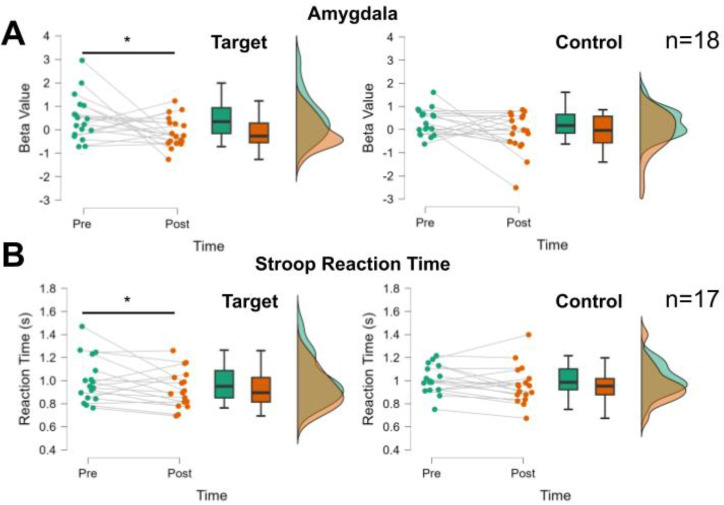
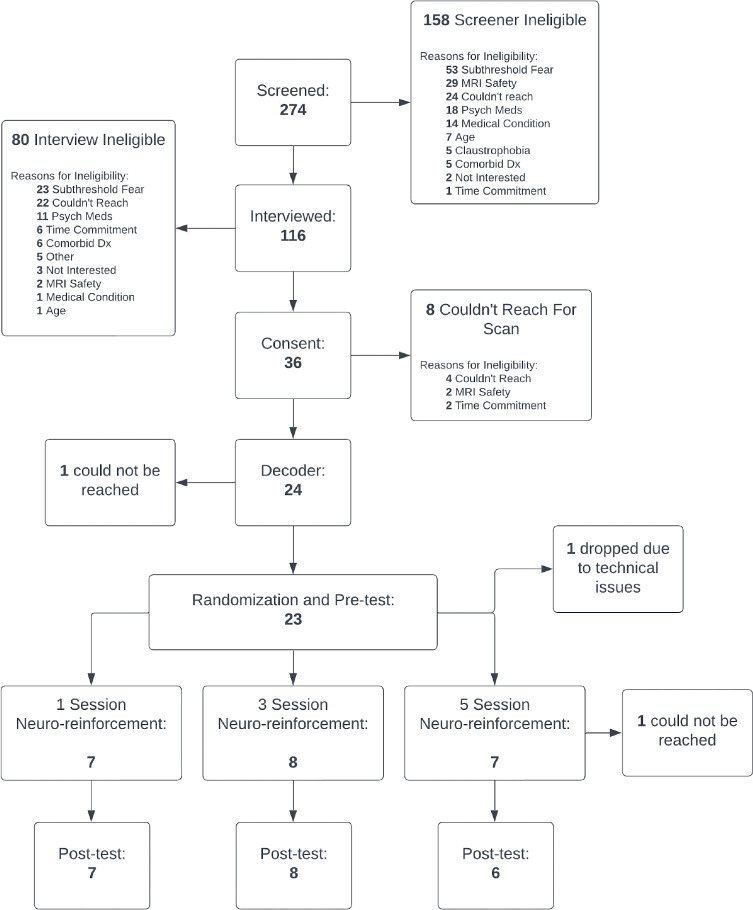
A total of 23 participants (69.6% female) were randomized to receive 1 (n=8), 3 (n=7), or 5 (n=7) sessions of multi-voxel neuro-reinforcement. Eighteen (n=6 each group) participants were analyzed for our primary outcome. After neuro-reinforcement, we observed an interaction indicating a significant decrease in amygdala response for the target phobia but not the control phobia. No adverse events or dropouts were reported as a result of the intervention.
Results suggest multi-voxel neuro-reinforcement can specifically reduce threat signatures in specific phobia. Consequently, this intervention may complement conventional psychotherapy approaches with a non-distressing experience for patients seeking treatment. This trial sets the stage for a larger randomized clinical trial to replicate these results and examine the effects on real-life exposure.
The now-closed trial was prospectively registered at ClinicalTrials.gov with ID NCT03655262.
一种名为多体素神经强化的新型闭环功能磁共振成像方法有潜力通过在意识之外直接在大脑中诱导恐惧表征来减轻基于暴露的干预措施的主观厌恶感。本研究旨在测试该方法作为特定恐惧症的一种干预手段。
在一项单大学随机、双盲、对照试验中,被诊断患有至少两种(1种目标、1种对照)动物亚型特定恐惧症的个体被随机分配(1:1:1)接受1、3或5次多体素神经强化治疗,在治疗过程中,他们因对目标动物表征的隐性激活而获得奖励。研究人员在不知道目标动物和对照动物分配情况的前提下评估杏仁核对恐惧刺激的反应。采用双向重复测量方差分析对治疗前至治疗后的差异进行分析。
共有23名参与者(69.6%为女性)被随机分配接受1次(n = 8)、3次(n = 7)或5次(n = 7)多体素神经强化治疗。对18名参与者(每组n = 6)进行了主要结局分析。神经强化治疗后,我们观察到一种交互作用,表明目标恐惧症的杏仁核反应显著降低,而对照恐惧症则没有。未报告因干预导致的不良事件或退出情况。
结果表明多体素神经强化可以特异性降低特定恐惧症中的威胁信号。因此,这种干预措施可能会以一种无痛苦的体验来补充传统心理治疗方法,为寻求治疗的患者提供帮助。该试验为一项更大规模的随机临床试验奠定了基础,以复制这些结果并研究对现实生活暴露的影响。
现已结束的该试验已在ClinicalTrials.gov上进行前瞻性注册,标识符为NCT03655262。