Zhou Chunfang, Basnet Rina, Zhen Chenxiang, Ma Shinan, Guo Xingrong, Wang Zhongxia, Yuan Yahong
Hubei Key Laboratory of Embryonic Stem Cell Research, Hubei Provincial Clinical Research Center for Umbilical Cord Blood Hematopoietic Stem Cells, Taihe Hospital, Hubei University of Medicine, Renmin Road 32, Shiyan, Hubei, 442000, People's Republic of China.
Department of Gastroenterology, Renmin Hospital, Hubei University of Medicine, Chaoyang Road 39, Shiyan, Hubei, 442000, People's Republic of China.
Discov Oncol. 2024 Aug 12;15(1):346. doi: 10.1007/s12672-024-01178-8.
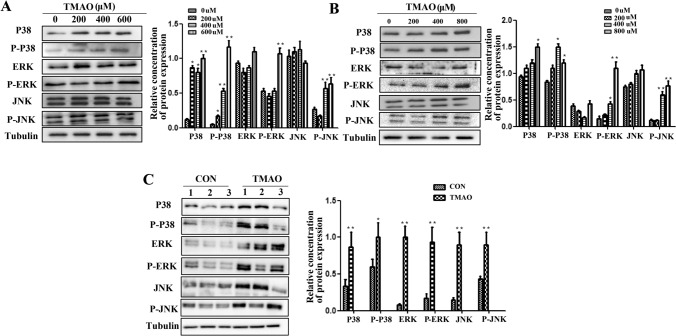
Trimethylamine-n-oxide (TMAO) is a metabolite of intestinal flora following the consumption of phosphatidylcholine-rich foods. Clinical cohort studies have shown that plasma TMAO may be a risk factor for cancer development, including hepatocellular carcinoma (HCC), but fundamental research data supporting this hypothesis are lacking. In this study, HCC cells were treated with TMAO in vivo and in vitro to evaluate the effect on some indicators related to the malignancy degree of HCC, and the relevant molecular mechanisms were explored. In vitro, TMAO promoted the proliferation and migration of HCC cells and significantly upregulated the expression of proteins related to epithelial-mesenchymal transformation (EMT). In vivo, after HCC cells were inoculated subcutaneously in nude mice given water containing TMAO, the tumors grew faster and larger than those in the mice given ordinary water. The immunohistochemistry analysis showed that proliferation, migration and EMT-related proteins in the tumor tissues were significantly upregulated by TMAO. Furthermore, TMAO obviously enhanced the phosphorylation of MAPK signaling molecules in vivo and in vitro. In conclusion, TMAO promotes the proliferation, migration and EMT of HCC cells by activating the MAPK pathway.
氧化三甲胺(TMAO)是食用富含磷脂酰胆碱的食物后肠道菌群产生的一种代谢产物。临床队列研究表明,血浆TMAO可能是包括肝细胞癌(HCC)在内的癌症发生的危险因素,但缺乏支持这一假设的基础研究数据。在本研究中,对肝癌细胞进行体内和体外TMAO处理,以评估其对肝癌恶性程度相关指标的影响,并探讨相关分子机制。在体外,TMAO促进肝癌细胞的增殖和迁移,并显著上调与上皮-间质转化(EMT)相关的蛋白表达。在体内,将肝癌细胞皮下接种到饮用含TMAO水的裸鼠体内后,肿瘤生长比饮用普通水的小鼠更快、更大。免疫组化分析显示,TMAO显著上调肿瘤组织中增殖、迁移及EMT相关蛋白的表达。此外,TMAO在体内和体外均明显增强MAPK信号分子的磷酸化。总之,TMAO通过激活MAPK途径促进肝癌细胞的增殖、迁移和EMT。