Liu Lingling, Zhang Claire Shuiqing, Zhang Anthony Lin, Cai Yefeng, Xue Charlie Changli
The China-Australia International Research Centre for Chinese Medicine, School of Health and Biomedical Sciences, STEM College, RMIT University, Melbourne, Victoria, Australia.
The Second Affiliated Hospital of Guangzhou University of Chinese Medicine, Guangdong Provincial Hospital of Chinese Medicine and Guangdong Provincial Academy of Chinese Medical Sciences, Guangzhou, China.
J Am Geriatr Soc. 2024 Dec;72(12):3890-3902. doi: 10.1111/jgs.19125. Epub 2024 Aug 12.
This study aims to evaluate the add-on effects of oral Chinese herbal medicine (CHM) for mild cognitive impairment (MCI), when used in addition to donepezil compared to donepezil alone.
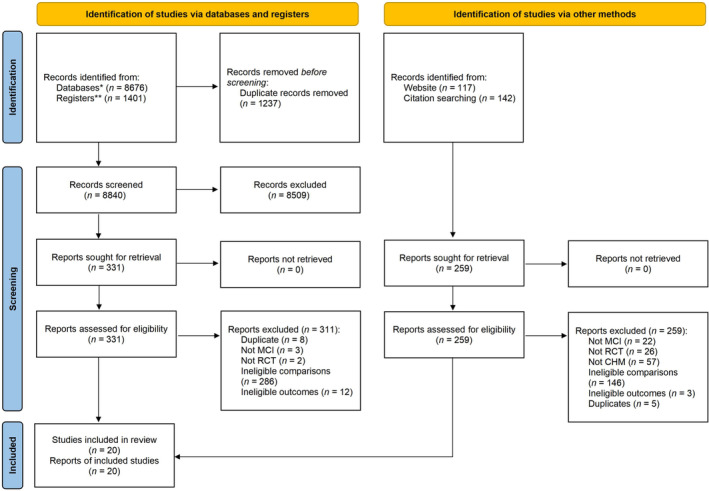
Randomized controlled trials comparing these treatments across all types of MCI were identified from nine databases and three registers until August 2023. Outcome measures were Mini-Mental State Examination (MMSE), Montreal Cognitive Assessment (MoCA), and adverse events (AEs). Methodological quality was assessed using Cochrane risk-of-bias tool, and evidence certainty was evaluated using the GRADE method.
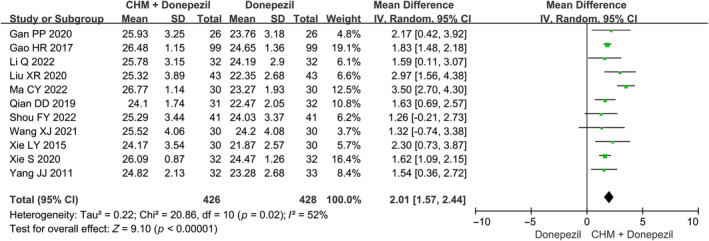
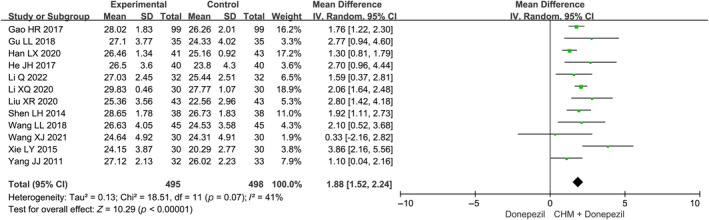
Involving 1611 participants across 20 studies, meta-analysis results indicate that oral CHM combined with donepezil significantly improved cognitive function in MCI patients compared to donepezil alone, as evidenced by MMSE (1.88 [1.52, 2.24], I = 41%, 12 studies, 993 participants) and MoCA (MD: 2.01 [1.57, 2.44], I = 52%, 11 studies, 854 participants). Eleven studies reported details of AEs, identifying gastrointestinal symptoms and insomnia as the most common symptoms. No significant difference in AEs frequency was found between the groups (RR: 0.91 [0.59, 1.39], I = 4%, 11 studies, 808 participants). All 20 studies were evaluated as having "some concerns" regarding the overall risk of bias. The certainty of evidence for MMSE was "moderate" and "low" for MoCA. From frequently utilized herbs, two classical CHM formulae were identified: Kai xin san and Si wu decoction. The observed treatment effects of commonly used herbs may be exerted through multiple pharmacological mechanisms, including anti-inflammatory, anti-oxidative stress, anti-apoptotic actions, promotion of neuronal survival and modulation of the cholinergic system.
The concurrent use of oral CHM and donepezil appears to be more effective than donepezil alone in improving the cognitive function of MCI, without leading to an increase in AEs. While recognizing concerns of overall methodological quality, this combined therapy should be considered as an alternative option for clinical practice.
本研究旨在评估口服中药对轻度认知障碍(MCI)的附加效果,即与单用多奈哌齐相比,联合使用多奈哌齐时的效果。
截至2023年8月,从九个数据库和三个登记处中检索比较所有类型MCI的这些治疗方法的随机对照试验。结局指标为简易精神状态检查表(MMSE)、蒙特利尔认知评估量表(MoCA)和不良事件(AE)。使用Cochrane偏倚风险工具评估方法学质量,并使用GRADE方法评估证据确定性。
纳入20项研究中的1611名参与者,荟萃分析结果表明,与单用多奈哌齐相比,口服中药联合多奈哌齐可显著改善MCI患者的认知功能,MMSE(1.88[1.52,2.24],I²=41%,12项研究,993名参与者)和MoCA(MD:2.01[1.57,2.44],I²=52%,11项研究,854名参与者)可证明这一点。11项研究报告了不良事件的详细情况,确定胃肠道症状和失眠是最常见的症状。两组之间不良事件发生率无显著差异(RR:0.91[0.59,1.39],I²=4%,11项研究,808名参与者)。所有20项研究在总体偏倚风险方面均被评估为“存在一些担忧”。MMSE的证据确定性为“中等”,MoCA的证据确定性为“低”。从常用草药中,确定了两个经典的中药方剂:开心散和四物汤。常用草药观察到治疗效果可能通过多种药理机制发挥作用,包括抗炎、抗氧化应激、抗凋亡作用、促进神经元存活和调节胆碱能系统。
口服中药与多奈哌齐联合使用在改善MCI认知功能方面似乎比单用多奈哌齐更有效,且不会导致不良事件增加。虽然认识到总体方法学质量存在担忧,但这种联合治疗应被视为临床实践的一种替代选择。