Ahmadu Bello University / Ahmadu Bello University Teaching Hospital, P.M.B. 06, Shika- Zaria, Kaduna State, Nigeria.
Division of Urology, Department of Surgery, Ahmadu Bello University Teaching Hospital, P.M.B. 06, Shika-Zaria, Kaduna State, Nigeria.
BMC Health Serv Res. 2024 Aug 12;24(1):918. doi: 10.1186/s12913-024-11340-1.
Prostate cancer mortality rates are high in Nigeria. While prostate cancer is highly curable with early detection and effective multidisciplinary management, the quality of care is suboptimal in this setting. Sustainable delivery of high-quality care for patients with localized prostate cancer is needed to save more lives. To inform future interventions to improve care, this study aimed to identify barriers and facilitators that influence prostate cancer detection and management in Nigeria.
Six focus group discussions (FGDs), stratified by stakeholders were conducted with a purposive sample of prostate cancer patients (n = 19), caregivers (n = 15), and healthcare providers (n = 18), in two academic tertiary hospitals in northern and southern Nigeria. A discussion guide organized based on the socio-ecological model was used. FGDs were recorded, transcribed, and analysed using the framework technique.
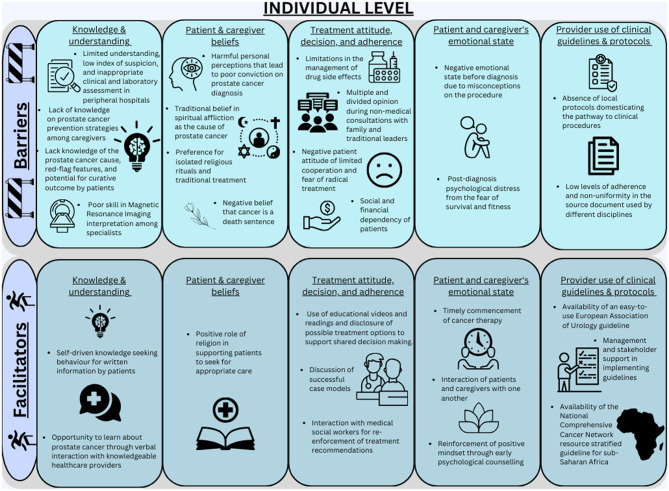
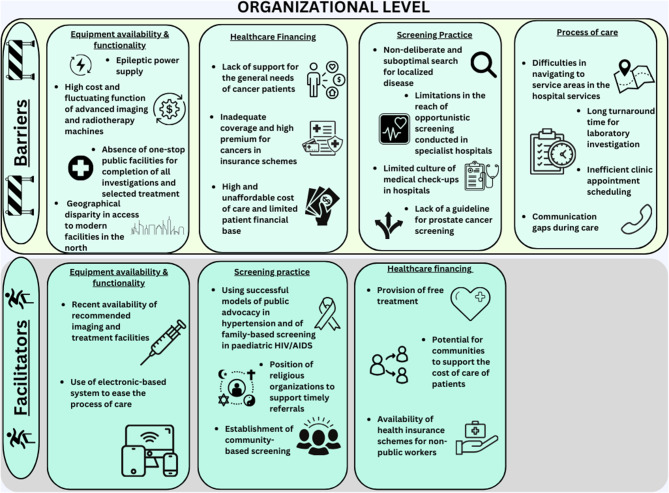
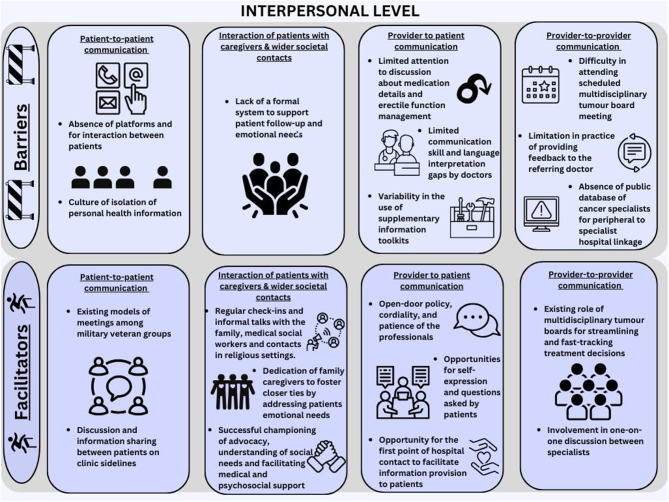
Barriers and facilitators were identified at the individual, interpersonal, and organizational levels. Barriers to detection included limited knowledge and misperceptions among patients, caregivers, and community-based non-specialist healthcare providers, and limitations of centralized opportunistic screening; while facilitators included the potential for religious institutions to encourage positive health-seeking behaviour. Barriers to management included non-uniformity in clinical guideline usage, treatment abandonment amidst concerns about treatment and survival, absence of patient interaction platforms and follow-up support systems, difficulty in navigating service areas, low health insurance coverage and limited financial resource of patients. Facilitators of management included the availability of resource stratified guidelines for prostate cancer management and the availability of patient peers, caregivers, nurses, and medical social workers to provide correct medical information and support patient-centred services. Participants also provided suggestions that could help improve prostate cancer detection and management in Nigeria.
This study identified multiple determinants affecting the detection and management of localized prostate cancer. These findings will inform the refinement of implementation strategies to improve the quality of prostate cancer care in Nigeria.
尼日利亚的前列腺癌死亡率很高。尽管通过早期发现和有效的多学科管理可以高度治愈前列腺癌,但在这种情况下,护理质量并不理想。为了挽救更多的生命,需要为局部前列腺癌患者提供可持续的高质量护理。为了为未来的干预措施提供信息以改善护理,本研究旨在确定影响尼日利亚前列腺癌检测和管理的障碍和促进因素。
在尼日利亚北部和南部的两家学术性三级医院,我们对 19 名前列腺癌患者、15 名护理人员和 18 名医疗保健提供者进行了分层的 6 个焦点小组讨论(FGD)。根据社会生态模式组织了讨论指南。使用框架技术对 FGD 进行记录、转录和分析。
在个人、人际和组织层面都发现了障碍和促进因素。检测障碍包括患者、护理人员和社区非专科医疗保健提供者的知识有限和误解,以及集中机会性筛查的局限性;而促进因素包括宗教机构鼓励积极寻求健康行为的潜力。管理障碍包括临床指南使用的不一致性、对治疗和生存的担忧导致的治疗中断、缺乏患者互动平台和随访支持系统、服务区域导航困难、健康保险覆盖率低以及患者有限的财务资源。管理的促进因素包括前列腺癌管理资源分层指南的可用性,以及患者同伴、护理人员、护士和医务社会工作者提供正确医疗信息和支持以患者为中心的服务的可用性。参与者还提出了一些建议,这些建议可以帮助改善尼日利亚的前列腺癌检测和管理。
本研究确定了影响局部前列腺癌检测和管理的多个决定因素。这些发现将为完善实施策略以提高尼日利亚前列腺癌护理质量提供信息。