Universidad de Buenos Aires., Facultad de Ciencias Exactas y Naturales. Departamento de Ecología, Genética y Evolución. Laboratorio de Eco-Epidemiología., Buenos Aires, Argentina.
Instituto de Ecología, Genética y Evolución (IEGEBA), CONICET-Universidad de Buenos Aires, Buenos Aires, Argentina.
Parasit Vectors. 2024 Aug 12;17(1):340. doi: 10.1186/s13071-024-06401-7.
The Gran Chaco ecoregion is a well-known hotspot of several neglected tropical diseases (NTDs) including Chagas disease, soil-transmitted helminthiasis and multiparasitic infections. Interspecific interactions between parasite species can modify host susceptibility, pathogenesis and transmissibility through immunomodulation. Our objective was to test the association between human co-infection with intestinal parasites and host parasitaemia, infectiousness to the vector and immunological profiles in Trypanosoma cruzi-seropositive individuals residing in an endemic region of the Argentine Chaco.
We conducted a cross-sectional serological survey for T. cruzi infection along with an intestinal parasite survey in two adjacent rural villages. Each participant was tested for T. cruzi and Strongyloides stercoralis infection by serodiagnosis, and by coprological tests for intestinal parasite detection. Trypanosoma cruzi bloodstream parasite load was determined by quantitative PCR (qPCR), host infectiousness by artificial xenodiagnosis and serum human cytokine levels by flow cytometry.
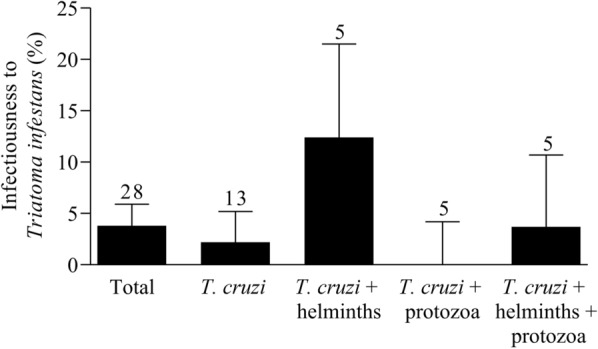
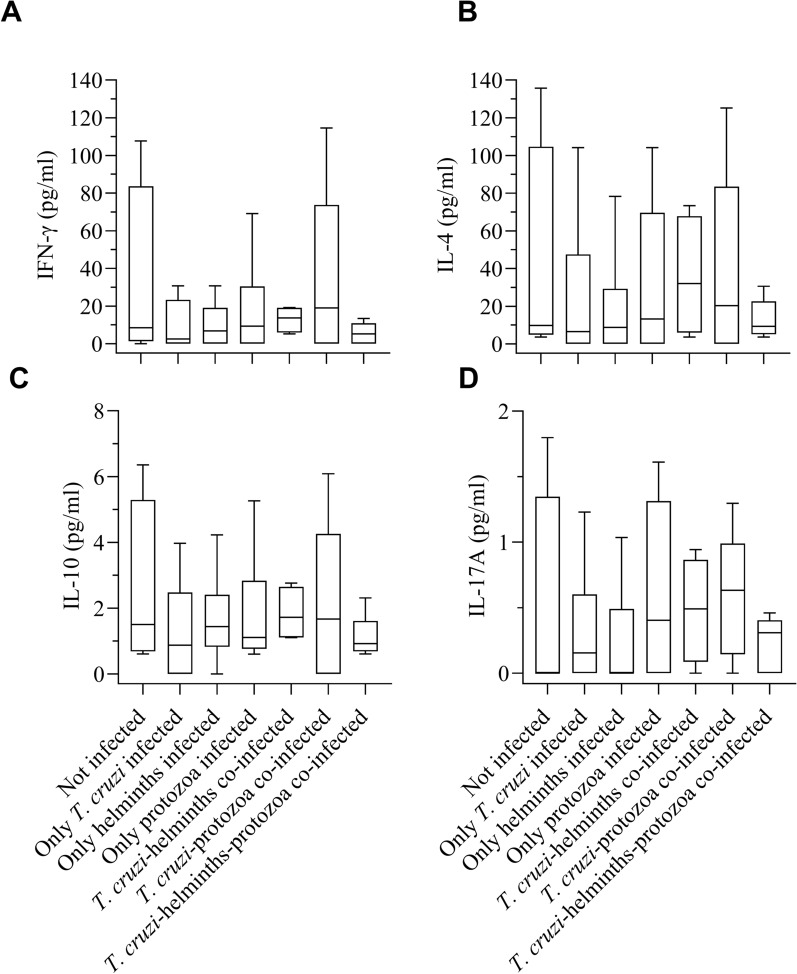
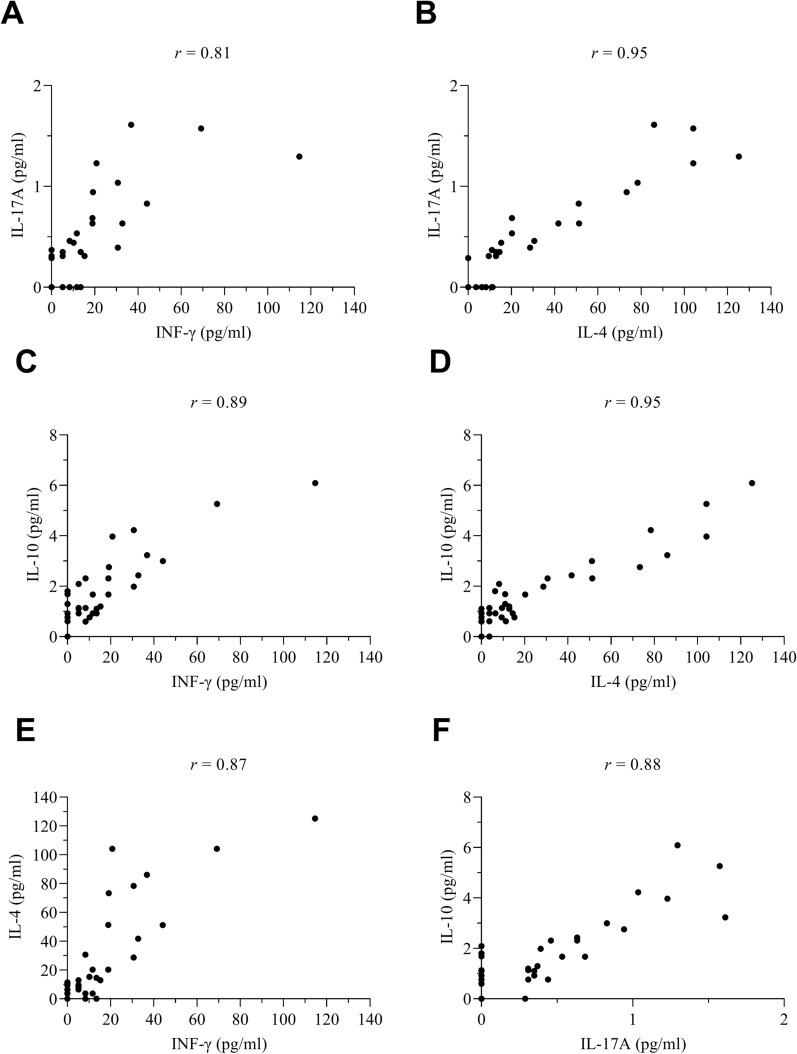
The seroprevalence for T. cruzi was 16.1% and for S. stercoralis 11.5% (n = 87). We found 25.3% of patients with Enterobius vermicularis. The most frequent protozoan parasites were Blastocystis spp. (39.1%), Giardia lamblia (6.9%) and Cryptosporidium spp. (3.4%). Multiparasitism occurred in 36.8% of the examined patients. Co-infection ranged from 6.9% to 8.1% for T. cruzi-seropositive humans simultaneously infected with at least one protozoan or helminth species, respectively. The relative odds of being positive by qPCR or xenodiagnosis (i.e. infectious) of 28 T. cruzi-seropositive patients was eight times higher in people co-infected with at least one helminth species than in patients with no such co-infection. Trypanosoma cruzi parasite load and host infectiousness were positively associated with helminth co-infection in a multiple regression analysis. Interferon-gamma (IFN-γ) response, measured in relation to interleukin (IL)-4 among humans infected with T. cruzi only, was 1.5-fold higher than for T. cruzi-seropositive patients co-infected with helminths. The median concentration of IL-4 was significantly higher in T. cruzi-seropositive patients with a positive qPCR test than in qPCR-negative patients.
Our results show a high level of multiparasitism and suggest that co-infection with intestinal helminths increased T. cruzi parasitaemia and upregulated the Th2-type response in the study patients.
格兰查科生态区是几个被忽视的热带病(NTDs)的著名热点,包括恰加斯病、土壤传播性蠕虫病和多种寄生虫感染。寄生虫种间的相互作用可以通过免疫调节来改变宿主的易感性、发病机制和传染性。我们的目的是检验在阿根廷查科地区一个流行地区居住的感染了克氏锥虫的个体中,肠道寄生虫的合并感染与宿主寄生虫血症、对媒介的传染性和免疫特征之间的关系。
我们在两个相邻的农村村庄进行了一项克氏锥虫感染的血清学横断面调查,以及一项肠道寄生虫调查。每个参与者都通过血清学诊断和肠道寄生虫检测的粪便检查来检测克氏锥虫和粪类圆线虫感染。通过定量 PCR(qPCR)来确定克氏锥虫的血液寄生虫载量,通过人工媒介诊断来确定宿主的传染性,通过流式细胞术来确定血清人类细胞因子水平。
克氏锥虫的血清流行率为 16.1%,粪类圆线虫为 11.5%(n=87)。我们发现有 25.3%的患者感染了蛲虫。最常见的原生动物寄生虫是芽囊原虫属(39.1%)、蓝氏贾第鞭毛虫(6.9%)和隐孢子虫属(3.4%)。在检查的患者中,36.8%的人患有多种寄生虫感染。在至少感染一种原生动物或蠕虫的克氏锥虫血清阳性者中,同时感染两种以上的寄生虫的比例分别为 6.9%和 8.1%。在 28 名克氏锥虫血清阳性的患者中,与没有这种合并感染的患者相比,至少合并感染一种蠕虫的患者进行 qPCR 或媒介诊断(即传染性)为阳性的相对几率高 8 倍。在多元回归分析中,克氏锥虫寄生虫载量和宿主传染性与蠕虫合并感染呈正相关。在只感染克氏锥虫的人群中,与白细胞介素(IL)-4 相比,干扰素-γ(IFN-γ)的反应高出 1.5 倍,而在克氏锥虫血清阳性患者中,与感染蠕虫相比,IFN-γ的反应高出 1.5 倍。在 qPCR 阳性的克氏锥虫血清阳性患者中,IL-4 的中位数浓度明显高于 qPCR 阴性的患者。
我们的结果显示出高水平的多种寄生虫感染,并表明肠道蠕虫的合并感染增加了克氏锥虫的寄生虫血症,并上调了研究患者的 Th2 型反应。