Amor Aranzazu, Rodriguez Esperanza, Saugar José M, Arroyo Ana, López-Quintana Beatriz, Abera Bayeh, Yimer Mulat, Yizengaw Endalew, Zewdie Derejew, Ayehubizu Zimman, Hailu Tadesse, Mulu Wondemagegn, Echazú Adriana, Krolewieki Alejandro J, Aparicio Pilar, Herrador Zaida, Anegagrie Melaku, Benito Agustín
National Center of Tropical Medicine, Institute of Health Carlos III, Madrid, Spain.
Mundo Sano Foundation, Madrid, Spain.
Parasit Vectors. 2016 Dec 1;9(1):617. doi: 10.1186/s13071-016-1912-8.
Soil-transmitted helminthiases (hookworms, Ascaris lumbricoides and Trichuris trichiura) are extremely prevalent in school-aged children living in poor sanitary conditions. Recent epidemiological data suggest that Strongyloides stercoralis is highly unreported. However, accurate data are essential for conducting interventions aimed at introducing control and elimination programmes.
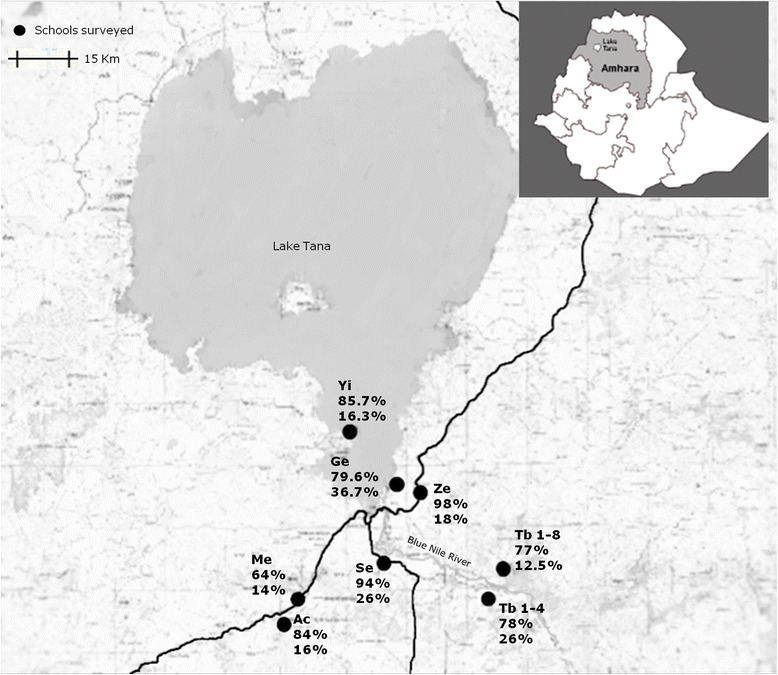
We conducted a cross-sectional survey of 396 randomly selected school-aged children in Amhara region in rural area in north-western Ethiopia, to assess the prevalence of S. stercoralis and other intestinal helminths. We examined stools using three techniques: conventional stool concentration; and two S. stercoralis-specific methods, i.e. the Baermann technique and polymerase chain reaction. The diagnostic accuracy of these three methods was then compared.
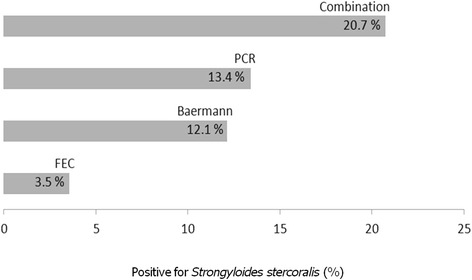
There was an overall prevalence of helminths of 77.5%, with distribution differing according to school setting. Soil-transmitted helminths were recorded in 69.2%. Prevalence of S. stercoralis and hookworm infection was 20.7 and 54.5%, respectively, and co-infection was detected in 16.3% of cases. Schistosoma mansoni had a prevalence of 15.7%. Prevalence of S. stercoralis was shown 3.5% by the conventional method, 12.1% by the Baermann method, and 13.4% by PCR, which thus proved to be the most sensitive.
Our results suggest that S. stercoralis could be overlooked and neglected in Ethiopia, if studies of soil-transmitted helminths rely on conventional diagnostic techniques alone. A combination of molecular and stool microscopy techniques yields a significantly higher prevalence. In view of the fact that current control policies for triggering drug administration are based on parasite prevalence levels, a comprehensive diagnostic approach should instead be applied to ensure comprehensive control of helminth infections.
土壤传播的蠕虫病(钩虫、蛔虫和鞭虫)在生活在卫生条件差的学龄儿童中极为普遍。最近的流行病学数据表明,粪类圆线虫的感染情况极未得到充分报告。然而,准确的数据对于开展旨在引入控制和消除计划的干预措施至关重要。
我们对埃塞俄比亚西北部农村阿姆哈拉地区随机抽取的396名学龄儿童进行了横断面调查,以评估粪类圆线虫和其他肠道蠕虫的感染率。我们使用三种技术检查粪便:传统粪便浓缩法;以及两种粪类圆线虫特异性方法,即贝尔曼法和聚合酶链反应。然后比较这三种方法的诊断准确性。
蠕虫的总体感染率为77.5%,其分布因学校环境而异。土壤传播的蠕虫感染率为69.2%。粪类圆线虫和钩虫感染率分别为20.7%和54.5%,16.3%的病例检测到合并感染。曼氏血吸虫的感染率为15.7%。传统方法显示粪类圆线虫感染率为3.5%,贝尔曼法为12.1%,聚合酶链反应法为13.4%,因此聚合酶链反应法被证明是最敏感的。
我们的结果表明,在埃塞俄比亚,如果仅依靠传统诊断技术来研究土壤传播的蠕虫病,粪类圆线虫可能会被忽视。分子技术和粪便显微镜检查技术相结合可显著提高感染率。鉴于目前触发药物给药的控制政策是基于寄生虫感染率水平,应采用综合诊断方法以确保对蠕虫感染进行全面控制。