University of Auckland, Auckland, New Zealand.
University of Auckland and Auckland University of Technology, Auckland, New Zealand.
Arthritis Care Res (Hoboken). 2024 Dec;76(12):1657-1665. doi: 10.1002/acr.25414. Epub 2024 Aug 29.
This study aimed to identify variables that predict gout remission in people with erosive gout receiving urate-lowering therapy.
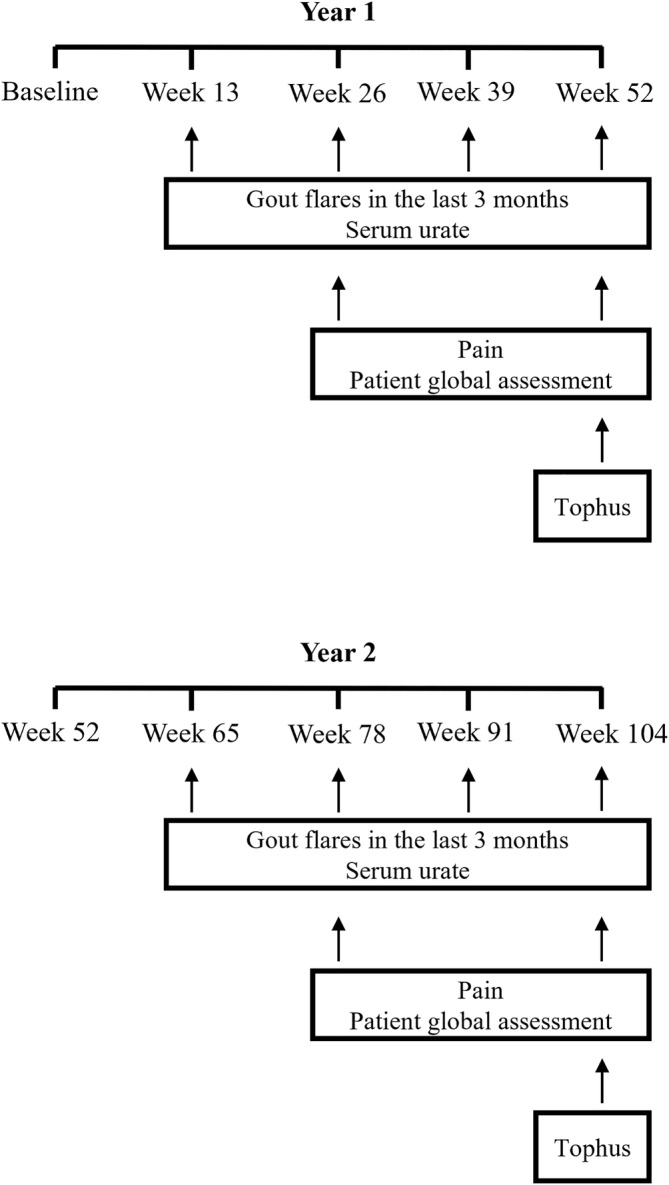
We analyzed data from a two-year, double-masked randomized-controlled trial of people with erosive gout, randomized to a serum urate target of <0.20 mmol/L or <0.30 mmol/L using oral urate-lowering therapies. All participants had dual-energy computed tomography (DECT) scans of the feet and ankles at baseline. The proportion of participants achieving gout remission according to the 2016 preliminary gout remission criteria and simplified gout remission criteria (without the patient reported outcomes) was analyzed. Logistic regression models were used to evaluate predictors of gout remission in year 2.
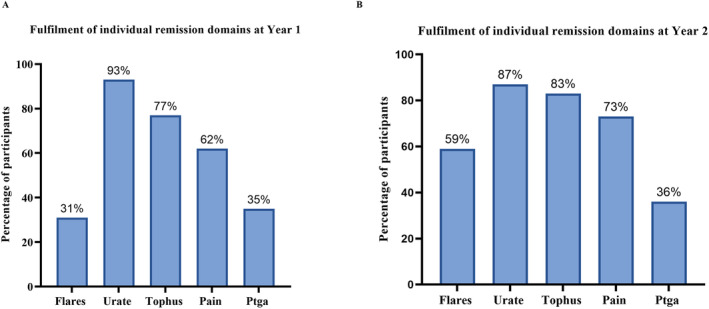
The preliminary gout remission criteria were fulfilled in 11 of 97 participants (11%) at year 1 and 21 of 92 participants (23%) at year 2. The simplified criteria were fulfilled in 26 of 97 participants (27%) in year 1 and 40 of 92 participants (44%) in year 2. In multivariable regression models, baseline DECT monosodium urate crystal volume was the only significant independent predictor of gout remission at year 2, using either criteria. Each 1-cm increase in the baseline DECT monosodium urate crystal volume decreased the odds of fulfilling the 2016 preliminary gout remission criteria (odds ratio [OR] 0.65, 95% confidence interval [CI] 0.46-0.93; P = 0.02) and the simplified gout remission criteria (OR 0.57, 95% CI 0.41-0.78; P < 0.001).
In people with erosive gout on urate-lowering therapy, higher baseline DECT monosodium urate crystal volume is associated with lower odds of gout remission after two years of treatment, defined by either the preliminary gout remission criteria or simplified gout remission criteria.
本研究旨在确定接受降尿酸治疗的侵蚀性痛风患者中预测痛风缓解的变量。
我们分析了一项为期两年、双盲、随机对照试验的数据,该试验纳入了侵蚀性痛风患者,随机分为血清尿酸目标值<0.20mmol/L 或<0.30mmol/L 的两组,分别使用口服降尿酸药物治疗。所有参与者在基线时均进行了足部和踝关节的双能 CT(DECT)扫描。根据 2016 年初步痛风缓解标准和简化痛风缓解标准(无患者报告结果),分析达到痛风缓解的参与者比例。使用逻辑回归模型评估第 2 年痛风缓解的预测因素。
第 1 年有 11 名(11%)参与者符合初步痛风缓解标准,第 2 年有 21 名(23%)参与者符合该标准;简化标准第 1 年有 26 名(27%)参与者符合,第 2 年有 40 名(44%)参与者符合。在多变量回归模型中,使用两种标准,基线 DECT 单钠尿酸盐晶体体积是第 2 年痛风缓解的唯一显著独立预测因素。基线 DECT 单钠尿酸盐晶体体积每增加 1cm,符合 2016 年初步痛风缓解标准的可能性降低(比值比 [OR]0.65,95%置信区间 [CI]0.46-0.93;P=0.02)和简化痛风缓解标准(OR0.57,95%CI0.41-0.78;P<0.001)。
在接受降尿酸治疗的侵蚀性痛风患者中,较高的基线 DECT 单钠尿酸盐晶体体积与两年后痛风缓解的可能性降低相关,无论是根据初步痛风缓解标准还是简化痛风缓解标准定义。