Fu Yuanyuan, Liu Chang, He Hong S, Wang Shaoqiang, Wang Lunche, Xie Zhijie
Hubei Key Laboratory of Regional Ecology and Environmental Change, School of Geography and Information Engineering, China University of Geosciences, Wuhan, China.
Hunan Key Laboratory of Remote Sensing of Ecological Environment in Dongting Lake Area, School of Geography and Information Engineering, China University of Geosciences, Wuhan, China.
Front Plant Sci. 2024 Jul 29;15:1430025. doi: 10.3389/fpls.2024.1430025. eCollection 2024.
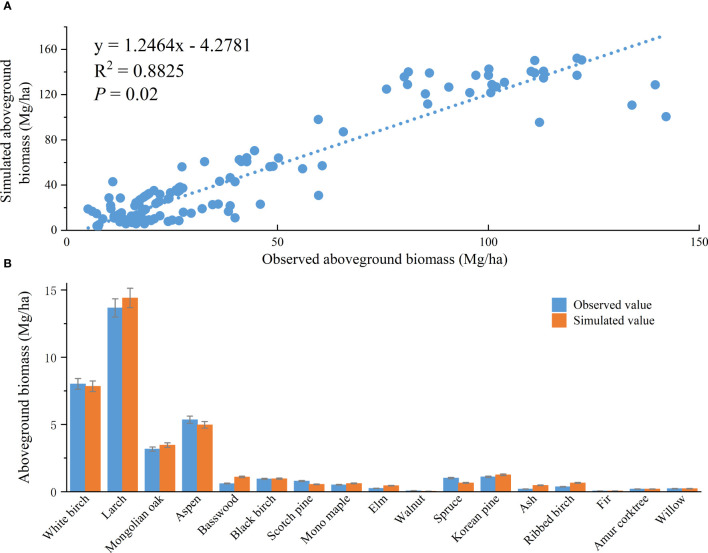
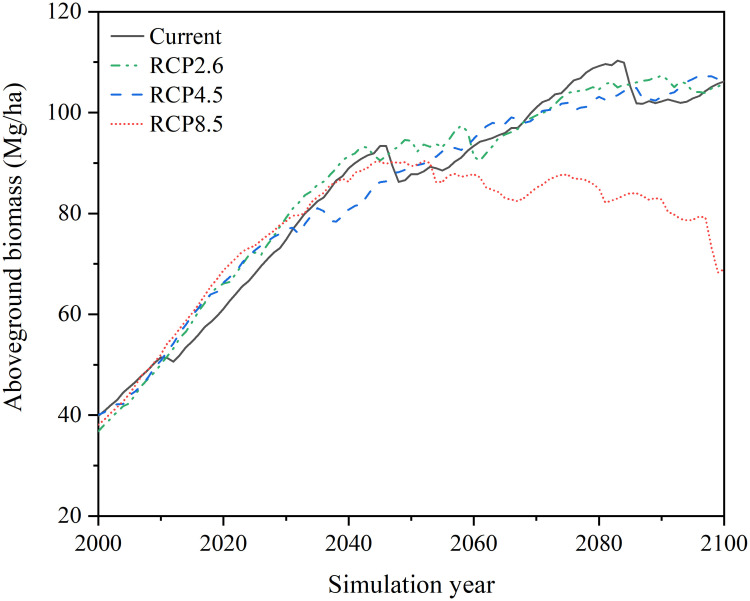
Global climate change has markedly influenced the structure and distribution of mid-high-latitude forests. In the forest region of Northeast China, the magnitude of climate warming surpasses the global average, which presents immense challenges to the survival and habitat sustainability of dominant tree species. We predicted the potential changes in aboveground biomass, dominant tree species composition, and distribution in the forest region of Northeast China over the next century under different climatic conditions encompassing the current scenario and future scenarios (RCP2.6, RCP4.5, and RCP8.5). Forest ecosystem process model LINKAGES 3.0 was used to simulate dynamic changes in species-level aboveground biomass under four climate scenarios at the homogeneous land-type unit level. The potential spatial distribution of tree species was investigated based on three indicators: extinction, colonization, and persistence. The results showed that LINKAGES 3.0 model effectively simulated the aboveground biomass of 17 dominant tree species in the forest region of Northeast China, achieving a high accuracy with R² = 0.88. Under the current, RCP2.6, and RCP4.5 climate scenarios, the dominant tree species presented gradual increases in aboveground biomass, whereas under RCP8.5, an initial increase and subsequent decline were observed. With increasing warming magnitude, cold-temperate coniferous tree species will gradually be replaced by other temperate broad-leaved tree species. Furthermore, a large temperature increase under RCP8.5 will likely produce a significant contraction in the potential distribution range of tree species like Larch, Scotch pine, Ribbed birch, Spruce and Fir, while most temperate broad-leaved tree species and Korean pine are expected to demonstrate a northward migration. These findings provide guidance for enhancing the adaptability and resilience of forest ecosystems in middle and high latitudes and addressing the threats posed by climate warming.
全球气候变化已显著影响了中高纬度森林的结构和分布。在中国东北地区的森林区域,气候变暖幅度超过全球平均水平,这给优势树种的生存和栖息地可持续性带来了巨大挑战。我们预测了在下个世纪不同气候条件下(包括当前情景和未来情景RCP2.6、RCP4.5和RCP8.5)中国东北地区森林地上生物量、优势树种组成和分布的潜在变化。利用森林生态系统过程模型LINKAGES 3.0在均质土地类型单元水平上模拟了四种气候情景下物种水平地上生物量的动态变化。基于灭绝、定殖和持续性这三个指标研究了树种的潜在空间分布。结果表明,LINKAGES 3.0模型有效地模拟了中国东北地区森林17种优势树种的地上生物量,R² = 0.88,精度较高。在当前、RCP2.6和RCP4.5气候情景下,优势树种地上生物量呈逐渐增加趋势,而在RCP8.5情景下,先增加后下降。随着变暖幅度的增加,寒温带针叶树种将逐渐被其他温带阔叶树种取代。此外,RCP8.5情景下大幅升温可能导致落叶松、樟子松、白桦、云杉和冷杉等树种的潜在分布范围显著收缩,而大多数温带阔叶树种和红松预计将向北迁移。这些研究结果为提高中高纬度森林生态系统的适应性和恢复力以及应对气候变暖带来的威胁提供了指导。