• 文献检索
  • 文档翻译
  • 深度研究
  • 学术资讯
  • Suppr Zotero 插件Zotero 插件
  • 邀请有礼
  • 套餐&价格
  • 历史记录
应用&插件
Suppr Zotero 插件Zotero 插件浏览器插件Mac 客户端Windows 客户端微信小程序
定价
高级版会员购买积分包购买API积分包
服务
文献检索文档翻译深度研究API 文档MCP 服务
关于我们
关于 Suppr公司介绍联系我们用户协议隐私条款
关注我们

Suppr 超能文献

核心技术专利:CN118964589B侵权必究
粤ICP备2023148730 号-1Suppr @ 2026

文献检索

告别复杂PubMed语法,用中文像聊天一样搜索,搜遍4000万医学文献。AI智能推荐,让科研检索更轻松。

立即免费搜索

文件翻译

保留排版,准确专业,支持PDF/Word/PPT等文件格式,支持 12+语言互译。

免费翻译文档

深度研究

AI帮你快速写综述,25分钟生成高质量综述,智能提取关键信息,辅助科研写作。

立即免费体验

酒精、HMGB1 与脑内固有免疫信号转导

Alcohol, HMGB1, and Innate Immune Signaling in the Brain.

机构信息

Bowles Center for Alcohol Studies, University of North Carolina School of Medicine, Chapel Hill, North Carolina.

Department of Pharmacology, University of North Carolina School of Medicine, Chapel Hill, North Carolina.

出版信息

Alcohol Res. 2024 Aug 8;44(1):04. doi: 10.35946/arcr.v44.1.04. eCollection 2024.

DOI:10.35946/arcr.v44.1.04
PMID:39135668
原文链接:https://pmc.ncbi.nlm.nih.gov/articles/PMC11318841/
Abstract

PURPOSE

Binge drinking (i.e., consuming enough alcohol to achieve a blood ethanol concentration of 80 mg/dL, approximately 4-5 drinks within 2 hours), particularly in early adolescence, can promote progressive increases in alcohol drinking and alcohol-related problems that develop into compulsive use in the chronic relapsing disease, alcohol use disorder (AUD). Over the past decade, neuroimmune signaling has been discovered to contribute to alcohol-induced changes in drinking, mood, and neurodegeneration. This review presents a mechanistic hypothesis supporting high mobility group box protein 1 (HMGB1) and Toll-like receptor (TLR) signaling as key elements of alcohol-induced neuroimmune signaling across glia and neurons, which shifts gene transcription and synapses, altering neuronal networks that contribute to the development of AUD. This hypothesis may help guide further research on prevention and treatment.

SEARCH METHODS

The authors used the search terms "HMGB1 protein," "alcohol," and "brain" across PubMed, Scopus, and Embase to find articles published between 1991 and 2023.

SEARCH RESULTS

The database search found 54 references in PubMed, 47 in Scopus, and 105 in Embase. A total of about 100 articles were included.

DISCUSSION AND CONCLUSIONS

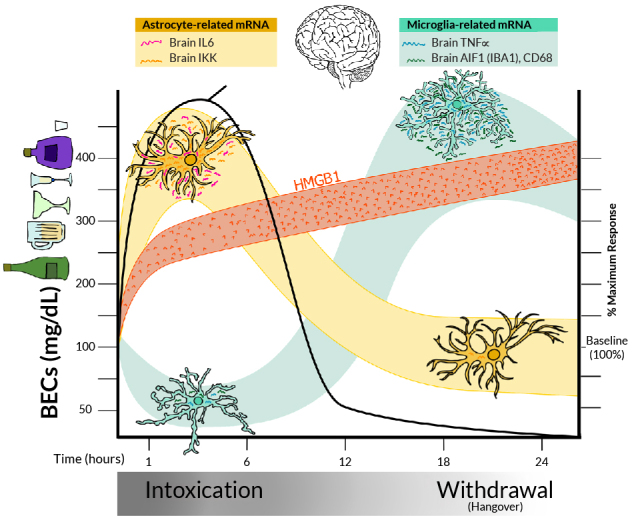
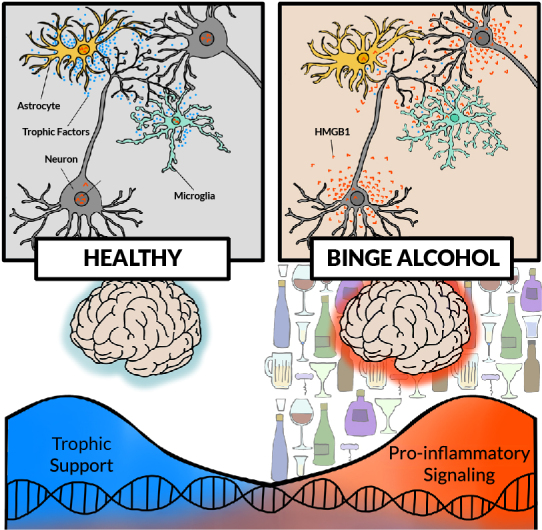
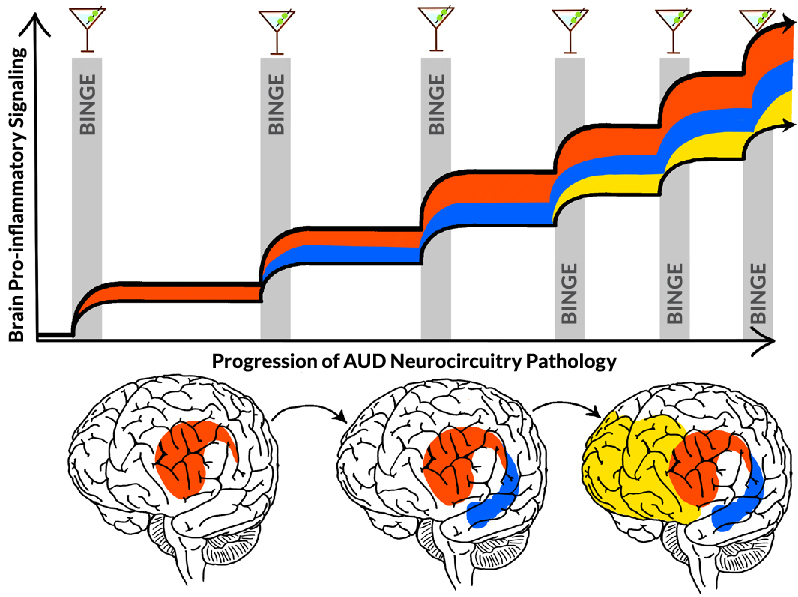
In the brain, immune signaling molecules play a role in normal development that differs from their functions in inflammation and the immune response, although cellular receptors and signaling are shared. In adults, pro-inflammatory signals have emerged as contributing to brain adaptation in stress, depression, AUD, and neurodegenerative diseases. HMGB1, a cytokine-like signaling protein released from activated cells, including neurons, is hypothesized to activate pro-inflammatory signals through TLRs that contribute to adaptations to binge and chronic heavy drinking. HMGB1 alone and in heteromers with other molecules activates TLRs and other immune receptors that spread signaling across neurons and glia. Both blood and brain levels of HMGB1 increase with ethanol exposure. In rats, an adolescent intermittent ethanol (AIE) binge drinking model persistently increases brain HMGB1 and its receptors; alters microglia, forebrain cholinergic neurons, and neuronal networks; and increases alcohol drinking and anxiety while disrupting cognition. Studies of human postmortem AUD brain have found elevated levels of HMGB1 and TLRs. These signals reduce cholinergic neurons, whereas microglia, the brain's immune cells, are activated by binge drinking. Microglia regulate synapses through complement proteins that can change networks affected by AIE that increase drinking, contributing to risks for AUD. Anti-inflammatory drugs, exercise, cholinesterase inhibitors, and histone deacetylase epigenetic inhibitors prevent and reverse the AIE-induced pathology. Further, HMGB1 antagonists and other anti-inflammatory treatments may provide new therapies for alcohol misuse and AUD. Collectively, these findings suggest that restoring the innate immune signaling balance is central to recovering from alcohol-related pathology.
https://cdn.ncbi.nlm.nih.gov/pmc/blobs/bb9f/11318841/4b6ee225d8fb/ARCR_Fig3.jpg
https://cdn.ncbi.nlm.nih.gov/pmc/blobs/bb9f/11318841/06492151606e/ARCR_Fig1.jpg
https://cdn.ncbi.nlm.nih.gov/pmc/blobs/bb9f/11318841/d8ef595a5865/ARCR_Fig2.jpg
https://cdn.ncbi.nlm.nih.gov/pmc/blobs/bb9f/11318841/4b6ee225d8fb/ARCR_Fig3.jpg
https://cdn.ncbi.nlm.nih.gov/pmc/blobs/bb9f/11318841/06492151606e/ARCR_Fig1.jpg
https://cdn.ncbi.nlm.nih.gov/pmc/blobs/bb9f/11318841/d8ef595a5865/ARCR_Fig2.jpg
https://cdn.ncbi.nlm.nih.gov/pmc/blobs/bb9f/11318841/4b6ee225d8fb/ARCR_Fig3.jpg
摘要

目的

狂饮(即摄入足够的酒精,使血液乙醇浓度达到 80mg/dL,大约在 2 小时内饮用 4-5 杯),特别是在青少年早期,会促进酒精摄入量的持续增加,并导致酒精相关问题发展为慢性复发性疾病,即酒精使用障碍(AUD)的强制性使用。在过去的十年中,神经免疫信号已被发现有助于酒精引起的饮酒、情绪和神经退行性变的变化。本综述提出了一个机制假设,支持高迁移率族蛋白 B1(HMGB1)和 Toll 样受体(TLR)信号作为酒精诱导的神经免疫信号在神经胶质和神经元中传递的关键因素,改变基因转录和突触,改变参与 AUD 发展的神经元网络。该假设可能有助于指导预防和治疗的进一步研究。

搜索方法

作者使用了“HMGB1 蛋白”、“酒精”和“大脑”这三个术语,在 PubMed、Scopus 和 Embase 数据库中进行了搜索,以找到 1991 年至 2023 年发表的文章。

搜索结果

在 PubMed 中发现了 54 篇参考文献,Scopus 中有 47 篇,Embase 中有 105 篇。总共大约有 100 篇文章被纳入。

讨论与结论

在大脑中,免疫信号分子在正常发育中发挥作用,其作用不同于在炎症和免疫反应中的作用,尽管细胞受体和信号是共享的。在成人中,促炎信号已被认为有助于应激、抑郁、AUD 和神经退行性疾病中的大脑适应。高迁移率族蛋白 B1(HMGB1)是一种细胞因子样信号蛋白,从激活的细胞(包括神经元)中释放,假设通过 TLR 激活促炎信号,有助于适应狂饮和慢性大量饮酒。HMGB1 单独存在或与其他分子形成异源二聚体,可激活 TLR 和其他免疫受体,从而在神经元和神经胶质细胞之间传播信号。血液和大脑中的 HMGB1 水平随着乙醇暴露而增加。在大鼠中,青少年间歇性乙醇(AIE)狂饮模型持续增加大脑 HMGB1 和其受体;改变小胶质细胞、前脑胆碱能神经元和神经元网络;增加酒精摄入和焦虑,同时破坏认知。对人类酒精使用障碍大脑的研究发现 HMGB1 和 TLR 水平升高。这些信号降低了胆碱能神经元,而小胶质细胞是大脑的免疫细胞,被狂饮激活。小胶质细胞通过补体蛋白调节突触,从而改变受 AIE 影响的网络,增加饮酒量,增加 AUD 的风险。抗炎药物、运动、胆碱酯酶抑制剂和组蛋白去乙酰化酶表观遗传抑制剂可预防和逆转 AIE 诱导的病理学。此外,HMGB1 拮抗剂和其他抗炎治疗可能为酒精滥用和 AUD 提供新的治疗方法。总之,这些发现表明,恢复固有免疫信号平衡是从酒精相关病理中恢复的核心。

相似文献

1
Alcohol, HMGB1, and Innate Immune Signaling in the Brain.酒精、HMGB1 与脑内固有免疫信号转导
Alcohol Res. 2024 Aug 8;44(1):04. doi: 10.35946/arcr.v44.1.04. eCollection 2024.
2
Epigenetic regulation of microglia and neurons by proinflammatory signaling following adolescent intermittent ethanol (AIE) exposure and in human AUD.青少年间歇性乙醇(AIE)暴露后以及在人类酒精使用障碍(AUD)中,促炎信号对小胶质细胞和神经元的表观遗传调控。
Adv Drug Alcohol Res. 2024 Mar 8;4:12094. doi: 10.3389/adar.2024.12094. eCollection 2024.
3
Targeting Persistent Changes in Neuroimmune and Epigenetic Signaling in Adolescent Drinking to Treat Alcohol Use Disorder in Adulthood.针对青少年饮酒中神经免疫和表观遗传信号的持久性变化,以治疗成年期的酒精使用障碍。
Pharmacol Rev. 2023 Mar;75(2):380-396. doi: 10.1124/pharmrev.122.000710. Epub 2022 Dec 12.
4
Mechanisms of neuroimmune gene induction in alcoholism.酒精中毒中神经免疫基因诱导的机制。
Psychopharmacology (Berl). 2016 May;233(9):1543-57. doi: 10.1007/s00213-015-3906-1. Epub 2015 Mar 20.
5
Increased Toll-like Receptor-MyD88-NFκB-Proinflammatory neuroimmune signaling in the orbitofrontal cortex of humans with alcohol use disorder.酒精使用障碍患者眶额皮质中 Toll 样受体-MyD88-NFκB-促炎神经免疫信号的增加。
Alcohol Clin Exp Res. 2021 Sep;45(9):1747-1761. doi: 10.1111/acer.14669. Epub 2021 Aug 20.
6
Neuroimmune Function and the Consequences of Alcohol Exposure.神经免疫功能与酒精暴露的后果
Alcohol Res. 2015;37(2):331-41, 344-51.
7
Adolescent binge drinking increases expression of the danger signal receptor agonist HMGB1 and Toll-like receptors in the adult prefrontal cortex.青少年 binge drinking 会增加成年前额叶皮层中危险信号受体激动剂 HMGB1 和 Toll 样受体的表达。
Neuroscience. 2012 Dec 13;226:475-88. doi: 10.1016/j.neuroscience.2012.08.046. Epub 2012 Sep 15.
8
Toll-like receptor signaling and stages of addiction.Toll样受体信号传导与成瘾阶段
Psychopharmacology (Berl). 2017 May;234(9-10):1483-1498. doi: 10.1007/s00213-017-4560-6. Epub 2017 Feb 17.
9
HMGB1 neuroimmune signaling and REST-G9a gene repression contribute to ethanol-induced reversible suppression of the cholinergic neuron phenotype.高迁移率族蛋白B1(HMGB1)神经免疫信号传导和REST-G9a基因抑制促成乙醇诱导的胆碱能神经元表型可逆性抑制。
Mol Psychiatry. 2023 Dec;28(12):5159-5172. doi: 10.1038/s41380-023-02160-6. Epub 2023 Jul 4.
10
The role of neuroimmune signaling in alcoholism.神经免疫信号传导在酒精中毒中的作用。
Neuropharmacology. 2017 Aug 1;122:56-73. doi: 10.1016/j.neuropharm.2017.01.031. Epub 2017 Feb 1.

引用本文的文献

1
Roles of Oxidative Stress and Autophagy in Alcohol-Mediated Brain Damage.氧化应激和自噬在酒精介导的脑损伤中的作用
Antioxidants (Basel). 2025 Feb 28;14(3):302. doi: 10.3390/antiox14030302.
2
Is Dysregulated at DNA Methylation and H3K4me3 Levels in Alcohol Use Disorder.在酒精使用障碍中,DNA甲基化和H3K4me3水平失调。
Int J Mol Sci. 2025 Feb 14;26(4):1623. doi: 10.3390/ijms26041623.

本文引用的文献

1
Epigenetic regulation of microglia and neurons by proinflammatory signaling following adolescent intermittent ethanol (AIE) exposure and in human AUD.青少年间歇性乙醇(AIE)暴露后以及在人类酒精使用障碍(AUD)中,促炎信号对小胶质细胞和神经元的表观遗传调控。
Adv Drug Alcohol Res. 2024 Mar 8;4:12094. doi: 10.3389/adar.2024.12094. eCollection 2024.
2
Acute alcohol induces greater dose-dependent increase in the lateral cortical network functional connectivity in adult than adolescent rats.急性酒精对成年大鼠外侧皮质网络功能连接性的剂量依赖性增加作用比对青春期大鼠的作用更强。
Addict Neurosci. 2023 Sep;7. doi: 10.1016/j.addicn.2023.100105. Epub 2023 Jun 2.
3
IL-6, but not TNF-α, response to alcohol cues and acute consumption associated with neural cue reactivity, craving, and future drinking in binge drinkers.
白细胞介素-6而非肿瘤坏死因子-α对酒精线索的反应以及与急性饮酒相关的神经线索反应性、渴望和酗酒者未来饮酒情况。
Brain Behav Immun Health. 2023 Jun 11;31:100645. doi: 10.1016/j.bbih.2023.100645. eCollection 2023 Aug.
4
Repeated Social Defeat Stress Induces HMGB1 Nuclear Export in Prefrontal Neurons, Leading to Social Avoidance in Mice.反复社交挫败应激诱导前额叶神经元 HMGB1 核输出,导致小鼠社交回避。
Cells. 2023 Jul 5;12(13):1789. doi: 10.3390/cells12131789.
5
The multifunctional protein HMGB1: 50 years of discovery.多功能蛋白 HMGB1:50 年的探索历程。
Nat Rev Immunol. 2023 Dec;23(12):824-841. doi: 10.1038/s41577-023-00894-6. Epub 2023 Jun 15.
6
Selective PDE4B and PDE4D inhibitors produce distinct behavioral responses to ethanol and GABAergic drugs in mice.选择性 PDE4B 和 PDE4D 抑制剂在小鼠中产生对乙醇和 GABA 能药物的不同行为反应。
Neuropharmacology. 2023 Jun 15;231:109508. doi: 10.1016/j.neuropharm.2023.109508. Epub 2023 Mar 18.
7
Optogenetic stimulation of anterior insular cortex neurons in male rats reveals causal mechanisms underlying suppression of the default mode network by the salience network.光遗传刺激雄性大鼠前岛叶皮层神经元揭示了突显网络抑制默认模式网络的因果机制。
Nat Commun. 2023 Feb 16;14(1):866. doi: 10.1038/s41467-023-36616-8.
8
Targeting Persistent Changes in Neuroimmune and Epigenetic Signaling in Adolescent Drinking to Treat Alcohol Use Disorder in Adulthood.针对青少年饮酒中神经免疫和表观遗传信号的持久性变化,以治疗成年期的酒精使用障碍。
Pharmacol Rev. 2023 Mar;75(2):380-396. doi: 10.1124/pharmrev.122.000710. Epub 2022 Dec 12.
9
Preclinical and clinical evidence for suppression of alcohol intake by apremilast.阿普司特抑制酒精摄入的临床前和临床证据。
J Clin Invest. 2023 Mar 15;133(6):e159103. doi: 10.1172/JCI159103.
10
Innate immune activation: Parallels in alcohol use disorder and Alzheimer's disease.先天免疫激活:酒精使用障碍与阿尔茨海默病的相似之处
Front Mol Neurosci. 2022 Sep 9;15:910298. doi: 10.3389/fnmol.2022.910298. eCollection 2022.