Alshammari Aya Hasan, Ishii Hideshi, Hirotsu Takaaki, Hatakeyama Hideyuki, Morishita Masayo, di Luccio Eric
Shonan Research and Development Center, Hirotsu Bio Science Inc., Tokyo, Japan.
Department of Medical Data Science, Center of Medical Innovation and Translational Research, Osaka University Graduate School of Medicine, Suita, Japan.
Front Oncol. 2024 Jul 29;14:1407008. doi: 10.3389/fonc.2024.1407008. eCollection 2024.
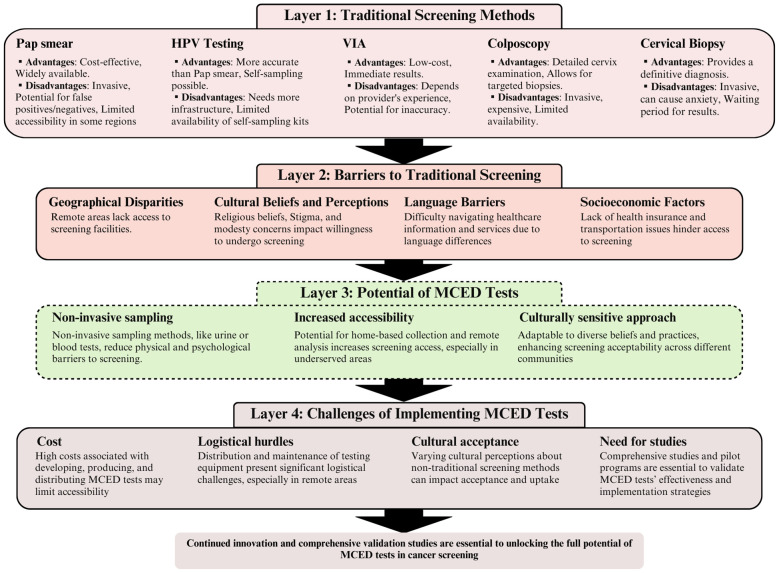
Cervical cancer screening is a critical public health measure, especially vital for underserved communities where disparities in access and outcomes are pronounced. Despite the life-saving potential of regular screening, numerous barriers-including geographical isolation, cultural and linguistic challenges, and socioeconomic factors-severely hinder accessibility for these populations. Multicancer early detection (MCED) tests emerge as a potentially effective intervention, offering a less invasive, more accessible approach that could transform how screenings are conducted. This paper explores the existing challenges in traditional cervical cancer screening methods, the potential of MCED tests to address these barriers, and the implications of these technologies for global health equity. Through a comprehensive review, we highlight the need for culturally sensitive, tailored interventions and the importance of effectively overcoming logistical and financial difficulties to implement MCED tests. Despite the promise shown by MCED tests, the paper acknowledges significant implementation challenges, including cost, logistical obstacles, and the need for cultural acceptance and validation studies. This study emphasizes the necessity for equitable MCED test implementation strategies, highlighting the potential of these innovative technologies to advance global health equity in cervical cancer prevention.
宫颈癌筛查是一项关键的公共卫生措施,对服务不足的社区尤为重要,在这些社区,获得筛查的机会和筛查结果存在明显差异。尽管定期筛查具有挽救生命的潜力,但包括地理隔离、文化和语言挑战以及社会经济因素在内的众多障碍严重阻碍了这些人群获得筛查的机会。多癌早期检测(MCED)测试成为一种潜在有效的干预措施,提供了一种侵入性较小、更容易获得的方法,可能会改变筛查的进行方式。本文探讨了传统宫颈癌筛查方法中存在的现有挑战、MCED测试解决这些障碍的潜力以及这些技术对全球卫生公平性的影响。通过全面综述,我们强调了需要采取具有文化敏感性的、量身定制的干预措施,以及有效克服实施MCED测试的后勤和资金困难的重要性。尽管MCED测试显示出前景,但本文承认实施过程中存在重大挑战,包括成本、后勤障碍以及文化接受度和验证研究的必要性。这项研究强调了公平实施MCED测试策略的必要性,突出了这些创新技术在推进宫颈癌预防方面全球卫生公平性的潜力。