Graduate Program of Rehabilitation Sciences and Physical and Functional Performance, Federal University of Juiz de Fora (UFJF) - Juiz de Fora, Juiz de Fora, Minas Gerais, Brazil.
Graduate Program in Health, Federal University of Juiz de Fora (UFJF) - Juiz de Fora, Juiz de Fora, Minas Gerais, Brazil.
PLoS One. 2024 Aug 13;19(8):e0306045. doi: 10.1371/journal.pone.0306045. eCollection 2024.
Individuals with chronic obstructive pulmonary disease (COPD) exhibit reduced levels of physical activity, which are associated with poorer outcomes. The number of clinical trials aiming to promote behavioral changes to increase physical activity in this population has grown; therefore, these trials have yet to produce satisfactory results. An ecological model encompassing individual, social, environmental, and political factors represent a potentially more effective approach to promoting physical activity. While favorable urban environments can positively impact physical activity, specifically tailored environmental interventions for individuals with COPD could enhance their engagement in physical activity. Therefore, the aim of this randomized controlled trial (RCT) study was to analyze the effects of walking in a suggested environment and free walking on physical activity levels in individuals with COPD.
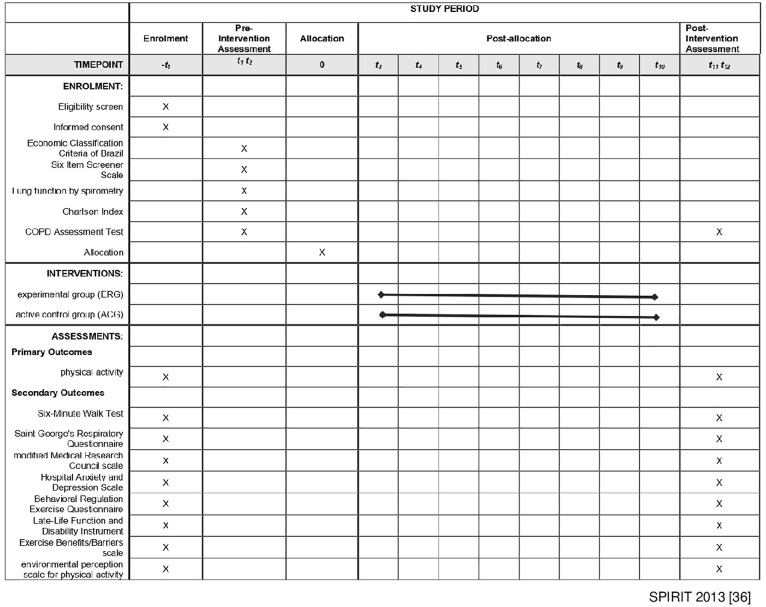
The environment on physical activity for chronic obstructive disease (EPCOT) is a randomized controlled clinical trial protocol approved by our institution's Ethics Committee and registered with The Brazilian Registry of Clinical Trials (ReBEC) (https://ensaiosclinicos.gov.br, number RBR-4tfwdhp). This protocol will involve 38 volunteers diagnosed with COPD recruited from the pulmonary physiotherapy and rehabilitation service. The volunteers were randomly divided into two walking groups: an experimental group (ERG) with guidance for walking in a suggested environment and an active control group (ACG) instructed to choose their own routes. The intervention consisted of eight consecutive weeks, with progressive walks carried out 3 to 5 times weekly. The primary outcome will be assessing participants' physical activity levels. Secondary outcomes will include exercise capacity, quality of life, dyspnea levels, motivation, anxiety, depression, and perceptions of the environment. All assessments will occur before and after the intervention period, aiming to fill a literature gap by investigating the impact of urban environments on COPD-related physical activity. The results may shed light on the importance of environmental factors in promoting physical activity among individuals with COPD, helping to develop more effective interventions.
患有慢性阻塞性肺疾病(COPD)的个体表现出较低水平的身体活动,这与较差的结果相关。旨在促进行为改变以增加该人群身体活动的临床试验数量有所增加;因此,这些试验尚未产生令人满意的结果。包含个体、社会、环境和政治因素的生态模型代表了一种更有效的促进身体活动的方法。虽然有利的城市环境可以对身体活动产生积极影响,但针对 COPD 患者的特定环境干预措施可以增强他们参与身体活动的能力。因此,本随机对照试验(RCT)的目的是分析在建议环境中行走和自由行走对 COPD 患者身体活动水平的影响。
EPCOT(环境对慢性阻塞性疾病的影响)是一项经我们机构伦理委员会批准并在巴西临床试验注册中心(ReBEC)(https://ensaiosclinicos.gov.br,编号 RBR-4tfwdhp)注册的 RCT 研究方案。该方案将纳入 38 名从肺物理治疗和康复服务中招募的诊断为 COPD 的志愿者。志愿者随机分为两组:实验组(ERG)在建议的环境中行走并接受指导,以及主动对照组(ACG)被指导选择自己的路线。干预包括连续八周,每周进行 3 至 5 次渐进式行走。主要结局将评估参与者的身体活动水平。次要结局包括运动能力、生活质量、呼吸困难程度、动机、焦虑、抑郁和对环境的感知。所有评估将在干预前后进行,旨在通过研究城市环境对 COPD 相关身体活动的影响来填补文献空白。结果可能揭示环境因素在促进 COPD 患者身体活动方面的重要性,有助于开发更有效的干预措施。