Mood Disorders Centre, School of Psychology, University of Exeter, Exeter, United Kingdom.
Department of Psychology, Ludwig-Maximilians-University of Munich, Munich, Germany.
JMIR Mhealth Uhealth. 2024 Aug 13;12:e51932. doi: 10.2196/51932.
Delivery of preventative interventions via mobile phone apps offers an effective and accessible way to address the global priority of improving the mental health of adolescents and young adults. A proven risk factor for anxiety and depression is elevated worry and rumination, also known as repetitive negative thinking (RNT).
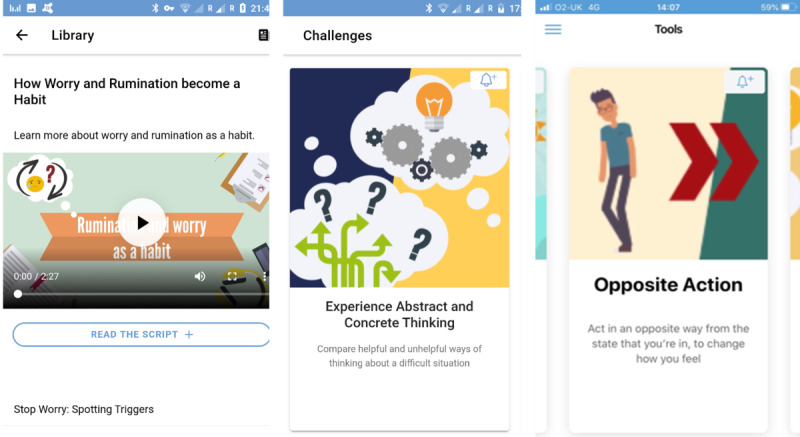
This was a prevention mechanism trial that aimed to investigate whether an RNT-targeting self-help mobile phone app (MyMoodCoach) reduces worry and rumination in young adults residing in the United Kingdom. A secondary objective was to test whether the app reduces symptoms of anxiety and depression and improves well-being.
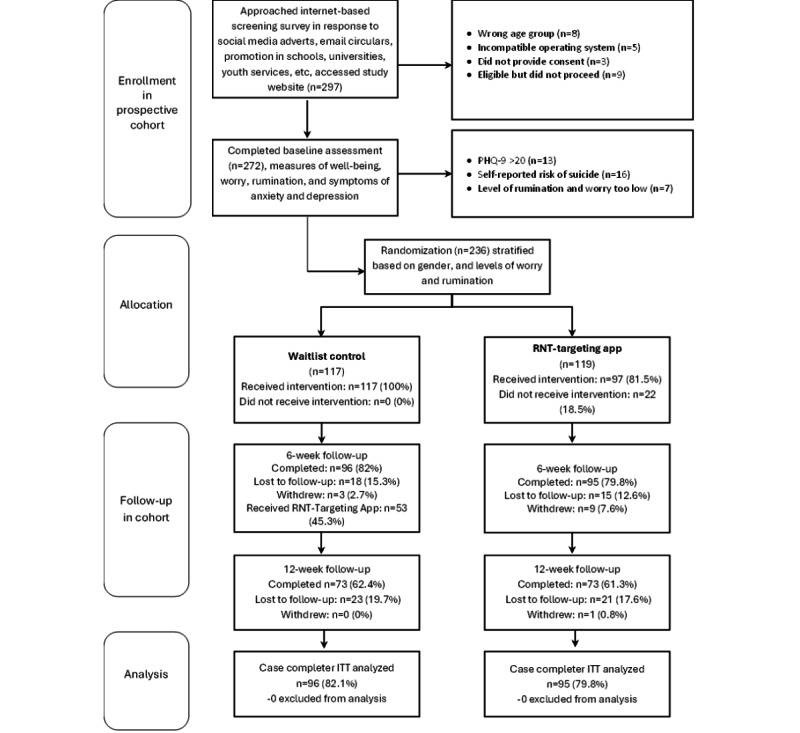
A web-based, single-blind, 2-arm parallel-group randomized controlled trial was conducted with 236 people aged between 16 and 24 years, who self-reported high levels of worry or rumination. Eligible participants were randomized to an active intervention group (usual practice, plus up to 6 weeks of using the RNT-targeting mobile app, n=119) or a waitlist control group (usual practice with no access to the app until after 6 weeks, n=117). The primary outcome was changes in worry and rumination 6 weeks after randomization. Secondary outcomes included changes in well-being and symptoms of anxiety and depression after 6 weeks and changes in all measures after 12 weeks.
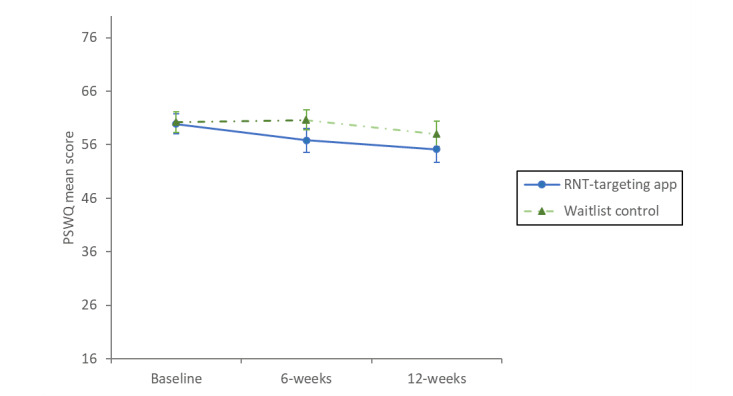
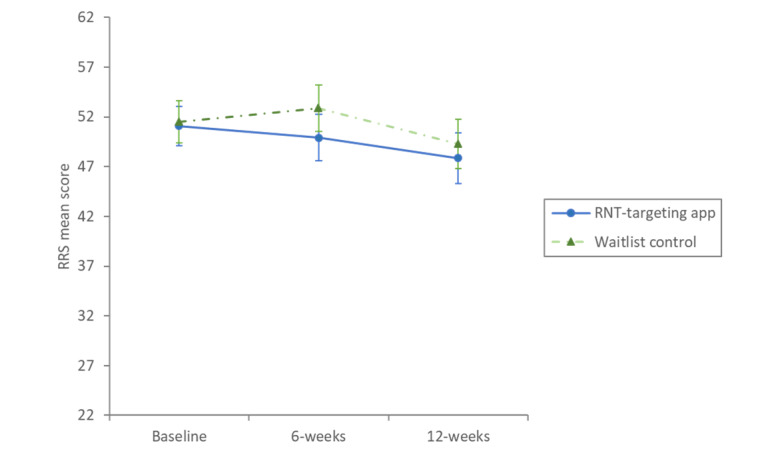
Participants randomly allocated to use the RNT-targeting self-help app showed significantly lower levels of rumination (mean difference -2.92, 95% CI -5.57 to -0.28; P=.03; η=0.02) and worry (mean difference -3.97, 95% CI -6.21 to -1.73; P<.001; η=0.06) at 6-week follow-up, relative to the waitlist control. Similar differences were observed for well-being (P<.001), anxiety (P=.03), and depression (P=.04). The waitlist control group also showed improvement when given access to the app after 6 weeks. Improvements observed in the intervention group after 6 weeks of using the app were maintained at the 12-week follow-up point.
The MyMoodCoach app had a significant positive effect on worry and rumination, well-being, anxiety, and depression in young adults, relative to waitlist controls, providing proof-of-principle that an unguided self-help app can effectively reduce RNT. This app, therefore, has potential for the prevention of anxiety and depression although longer-term effects on incidence need to be directly evaluated.
ClinicalTrials.gov NCT04950257; https://www.clinicaltrials.gov/ct2/show/NCT04950257.
INTERNATIONAL REGISTERED REPORT IDENTIFIER (IRRID): RR2-10.1186/s12888-021-03536-0.
通过手机应用程序提供预防干预措施为改善青少年和年轻人的心理健康这一全球重点问题提供了一种有效且便捷的方式。焦虑和抑郁的一个已知风险因素是过度担忧和沉思,也称为重复性消极思维(RNT)。
这是一项预防机制试验,旨在调查针对 RNT 的自我帮助手机应用程序(MyMoodCoach)是否可以减少英国年轻人的担忧和沉思。次要目标是测试该应用程序是否可以减轻焦虑和抑郁症状并提高幸福感。
这是一项基于网络的、单盲、2 臂平行组随机对照试验,共有 236 名年龄在 16 至 24 岁之间、自我报告有高水平担忧或沉思的参与者。符合条件的参与者被随机分配至积极干预组(常规治疗,外加最多 6 周使用针对 RNT 的手机应用程序,n=119)或候补对照组(常规治疗,在 6 周后才可以使用该应用程序,n=117)。主要结局是随机分组后 6 周时的担忧和沉思变化。次要结局包括 6 周和 12 周时的幸福感和焦虑及抑郁症状变化。
与候补对照组相比,随机分配使用针对 RNT 的自我帮助应用程序的参与者的沉思水平显著降低(平均差异-2.92,95%置信区间-5.57 至-0.28;P=.03;η=0.02)和担忧(平均差异-3.97,95%置信区间-6.21 至-1.73;P<.001;η=0.06),随访 6 周。在幸福感(P<.001)、焦虑(P=.03)和抑郁(P=.04)方面也观察到类似的差异。候补对照组在 6 周后获得应用程序访问权限后也有所改善。在使用该应用程序 6 周后,干预组观察到的改善在 12 周随访时得以维持。
与候补对照组相比,MyMoodCoach 应用程序对年轻人的担忧和沉思、幸福感、焦虑和抑郁有显著的积极影响,这证明了无指导的自助应用程序可以有效地减少 RNT。因此,该应用程序具有预防焦虑和抑郁的潜力,尽管需要直接评估其对发病率的长期影响。
ClinicalTrials.gov NCT04950257;https://www.clinicaltrials.gov/ct2/show/NCT04950257。
国际注册报告标识符(IRRID):RR2-10.1186/s12888-021-03536-0。