Jørgensen Astrid Ytrehus, Engdahl Bo, Bratsberg Bernt, Mehlum Ingrid Sivesind, Hoffman Howard J, Aarhus Lisa
Department of Occupational Medicine and Epidemiology, National Institute of Occupational Health, Oslo, Norway.
Department of Chronic Diseases and Ageing, Norwegian Institute of Public Health, Oslo, Norway.
Ear Hear. 2025;46(1):121-127. doi: 10.1097/AUD.0000000000001554. Epub 2024 Aug 14.
The association between hearing loss and income has only been examined in cross-sectional studies. We aim to study annual increase in earnings over 20 years, comparing people with and without hearing loss.
We used data from a population-based hearing study in Norway (The Trøndelag Health Study, 1996-1998), including 14,825 persons (46.2% men, mean age at baseline 30.6 years, age range 20 to 40 years). Hearing loss was defined as the pure-tone average threshold of 0.5 to 4 kHz in the better hearing ear ≥20 dB HL (n = 230). Annual earnings were assessed from 1997 to 2017. Longitudinal analyses were performed with linear mixed models adjusted for age, sex, and education.
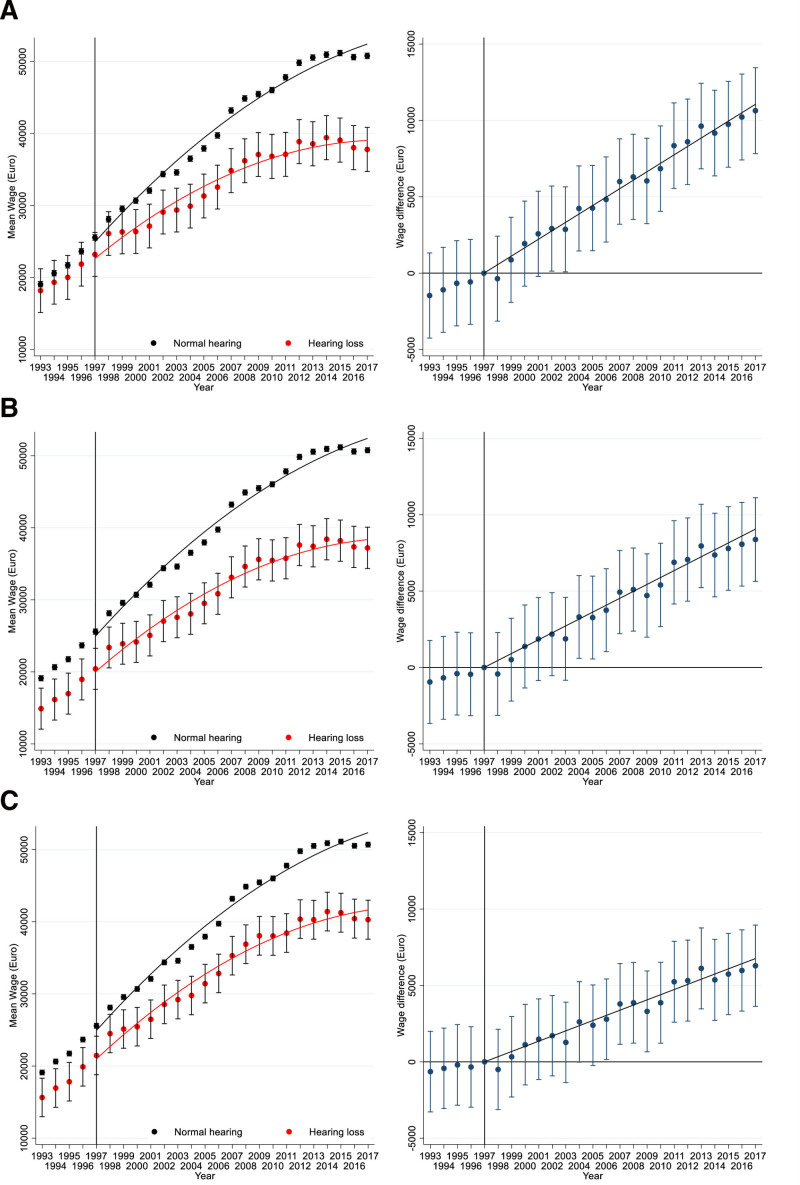
People without hearing loss at baseline (before age 40) had a greater annual increase in earnings over a 20-year follow-up period compared with people with hearing loss. For people with normal hearing, annual earnings over 20 years increased by 453 Euro (EUR) (95% confidence interval [CI] = 384 to 522) or 13.2% more per year than for people with hearing loss, adjusted for age and sex. The difference in annual earnings over 20 year was greater among women (462 EUR, 95% CI = 376 to 547) than men (424 EUR, 95% CI = 315 to 533), greater among younger than older adults, and greater among lower than higher educated persons. When including adjustment for education in the model, in addition to age and sex, the difference in annual earnings over 20 years between persons with and without hearing loss was reduced (337 EUR, 95% CI = 269 to 405).
The results from this large population-based study indicates that people with hearing loss experience lower long-term earnings growth compared with people with normal hearing. The findings highlight the need for increased interventions in the workplace for people with hearing loss.
听力损失与收入之间的关联仅在横断面研究中得到检验。我们旨在研究20年间收入的年度增长情况,比较有听力损失和无听力损失的人群。
我们使用了挪威一项基于人群的听力研究(特隆赫姆健康研究,1996 - 1998年)的数据,包括14825人(男性占46.2%,基线平均年龄30.6岁,年龄范围20至40岁)。听力损失定义为较好耳0.5至4千赫兹的纯音平均阈值≥20分贝听力级(n = 230)。评估了1997年至2017年的年收入。采用线性混合模型进行纵向分析,并对年龄、性别和教育程度进行了调整。
在基线时(40岁之前)无听力损失的人群在20年随访期内的年收入增长幅度大于有听力损失的人群。对于听力正常的人群,在调整年龄和性别后,20年的年收入比有听力损失的人群增加了453欧元(95%置信区间[CI] = 384至522),即每年多增加13.2%。20年的年收入差异在女性中(462欧元,95% CI = 376至547)大于男性(424欧元,95% CI = 315至533),在年轻人中大于老年人,在低学历人群中大于高学历人群。当在模型中纳入教育程度调整,以及年龄和性别调整时,有听力损失和无听力损失人群20年的年收入差异减小(337欧元,95% CI = 269至405)。
这项基于大量人群的研究结果表明,与听力正常的人群相比,有听力损失的人群长期收入增长较低。研究结果凸显了在工作场所对有听力损失的人群加强干预的必要性。