Czulada Evan, Shah Samir A, Tsimploulis Apostolos
School of Medicine, Georgetown University, Washington, D.C. 20007, USA.
School of Medicine and Health Sciences, George Washington University, Washington, D.C. 20037, USA.
Rev Cardiovasc Med. 2024 Jul 11;25(7):261. doi: 10.31083/j.rcm2507261. eCollection 2024 Jul.
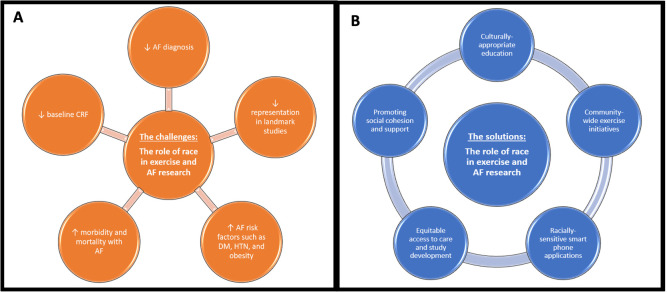
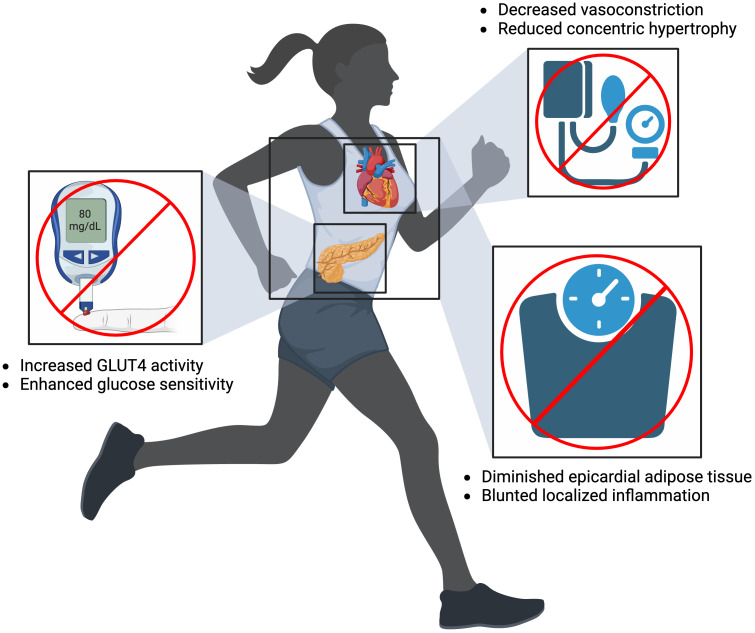
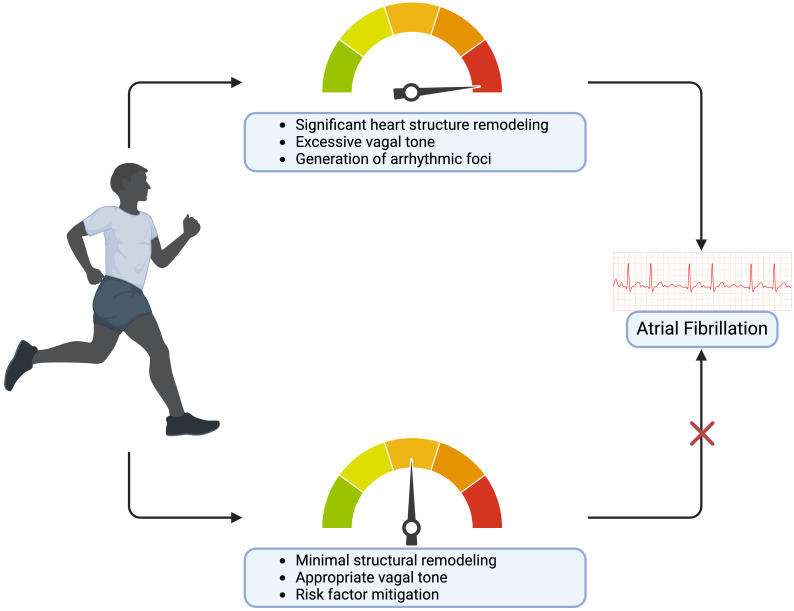
The expanding field of cardiorespiratory fitness (CRF) in individuals with and without atrial fibrillation (AF) presents a complex landscape, demanding careful interpretation of the existing research. AF, characterized by significant mortality and morbidity, prompts the exploration of strategies to mitigate its impact. Increasing physical activity (PA) levels emerges as a promising avenue to address AF risk factors, such as obesity, hypertension, and diabetes mellitus, through mechanisms of reduced vasoconstriction, endothelin-1 modulation, and improved insulin sensitivity. However, caution is warranted, as recent investigations suggest a heightened incidence of AF, particularly in athletes engaged in high-intensity exercise, due to the formation of ectopic foci and changes in cardiac anatomy. Accordingly, patients should adhere to guideline-recommended amounts of low-to-moderate PA to balance benefits and minimize adverse effects. When looking closer at the current evidence, gender-specific differences have been observed and challenged conventional understanding, with women demonstrating decreased AF risk even at extreme exercise levels. This phenomenon may be rooted in divergent hemodynamic and structural responses to exercise between men and women. Existing research is predominantly observational and limited to racially homogenous populations, which underscores the need for comprehensive studies encompassing diverse, non-White ethnic groups in athlete and non-athlete populations. These individuals exhibit a disproportionately high burden of AF risk factors that could be addressed through improved CRF. Despite the limitations, randomized control trials offer promising evidence for the efficacy of CRF interventions in patients with preexisting AF, showcasing improvements in clinically significant AF outcomes and patient quality of life. The potential of CRF as a countermeasure to the consequences of AF remains an area of great promise, urging future research to delve deeper to explore its role within specific racial and gender contexts. This comprehensive understanding will contribute to the development of tailored strategies for optimizing cardiovascular health and AF prevention in all those who are affected.
在有和没有心房颤动(AF)的个体中,心肺适能(CRF)这一不断扩展的领域呈现出复杂的局面,需要对现有研究进行仔细解读。AF具有显著的死亡率和发病率,促使人们探索减轻其影响的策略。增加身体活动(PA)水平成为解决AF风险因素(如肥胖、高血压和糖尿病)的一个有前景的途径,其机制包括减少血管收缩、调节内皮素-1以及改善胰岛素敏感性。然而,需要谨慎对待,因为最近的研究表明AF的发病率有所上升,尤其是在从事高强度运动的运动员中,这是由于异位灶的形成和心脏解剖结构的改变。因此,患者应遵循指南推荐的低至中等强度PA量,以平衡益处并将不良影响降至最低。当更仔细地审视当前证据时,观察到了性别差异,并挑战了传统认知,女性即使在极端运动水平下AF风险也会降低。这种现象可能源于男性和女性对运动的不同血流动力学和结构反应。现有研究主要是观察性的,且限于种族同质人群,这凸显了对包括运动员和非运动员人群中不同非白人种族群体的全面研究的必要性。这些个体承受着过高比例的AF风险因素负担,而通过改善CRF可以解决这些问题。尽管存在局限性,但随机对照试验为CRF干预对已有AF患者的疗效提供了有前景的证据,显示出在临床上显著的AF结局和患者生活质量方面有所改善。CRF作为应对AF后果的对策的潜力仍然是一个很有前景的领域,促使未来的研究更深入地探索其在特定种族和性别背景下的作用。这种全面的理解将有助于制定量身定制的策略,以优化所有受影响者的心血管健康和预防AF。