Department of Paediatrics, The University of Melbourne, Parkville, VIC, Australia.
Infection, Immunity & Global Health, Murdoch Children's Research Institute, Parkville, VIC, Australia.
Hum Vaccin Immunother. 2024 Dec 31;20(1):2323853. doi: 10.1080/21645515.2024.2323853. Epub 2024 Mar 6.
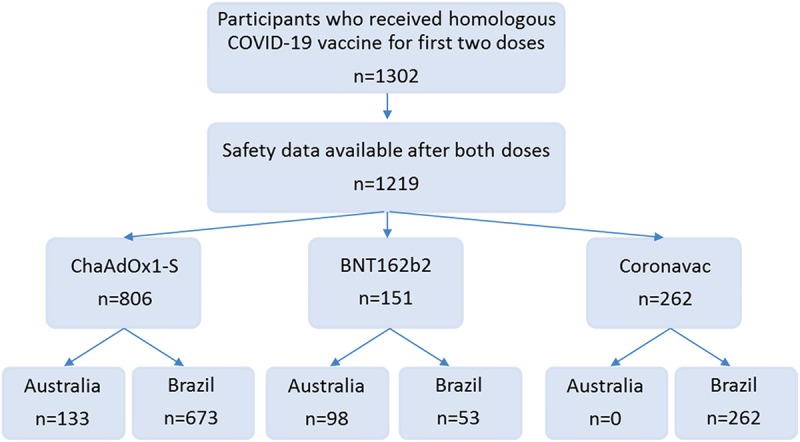
Various novel platform technologies have been used for the development of COVID-19 vaccines. In this nested cohort study among healthcare workers in Australia and Brazil who received three different COVID-19-specific vaccines, we (a) evaluated the incidence of adverse events following immunization (AEFI); (b) compared AEFI by vaccine type, dose and country; (c) identified factors influencing the incidence of AEFI; and (d) assessed the association between reactogenicity and vaccine anti-spike IgG antibody responses. Of 1302 participants who received homologous 2-dose regimens of ChAdOx1-S (Oxford-AstraZeneca), BNT162b2 (Pfizer-BioNTech) or CoronaVac (Sinovac), 1219 (94%) completed vaccine reaction questionnaires. Following the first vaccine dose, the incidence of any systemic reaction was higher in ChAdOx1-S recipients (374/806, 46%) compared with BNT162b2 (55/151, 36%; = 0.02) or CoronaVac (26/262, 10%; < 0.001) recipients. After the second vaccine dose, the incidence of any systemic reaction was higher in BNT162b2 recipients (66/151, 44%) compared with ChAdOx1-S (164/806, 20%; < 0.001) or CoronaVac (23/262, 9%; < 0.001) recipients. AEFI risk was higher in younger participants, females, participants in Australia, and varied by vaccine type and dose. Prior COVID-19 did not impact the risk of AEFI. Participants in Australia compared with Brazil reported a higher incidence of any local reaction (170/231, 74% vs 222/726, 31%, < 0.001) and any systemic reaction (171/231, 74% vs 328/726, 45%, < 0.001), regardless of vaccine type. Following a primary course of ChAdOx1-S or CoronaVac vaccination, participants who did not report AEFI seroconverted at a similar rate to those who reported local or systemic reactions. In conclusion, we found that the incidence of AEFI was influenced by participant age and COVID-19 vaccine type, and differed between participants in Australia and Brazil.
各种新型平台技术已被用于开发 COVID-19 疫苗。在这项针对澳大利亚和巴西的医护人员进行的三剂不同 COVID-19 特异性疫苗接种的嵌套队列研究中,我们:(a) 评估了接种后不良反应 (AEFI) 的发生率;(b) 比较了不同疫苗类型、剂量和国家的 AEFI;(c) 确定了影响 AEFI 发生率的因素;(d) 评估了反应原性与疫苗抗刺突 IgG 抗体反应之间的关系。在接受同源两剂 ChAdOx1-S(牛津-阿斯利康)、BNT162b2(辉瑞-生物技术)或 CoronaVac(科兴)疫苗的 1302 名参与者中,有 1219 名(94%)完成了疫苗反应问卷。在接种第一剂疫苗后,ChAdOx1-S 组(806 例中的 374 例,46%)全身反应发生率高于 BNT162b2 组(151 例中的 55 例,36%;=0.02)或 CoronaVac 组(262 例中的 26 例,10%;<0.001)。在接种第二剂疫苗后,BNT162b2 组(151 例中的 66 例,44%)全身反应发生率高于 ChAdOx1-S 组(806 例中的 164 例,20%;<0.001)或 CoronaVac 组(262 例中的 23 例,9%;<0.001)。年轻参与者、女性、澳大利亚参与者、不同疫苗类型和剂量的 AEFI 风险更高。既往 COVID-19 感染不会影响 AEFI 风险。与巴西相比,澳大利亚参与者报告的任何局部反应(231 例中的 170 例,74%;726 例中的 222 例,31%;<0.001)和任何全身反应(231 例中的 171 例,74%;726 例中的 328 例,45%;<0.001)发生率更高,无论疫苗类型如何。在接受 ChAdOx1-S 或 CoronaVac 疫苗初免后,未报告 AEFI 的参与者与报告局部或全身反应的参与者的血清转化率相似。总之,我们发现 AEFI 的发生率受参与者年龄和 COVID-19 疫苗类型的影响,并且在澳大利亚和巴西参与者之间存在差异。