Precision Medicine, School of Clinical Sciences at Monash Health, Monash University, Clayton, VIC, Australia.
Victorian Heart Institute, Monash University, Clayton, VIC, Australia.
Sci Rep. 2024 Aug 14;14(1):18917. doi: 10.1038/s41598-024-69398-0.
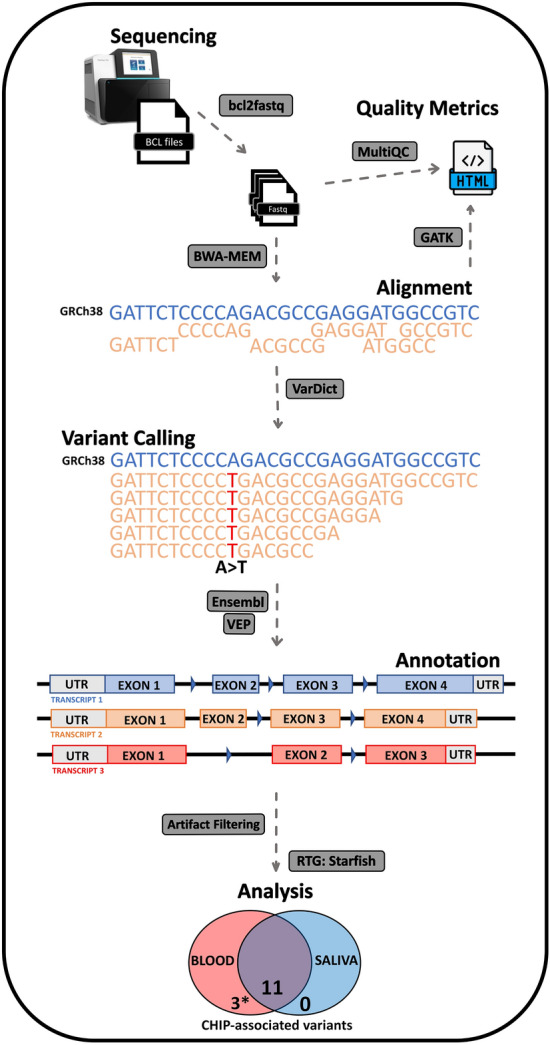
Clonal haematopoiesis of indeterminate potential (CHIP) has been associated with many adverse health outcomes. However, further research is required to understand the critical genes and pathways relevant to CHIP subtypes, evaluate how CHIP clones evolve with time, and further advance functional characterisation and therapeutic studies. Large epidemiological studies are well placed to address these questions but often collect saliva rather than blood from participants. Paired saliva- and blood-derived DNA samples from 94 study participants were sequenced using a targeted CHIP-gene panel. The ten genes most frequently identified to carry CHIP-associated variants were analysed. Fourteen unique variants associated with CHIP, ten in DNMT3A, two in TP53 and two in TET2, were identified with a variant allele fraction (VAF) between 0.02 and 0.2 and variant depth ≥ 5 reads. Eleven of these CHIP-associated variants were detected in both the blood- and saliva-derived DNA sample. Three variants were detected in blood with a VAF > 0.02 but fell below this threshold in the paired saliva sample (VAF 0.008-0.013). Saliva-derived DNA is suitable for detecting CHIP-associated variants. Saliva can offer a cost-effective biospecimen that could both advance CHIP research and facilitate clinical translation into settings such as risk prediction, precision prevention, and treatment monitoring.
不定潜能的克隆性造血 (CHIP) 与许多不良健康结果相关。然而,需要进一步的研究来了解与 CHIP 亚型相关的关键基因和途径,评估 CHIP 克隆随时间的演变方式,并进一步推进功能特征和治疗研究。大型流行病学研究非常适合解决这些问题,但通常从参与者中收集唾液而不是血液。对 94 名研究参与者的配对唾液和血液衍生 DNA 样本进行了靶向 CHIP 基因面板测序。分析了最常被鉴定为携带 CHIP 相关变异的十个基因。确定了与 CHIP 相关的 14 个独特变异,其中 10 个在 DNMT3A 中,2 个在 TP53 中,2 个在 TET2 中,变异等位基因分数 (VAF) 在 0.02 到 0.2 之间,变异深度≥5 个读数。这 11 个 CHIP 相关变异在血液和唾液衍生的 DNA 样本中均被检测到。三个变体在血液中检测到,VAF>0.02,但在配对的唾液样本中低于此阈值 (VAF 0.008-0.013)。唾液衍生的 DNA 适合检测 CHIP 相关变异。唾液可以提供一种具有成本效益的生物样本,不仅可以推进 CHIP 研究,还可以促进其在风险预测、精准预防和治疗监测等环境中的临床转化。