Department of Child and Adolescent Psychiatry, Medical University Vienna, Spitalgasse 23, 1090, Vienna, Austria.
Comprehensive Center for Pediatrics (CCP), Medical University of Vienna, Vienna, Austria.
Neuropsychiatr. 2024 Dec;38(4):189-197. doi: 10.1007/s40211-024-00503-5. Epub 2024 Aug 14.
The COVID-19 pandemic has had unprecedented and deteriorating effects on the mental health of adolescents and young adults. Various studies have described changes regarding substance abuse, but findings are conflicting.
We conducted a cross-sectional online survey on nicotine, alcohol, and illicit drug use.
From March to May 2023, 502 participants aged 14-24 from a community-based sample completed the questionnaire.
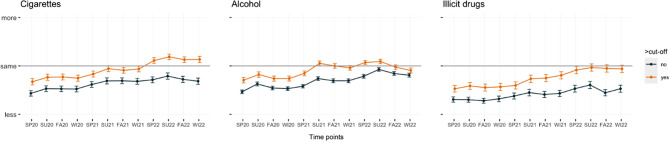
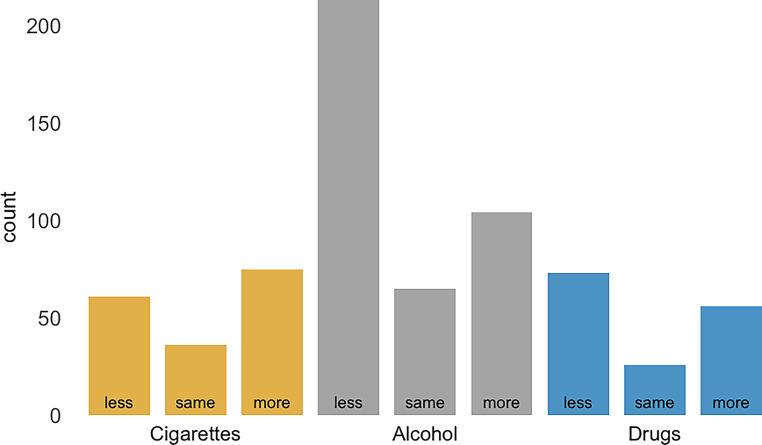
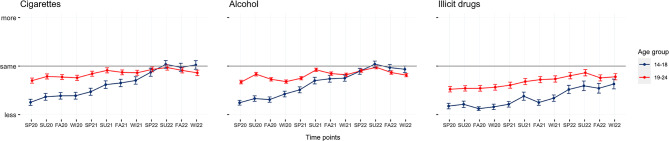
We found a general trend of declining or stable substance use during the first 2 years of the pandemic; however, in the third year (i.e., 2022), substance use returned to pre-pandemic levels or exceeded it. Compared with young adults (age 19-24), adolescents' (age 14-18) use increased more clearly. Participants who scored above the cut-off on screening measures for problematic substance use showed a more pronounced increase in the use of cigarettes and illicit drugs but not of alcohol. Higher alcohol consumption during lockdowns was associated with increased likelihood of current problematic alcohol (odds ratio [OR]: 3.03) and cannabis use (OR: 2.60). Furthermore, individuals who reported increased usage of one psychotropic substance during lockdowns were more likely to have increased their use of other substances as well (OR: 2.66-4.87).
Although not optimally generalizable due to the retrospective online format and convenience sampling, our results support the notion that special attention ought to be paid to certain subgroups such as younger people and those who already exhibit problematic substance use during the pandemic. Following up on post-pandemic trends in substance use is crucial for developing prevention measures and targeted interventions.
新冠疫情对青少年和青年的心理健康产生了前所未有的、恶化的影响。许多研究都描述了与物质滥用相关的变化,但结果却相互矛盾。
我们进行了一项关于尼古丁、酒精和非法药物使用的横断面在线调查。
2023 年 3 月至 5 月,来自基于社区样本的 502 名 14-24 岁的参与者完成了问卷。
我们发现,在疫情的头 2 年,物质使用总体呈下降或稳定趋势;然而,在第 3 年(即 2022 年),物质使用又回到了疫情前的水平或超过了疫情前的水平。与成年(19-24 岁)相比,青少年(14-18 岁)的物质使用增加更为明显。在筛查物质使用问题的测量中得分高于临界值的参与者,香烟和非法药物的使用增加更为明显,但酒精的使用没有增加。在封锁期间饮酒量较高与当前有问题的酒精(比值比[OR]:3.03)和大麻使用(OR:2.60)的可能性增加相关。此外,报告在封锁期间增加使用一种精神药物的个体更有可能增加其他物质的使用(OR:2.66-4.87)。
尽管由于回顾性在线格式和便利抽样,结果的推广性不是最佳的,但我们的结果支持这样一种观点,即应特别关注某些亚组,如年轻人和那些在疫情期间已经表现出物质使用问题的人。关注疫情后物质使用的趋势对于制定预防措施和有针对性的干预措施至关重要。