Department of Food Studies, Nutrition and Dietetics, Uppsala University, Box 560, Uppsala, 751 22, Sweden.
Department of Biosciences and Nutrition, Karolinska Institutet, Stockholm, 171 77, Sweden.
BMC Public Health. 2024 Aug 14;24(1):2214. doi: 10.1186/s12889-024-19560-0.
Eating is fundamental not only to survival and health, but also to how humans organise their social lives. Eating together with others is often seen as the healthy ideal, while eating alone is highlighted as a risk factor for negative health outcomes, especially among older adults. This paper, therefore, investigates the relationship between the frequency and subjective experience of eating alone and food-related outcomes among 70- to 75-year-olds in Sweden.
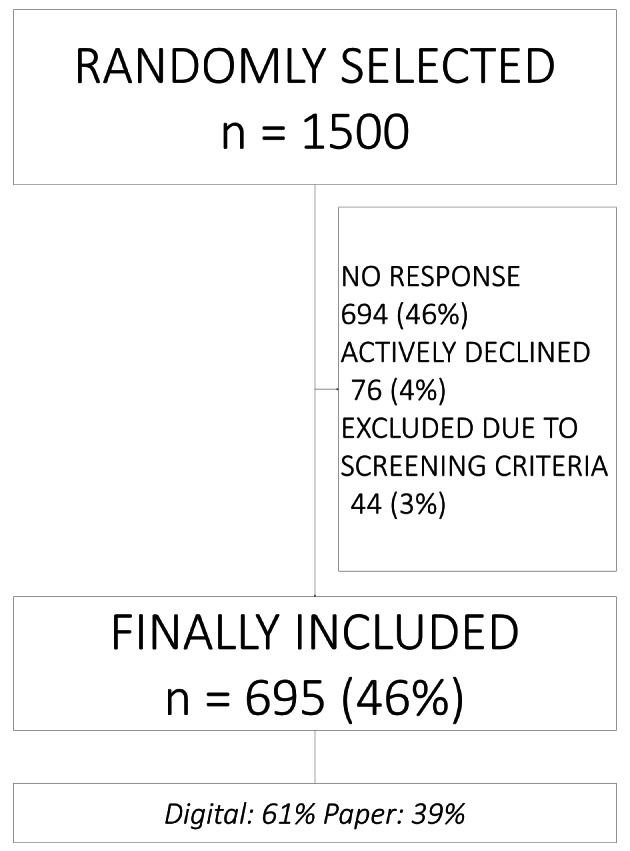
A survey was distributed to a nationally representative random sample of 1500 community-living in Sweden, aged 70-75 years. Two different constructs of eating alone (objective and subjective) were measured, along with the following food-related outcomes: a food index, intake of food groups, consumption of ready-made meals, number of main meals per day, and body mass index (BMI).
In total, 695 respondents were included in the final sample. A quarter of the respondents were categorised as eating alone, of which a small proportion reported that doing so bothered them. There were no associations between eating alone and food index scores, BMI, or intake frequencies of fruits and berries, or fish and shellfish. However, people eating alone were less likely to report eating three meals per day (OR: 0.53, CI: 0.37-0.76, p = 0.006), less likely to report higher intake frequencies of vegetables and snacks, sugary foods, and sweet drinks (adjusted OR: 0.68, CI: 0.48-0.95, p = 0.023 resp. OR: 0.59, CI: 0.43-0.81, p = 0.001), and more likely to report higher intake frequencies of ready-made meals (adjusted OR: 3.71, CI: 2.02-6.84, p < 0.001) compared to those eating together with others. The subjective experience of eating alone did not have an impact on food-related outcomes.
Eating alone or with others played a role in participants' food intake, and seemed to influence aspects of the organisation of everyday eating routines rather than overall dietary healthiness or weight status. Our findings add to the previous body of research on commensality, eating alone, and health among the older population, providing insights into the development of future health policies and research.
进食不仅是生存和健康的基础,也是人类组织社交生活的方式。与他人一起进食通常被视为健康的理想选择,而独自进食则被强调为负面健康结果的风险因素,尤其是在老年人中。因此,本文调查了瑞典 70 至 75 岁老年人中单独进食的频率和主观体验与食物相关结果之间的关系。
向瑞典全国范围内的 1500 名社区居住的 70-75 岁老年人随机发放了一份调查问卷。测量了两种不同的单独进食情况(客观和主观)以及以下与食物相关的结果:食物指数、食物组摄入量、即食餐消费、每天主餐次数和体重指数(BMI)。
共有 695 名受访者被纳入最终样本。四分之一的受访者被归类为独自进食,其中一小部分人表示这样做让他们感到困扰。独自进食与食物指数评分、BMI 或水果和浆果、鱼类和贝类的摄入频率之间没有关联。然而,独自进食的人每天报告吃三顿饭的可能性较小(OR:0.53,95%CI:0.37-0.76,p=0.006),报告较高蔬菜和零食、含糖食品和甜饮料摄入频率的可能性较小(调整后的 OR:0.68,95%CI:0.48-0.95,p=0.023 分别为 OR:0.59,95%CI:0.43-0.81,p=0.001),报告即食餐摄入频率较高的可能性较大(调整后的 OR:3.71,95%CI:2.02-6.84,p<0.001)与那些与他人一起进食的人相比。独自进食的主观体验对食物相关结果没有影响。
独自进食或与他人一起进食在参与者的食物摄入量中发挥了作用,并且似乎影响了日常饮食常规组织的方面,而不是整体饮食健康或体重状况。我们的研究结果增加了关于老年人共餐、独自进食和健康的先前研究,为未来健康政策和研究提供了见解。