Zhang Jufeng, Chen Yan, Lin Zhiwei, Jiang Na, Zhou Lin, Chen Sun, Xia Hongping
Department of Neonatology, Xinhua Hospital, Shanghai Jiao Tong University School of Medicine, Shanghai, China.
Pediatric Cardiac Center, Xinhua Hospital, Shanghai Jiao Tong University School of Medicine, Shanghai, China.
Transl Pediatr. 2024 Jul 31;13(7):1097-1105. doi: 10.21037/tp-24-42. Epub 2024 Jul 23.
Pulmonary stenosis (PS) is one rare congenital heart disease (CHD) featuring obstruction of right ventricular outflow tract. Critical pulmonary stenosis (CPS) is neonatal PS having cyanosis and evidence of patent ductus arteriosus (PDA) dependency. There is limited data on the clinical outcomes of CPS with different modes of transportation. This study aimed to investigate clinical features and outcomes of CPS through the intrauterine transport (IT) and postnatal transport (PT).
Single-center retrospective research was performed. Neonates with CPS were grouped into the IT group and PT group. Clinical characteristics and outcomes of the neonates were compared between the two groups.
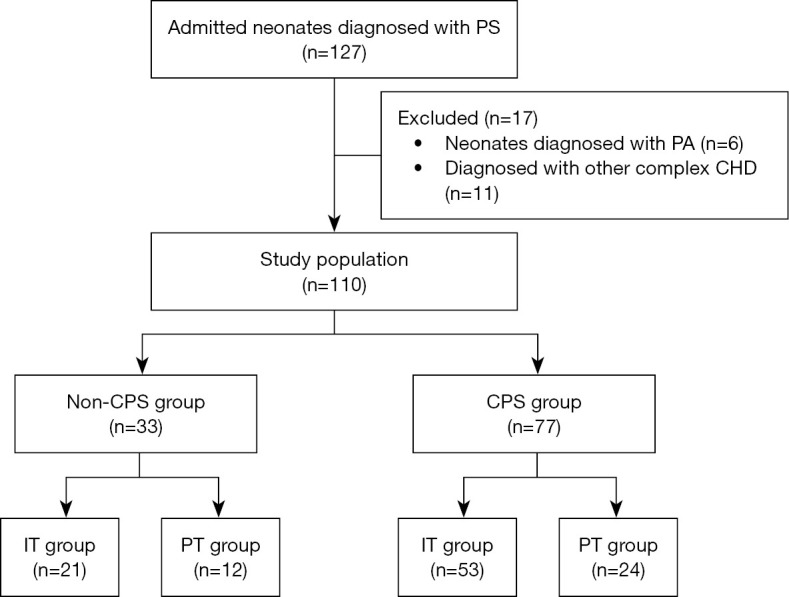
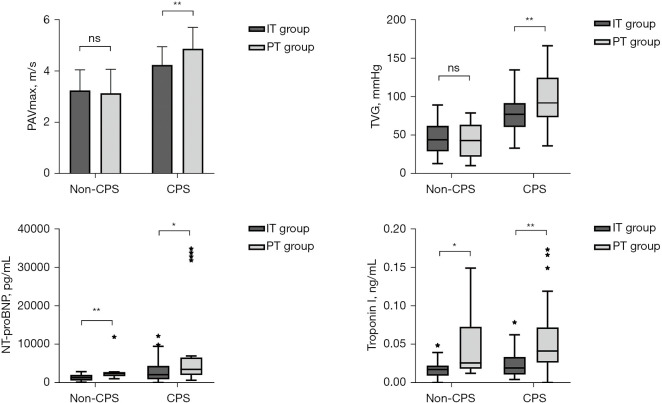
Totally 110 neonates with PS were included in this study, 77 with CPS and 33 with non-CPS. In the infants with CPS, there were 53 and 24 in the IT and PT group respectively. Echocardiography showed that transvalvular pulmonary gradient (TVG) stayed lower in the IT group than that in the PT group {77.0 [interquartile range (IQR), 60.5-91.5] . 92.0 (IQR, 73.3-125.0) mmHg, P=0.006}. Levels of serum N-terminal pro-brain natriuretic peptide (NT-proBNP) and troponin I also remained lower in the IT group than those in the PT group [2,256 (IQR, 1,054-4,527) . 3,708 (IQR, 2,138-6,789) pg/mL, P=0.02; 0.020 (IQR, 0.011-0.034) . 0.042 (IQR, 0.027-0.072) ng/mL, P<0.001, respectively]. All infants with CPS received percutaneous balloon pulmonary valvuloplasty (PBPV) therapy in neonatal period and were discharged from the hospital. Length of hospital stay remained shorter in the IT group than that in the PT group [13.0 (IQR, 11.0-15.0) . 15.5 (IQR, 10.8-22.8) days, P=0.03].
IT and early management after birth could effectively reduce the severity of CPS before PBPV treatment and shorten the length of hospital stay among neonates suffering from CPS.
肺动脉狭窄(PS)是一种罕见的先天性心脏病(CHD),其特征为右心室流出道梗阻。重症肺动脉狭窄(CPS)是指新生儿期的PS,伴有紫绀且有动脉导管未闭(PDA)依赖的证据。关于不同转运方式下CPS临床结局的数据有限。本研究旨在通过宫内转运(IT)和出生后转运(PT)来调查CPS的临床特征和结局。
进行单中心回顾性研究。将患有CPS的新生儿分为IT组和PT组。比较两组新生儿的临床特征和结局。
本研究共纳入110例PS新生儿,其中77例为CPS,33例为非CPS。在CPS婴儿中,IT组和PT组分别有53例和24例。超声心动图显示,IT组的跨瓣肺动脉压差(TVG)低于PT组{77.0[四分位数间距(IQR),60.5 - 91.5] vs. 92.0(IQR,73.3 - 125.0)mmHg,P = 0.006}。IT组血清N末端脑钠肽前体(NT - proBNP)和肌钙蛋白I水平也低于PT组[2,256(IQR,1,054 - 4,527)vs. 3,708(IQR,2,138 - 6,789)pg/mL,P = 0.02;0.020(IQR,0.011 - 0.034)vs. 0.042(IQR,0.027 - 0.072)ng/mL,P < 0.001]。所有CPS婴儿在新生儿期均接受了经皮球囊肺动脉瓣成形术(PBPV)治疗并出院。IT组的住院时间也短于PT组[13.0(IQR,11.0 - 15.0)vs. 15.5(IQR,10.8 - 22.8)天,P = 0.03]。
IT和出生后的早期管理可有效降低PBPV治疗前CPS的严重程度,并缩短CPS新生儿的住院时间。