Feng Li-Long, Lu Ke, Li Chong, Xu Min-Zhe, Ye Yao-Wei, Yin Yi, Shan Hui-Qiang
Department of Orthopedics, Affiliated Kunshan Hospital of Jiangsu University, Suzhou, Jiangsu, China.
Front Med (Lausanne). 2024 Jul 31;11:1415739. doi: 10.3389/fmed.2024.1415739. eCollection 2024.
The relationship between the levels of high-density lipoprotein (HDL) and bone mineral density (BMD) is controversial. Furthermore, the specific role of apolipoprotein A1 (APOA1), a primary HDL component, in regulating BMD remains unclear. This study aimed to elucidate the correlation between APOA1 levels and lumbar BMD in patients with osteoporotic fracture (OPF) for novel insights into potential therapeutic strategies against osteoporosis.
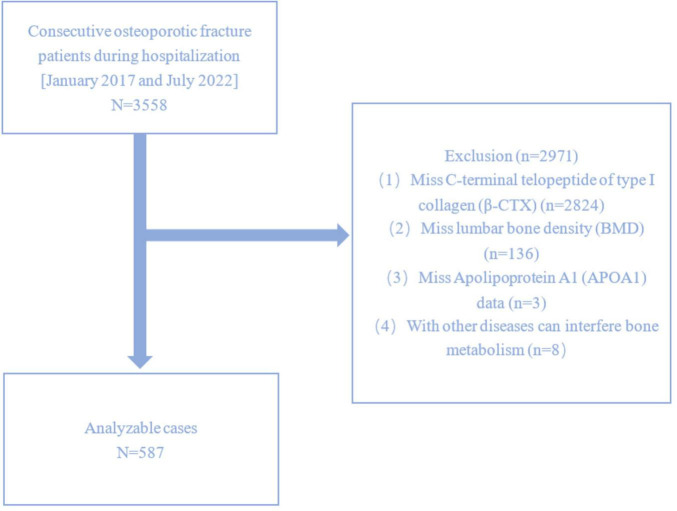
This study included 587 OPF patients enrolled at the Kunshan Hospital, Affiliated with Jiangsu University between January 2017 and July 2022. The patient's serum APOA1 levels were determined, followed by the assessment of lumbar BMD and C-terminal telopeptide of type I collagen (β-CTX) as outcome variables. The association of APOA1 levels with lumbar BMD and β-CTX was assessed Generalized Estimating Equations (GEE) and spline smoothing plot analyses. A generalized additive model (GAM) helped ascertain non-linear correlations. Moreover, a subgroup analysis was also conducted to validate the result's stability.
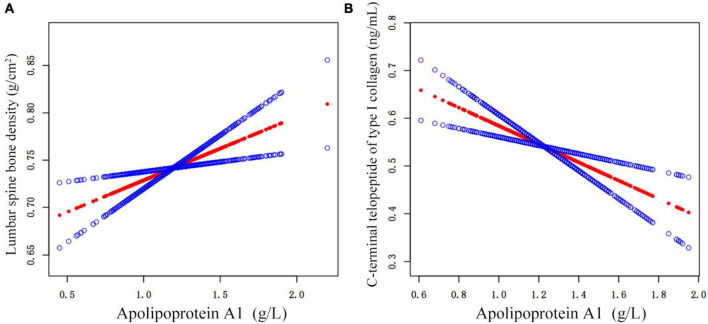
It was observed that APOA1 levels were positively correlated with lumbar BMD (β = 0.07, 95% CI: 0.02 to 0.11, = 0.0045), indicating that increased APOA1 levels were linked with enhanced lumbar BMD. Furthermore, APOA1 levels were negatively related to β-CTX (β = -0.19, 95% CI: -0.29 to -0.09, = 0.0003), suggesting APOA1 might reduce osteolysis. In addition, these findings were robustly supported by subgroup and threshold effect analyses.
This study indicated that increased APOA1 levels were correlated with enhanced lumbar BMD and decreased osteolysis in OPF patients. Therefore, APOA1 may inhibit osteoclast activity to prevent further deterioration in osteoporotic patients. However, further research I warranted to validate these conclusions and elucidate the underlying physiologies.
高密度脂蛋白(HDL)水平与骨密度(BMD)之间的关系存在争议。此外,载脂蛋白A1(APOA1)作为HDL的主要成分,在调节骨密度方面的具体作用仍不清楚。本研究旨在阐明骨质疏松性骨折(OPF)患者中APOA1水平与腰椎骨密度之间的相关性,为骨质疏松症潜在治疗策略提供新见解。
本研究纳入了2017年1月至2022年7月在江苏大学附属昆山医院登记的587例OPF患者。测定患者血清APOA1水平,随后评估腰椎骨密度和I型胶原C末端肽(β-CTX)作为结局变量。采用广义估计方程(GEE)和样条平滑图分析评估APOA1水平与腰椎骨密度和β-CTX的关联。广义相加模型(GAM)有助于确定非线性相关性。此外,还进行了亚组分析以验证结果的稳定性。
观察到APOA1水平与腰椎骨密度呈正相关(β = 0.07,95%CI:0.02至0.11,P = 0.0045),表明APOA1水平升高与腰椎骨密度增加有关。此外,APOA1水平与β-CTX呈负相关(β = -0.19,95%CI:-0.29至-0.09,P = 0.0003),提示APOA1可能减少骨溶解。此外,亚组和阈值效应分析有力支持了这些发现。
本研究表明,OPF患者中APOA1水平升高与腰椎骨密度增加和骨溶解减少相关。因此,APOA1可能抑制破骨细胞活性,以防止骨质疏松患者病情进一步恶化。然而,需要进一步研究来验证这些结论并阐明潜在的生理机制。