Zhang Jing-Jing, Qian Yu-Lan, Wu Zi-Yang, Li Yue, Guan Ying-Jie, Sun Cui, Fu Kai-Li, Mei Tong-Lin, Goyal Gaurav, Bernasconi Paolo, Damiani Daniela, Zhu Jian-Guo
Department of Pharmacy, The First Affiliated Hospital of Soochow University, Suzhou, China.
School of International Pharmaceutical Business, China Pharmaceutical University, Nanjing, China.
Transl Cancer Res. 2024 Jul 31;13(7):3783-3797. doi: 10.21037/tcr-24-747. Epub 2024 Jul 26.
Tyrosine kinase inhibitors (TKIs) have become the preferred drugs for the treatment of chronic phase (CP) chronic myeloid leukemia (CML). This study aims to compare the safety and efficacy of different TKIs as first-line treatments for CML using network meta-analysis (NMA), providing a basis for the precise clinical use of TKIs.
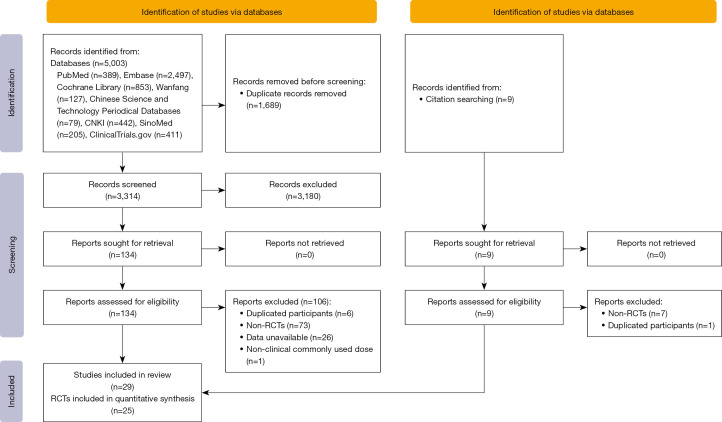
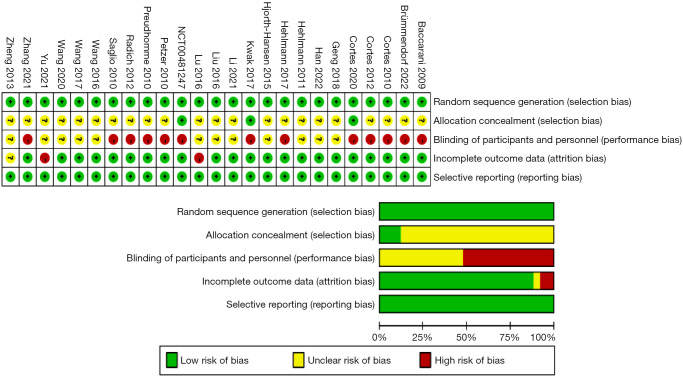
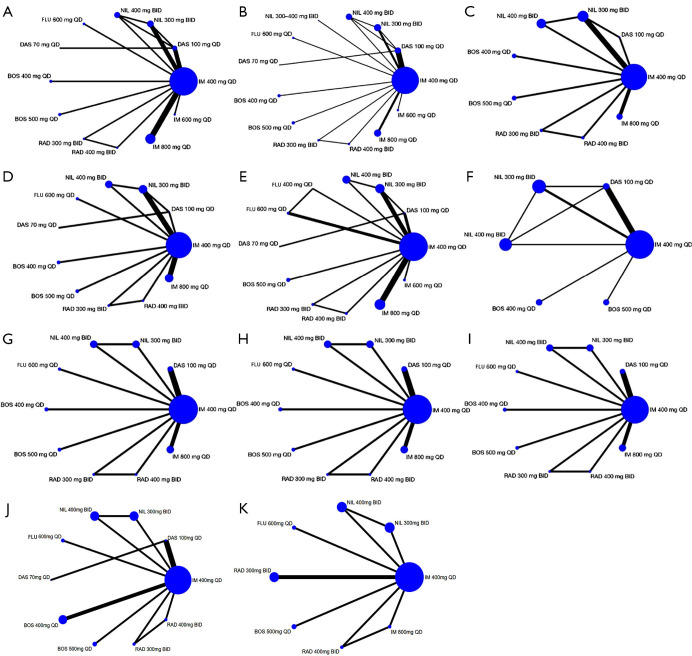
A systematic search was conducted on PubMed, Cochrane Library, Embase, China National knowledge Infrastructure (CNKI), Wanfang, Chinese Science and Technology Periodical Databases (VIP), SinoMed and ClinicalTrials.gov to include RCTs that compared the different TKIs as first line treatment for CML. The search timeline was from inception to 21 July 2023. Using the Preferred Reporting Items for Systematic Reviews and Meta-Analyses (PRISMA) and the frequentist NMA methods, the efficacy and safety of different TKIs were compared, including the rates of major molecular response (MMR), complete cytogenetic response (CCyR), all grade adverse events, grade 3 or higher hematologic adverse events and liver toxicity.
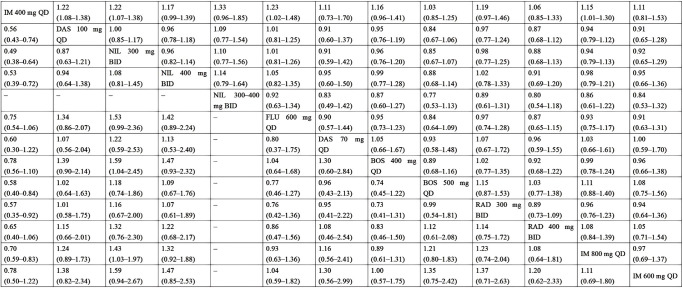
A total of 25 RCTs involving 6,823 patients with CML and 6 types of TKIs were included. In terms of efficacy, second-generation TKIs such as dasatinib, nilotinib, and radotinib showed certain advantages in improving patients' MMR and CCyR compared to imatinib. Additionally, imatinib 800 mg provided better MMRs and CCyRs than imatinib 400 mg. As far as safety was concerned, there was no significant difference in the incidence of all grade adverse events among the different TKIs. All TKIs can cause serious grade 3-4 hematologic adverse events, including anemia, thrombocytopenia, and neutropenia. Dasatinib more likely caused anemia, bosutinib thrombocytopenia, and imatinib neutropenia, whereas nilotinib and flumatinib might have better safety profiles in terms of severe hematologic adverse events. For liver toxicity, radotinib 400 mg and imatinib 800 mg, respectively, had the highest likelihood of ranking first in incidence rates of all grade ALT and AST elevation.
In CML, second-generation TKIs are more clinically effective than imatinib even if this last drug has a relatively better safety profile. Thus, as each second-generation TKI has a distinct clinical efficacy and safety, and is associated with different economic factors, its choice should be dictated by the specific patient clinical conditions (patient's specific disease characteristics, comorbid conditions, potential drug interactions, as well as their adherence). Nevertheless, due to the limited number of original research, additional high-quality studies are needed to achieve any firm conclusion on which second-generation TKI is the best choice for that peculiar patient.
酪氨酸激酶抑制剂(TKIs)已成为治疗慢性期(CP)慢性髓性白血病(CML)的首选药物。本研究旨在使用网络荟萃分析(NMA)比较不同TKIs作为CML一线治疗的安全性和有效性,为TKIs的精准临床应用提供依据。
对PubMed、Cochrane图书馆、Embase、中国知网(CNKI)、万方、维普中文科技期刊数据库(VIP)、中国生物医学文献数据库(SinoMed)和ClinicalTrials.gov进行系统检索,以纳入比较不同TKIs作为CML一线治疗的随机对照试验(RCTs)。检索时间范围为建库至2023年7月21日。采用系统评价和荟萃分析的首选报告项目(PRISMA)和频率学派NMA方法,比较不同TKIs的疗效和安全性,包括主要分子反应(MMR)率、完全细胞遗传学反应(CCyR)率、所有级别的不良事件、3级或更高等级的血液学不良事件和肝毒性。
共纳入25项涉及6823例CML患者和6种TKIs的RCTs。在疗效方面,与伊马替尼相比,达沙替尼、尼罗替尼和拉多替尼等第二代TKIs在改善患者的MMR和CCyR方面显示出一定优势。此外,800 mg伊马替尼比400 mg伊马替尼提供更好的MMR和CCyR。就安全性而言,不同TKIs之间所有级别的不良事件发生率无显著差异。所有TKIs均可引起严重的3-4级血液学不良事件,包括贫血、血小板减少和中性粒细胞减少。达沙替尼更易引起贫血,博舒替尼易引起血小板减少,伊马替尼易引起中性粒细胞减少,而尼罗替尼和氟马替尼在严重血液学不良事件方面可能具有更好的安全性。对于肝毒性,400 mg拉多替尼和800 mg伊马替尼在所有级别谷丙转氨酶(ALT)和谷草转氨酶(AST)升高发生率方面分别最有可能排名第一。
在CML中,即使伊马替尼具有相对较好的安全性,但第二代TKIs在临床上比伊马替尼更有效。因此,由于每种第二代TKI具有独特的临床疗效和安全性,且与不同的经济因素相关,其选择应根据患者的具体临床情况(患者的特定疾病特征、合并症、潜在药物相互作用以及依从性)来决定。然而,由于原始研究数量有限,需要更多高质量研究才能就哪种第二代TKI是该特定患者的最佳选择得出任何确凿结论。