Department of Neurology and Center of Clinical Neuroscience, Charles University, 1st Faculty of Medicine and General University Hospital in Prague, Prague, Czechia.
Department of Neurosciences, Biomedicine and Movement Sciences, University of Verona, Verona, Italy.
Eur J Neurol. 2024 Oct;31(10):e16350. doi: 10.1111/ene.16350. Epub 2024 Aug 15.
Functional neurological disorder (FND) is a common cause of neurological disability. Despite recent advances in pathophysiological understanding and treatments, application of this knowledge to clinical practice is variable and limited.
Our aim was to provide an expert overview of the state of affairs of FND practice across Europe, focusing on education and training, access to specialized care, reimbursement and disability policies, and academic and patient-led representation of people with FND.
We conducted a survey across Europe, featuring one expert per country. We asked experts to compare training and services for people with FND to those provided to people with multiple sclerosis (MS).
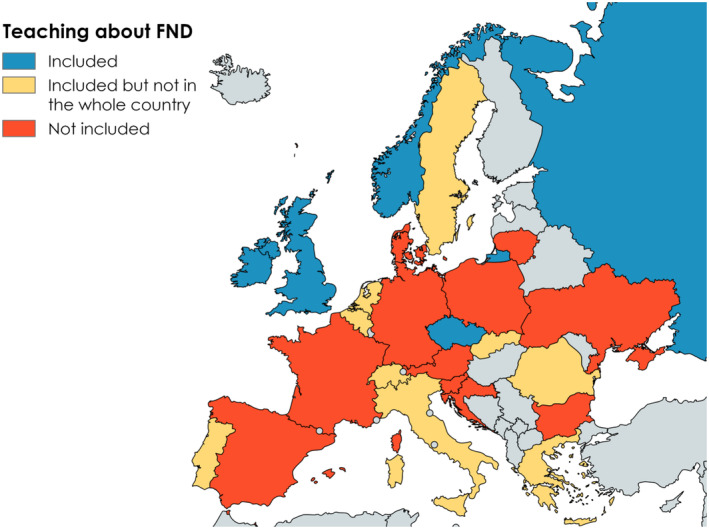
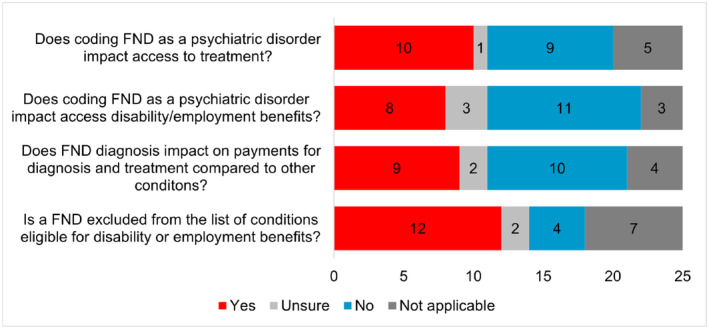
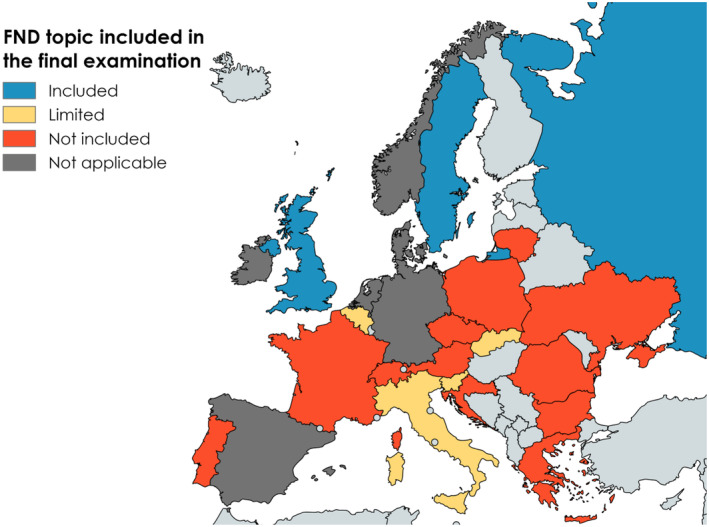
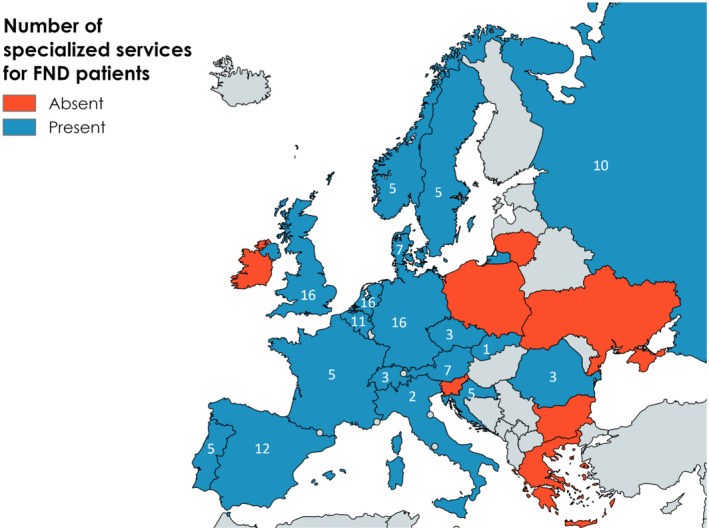
Responses from 25 countries revealed that only five included FND as a mandatory part of neurological training, while teaching about MS was uniformly included. FND was part of final neurology examinations in 3/17 countries, unlike MS that was included in all 17. Seventeen countries reported neurologists with an interest in FND but the estimated mean ratio of FND-interested neurologists to MS neurologists was 1:20. FND coding varied, with psychiatric coding for FND impacting treatment access and disability benefits in the majority of countries. Twenty countries reported services refusing to see FND patients. Eight countries reported an FND special interest group or network; 11 reported patient-led organizations.
FND is largely a marginal topic within European neurology training and there is limited access to specialized care and disability benefits for people with FND across Europe. We discuss how this issue can be addressed at an academic, healthcare and patient organization level.
功能性神经疾病(FND)是一种常见的神经功能障碍原因。尽管最近在病理生理学理解和治疗方面取得了进展,但这些知识在临床实践中的应用仍然存在差异且有限。
我们的目的是提供欧洲 FND 实践状况的专家概述,重点关注教育和培训、获得专业护理、报销和残疾政策,以及 FND 患者的学术和患者代表。
我们在欧洲进行了一项调查,每个国家都有一位专家参与。我们要求专家将 FND 患者的培训和服务与多发性硬化症(MS)患者的服务进行比较。
来自 25 个国家的回复显示,只有五个国家将 FND 作为神经科培训的必修部分,而 MS 的教学则是统一包含的。在 17 个国家中,FND 是最终神经科考试的一部分,而 MS 在所有 17 个国家中都包括在内。17 个国家报告称有对 FND 感兴趣的神经科医生,但 FND 感兴趣的神经科医生与 MS 神经科医生的估计平均比例为 1:20。FND 的编码存在差异,FND 的精神科编码会影响大多数国家的治疗机会和残疾福利。20 个国家报告称有服务机构拒绝接收 FND 患者。8 个国家报告称有 FND 特别兴趣小组或网络;11 个国家报告称有患者主导的组织。
FND 在欧洲神经科培训中基本上是一个边缘话题,欧洲各地的 FND 患者获得专业护理和残疾福利的机会有限。我们讨论了如何在学术、医疗保健和患者组织层面上解决这个问题。