Division of Nonclinical Science, Center for Tobacco Products, U.S. Food and Drug Administration, Silver Spring, MD, United States of America.
Division of Population Health Science, Center for Tobacco Products, U.S. Food and Drug Administration, Silver Spring, MD, United States of America.
PLoS One. 2024 Aug 15;19(8):e0308930. doi: 10.1371/journal.pone.0308930. eCollection 2024.
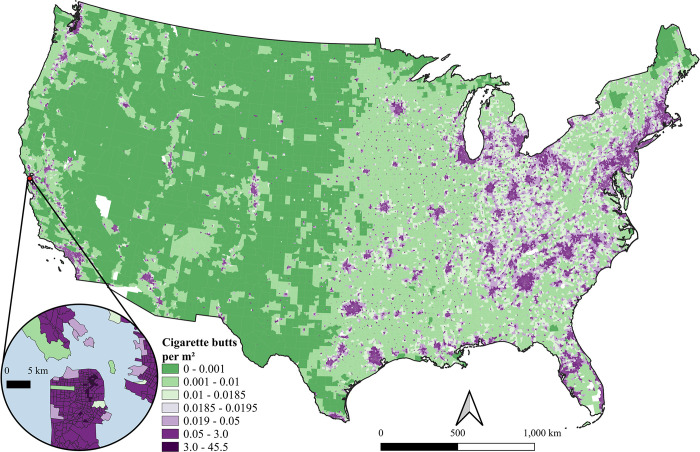
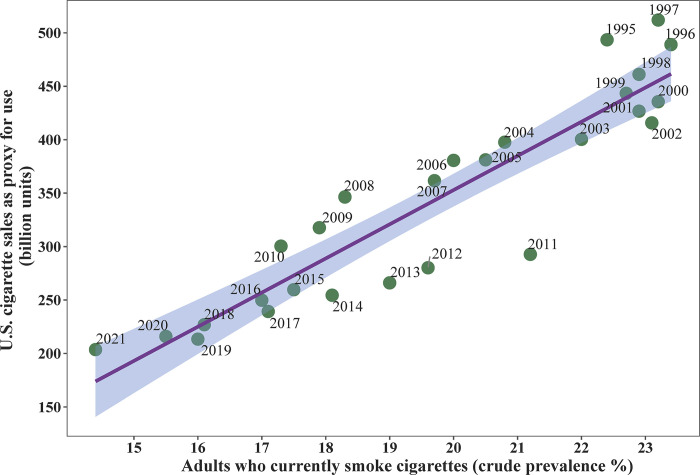
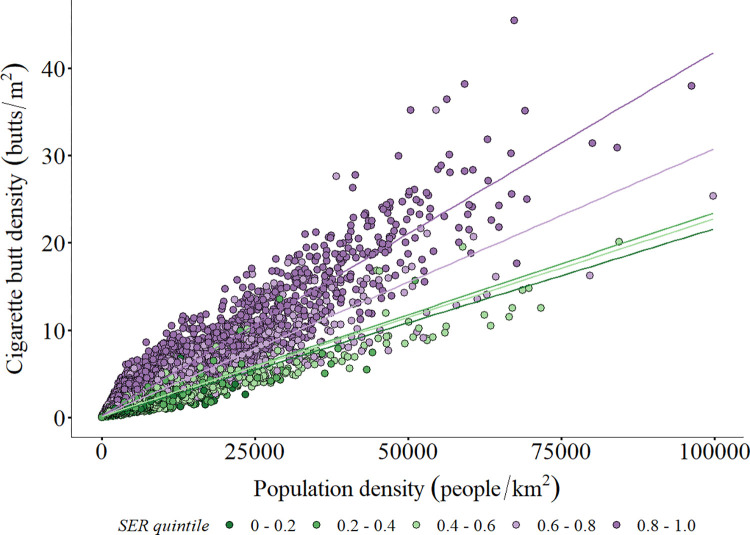
Littering of cigarette butts is a major environmental challenge. In 2022, ~124 billion cigarette butts were littered in the United States. This litter may pose an environmental justice concern by disproportionately affecting human and environmental health in communities of color or communities of low socioeconomic status. However, the lack of data on the distribution and magnitude of cigarette butt littering prevents an environmental justice analysis and limits the ability to tackle this environmental challenge. We conducted an environmental justice assessment of tobacco product waste, specifically cigarette butts, through spatially-explicit, place-based estimates across the contiguous U.S. We built a bottom-up model by synthesizing census tract-level population and smoking prevalence, state-level cigarette consumption, and published littering data to assess the spatial pattern of cigarette consumption and littering, and its implications for environmental injustice in >71,600 U.S. census tracts. Further, we compared the model output to urbanicity (rural-urban commuting area) and Social-Environmental Risk (SER; CDC Environmental Justice Index). Cigarette butt density was not uniformly distributed across the U.S. and ranged from 0-45.5 butts/m2, with an area-weighted average of 0.019 ± 0.0005 butts/m2. Cigarette butt density was 96 times higher in metropolitan vs. rural areas. Cigarette butt density increased significantly with SER, with 5.6 times more littered cigarette butts, and a steeper response to population density, in census tracts with the highest SER vs. the lowest SER. These results demonstrate the relative influences of location, smoking prevalence, and population density, and show that cigarette butt littering is a potential environmental justice concern in the U.S. This study provides information that may help devise targeted strategies to reduce cigarette butt pollution and prevent disproportionate impacts. The spatial data layer with place-based cigarette consumption and butt density is a tool that can support municipal, state, and federal level policy work and future studies on associations among cigarette butt pollution and environmental health outcomes.
乱扔烟头是一个主要的环境挑战。2022 年,美国约有 1240 亿个烟头被乱扔。这种垃圾可能会对有色人种社区或社会经济地位较低的社区的人类和环境健康造成不成比例的影响,从而引发环境正义方面的担忧。然而,由于缺乏关于烟头乱扔分布和程度的数据,无法进行环境正义分析,也限制了应对这一环境挑战的能力。我们通过综合人口普查区层面的人口和吸烟流行率、州级香烟消费以及已发表的垃圾数据,对美国各地的烟草产品废物(特别是烟头)进行了环境正义评估。我们建立了一个自下而上的模型,通过综合人口普查区层面的人口和吸烟流行率、州级香烟消费和已发表的垃圾数据来评估香烟消费和垃圾的空间模式,以及其对超过 71600 个美国人口普查区的环境正义的影响。此外,我们将模型输出与城市性(城乡通勤区)和社会-环境风险(CDC 环境正义指数)进行了比较。烟头密度在美国各地的分布并不均匀,范围从 0-45.5 个/平方米,加权平均值为 0.019±0.0005 个/平方米。与农村地区相比,大都市地区的烟头密度高出 96 倍。烟头密度与 SER 呈显著正相关,在 SER 最高的人口普查区,烟头密度比 SER 最低的人口普查区高 5.6 倍,且对人口密度的反应更为陡峭。这些结果表明了位置、吸烟流行率和人口密度的相对影响,并表明在美国,烟头乱扔是一个潜在的环境正义问题。本研究提供的信息可能有助于制定有针对性的策略来减少烟头污染,防止不成比例的影响。基于位置的香烟消费和烟头密度的空间数据层是一个工具,可以支持市级、州级和联邦级的政策工作,以及未来关于烟头污染与环境健康结果之间关联的研究。