Green Nick, Gao Hongyu, Chu Xiaona, Yuan Qiuyue, McGuire Patrick, Lai Dongbing, Jiang Guanglong, Xuei Xiaoling, Reiter Jill L, Stevens Julia, Sutherland Greg T, Goate Alison M, Pang Zhiping P, Slesinger Paul A, Hart Ronald P, Tischfield Jay A, Agrawal Arpana, Wang Yue, Duren Zhana, Edenberg Howard J, Liu Yunlong
Indiana University School of Medicine, Department of Medical and Molecular Genetics, Indianapolis, Indiana 46202, United States.
Center for Computational Biology and Bioinformatics, Indiana University School of Medicine, Indianapolis, Indiana 46202, United States.
bioRxiv. 2024 Oct 31:2024.08.02.606355. doi: 10.1101/2024.08.02.606355.
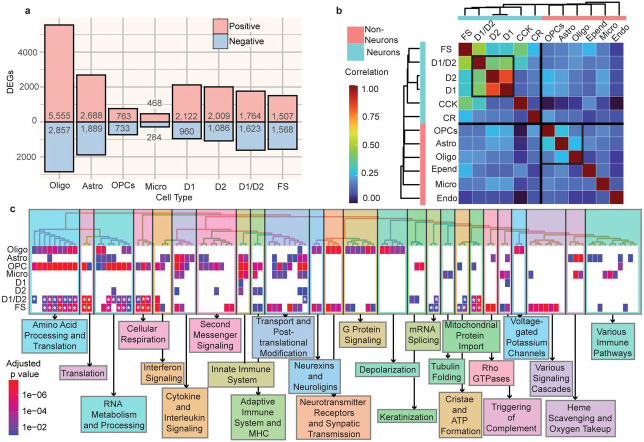
Alcohol use disorder (AUD) induces complex transcriptional and regulatory changes across multiple brain regions including the caudate nucleus, which remains understudied. Using paired single-nucleus RNA-seq and ATAC-seq on caudate samples from 143 human postmortem brains, including 74 with AUD, we identified 17 distinct cell types. We found that a significant portion of the alcohol-induced changes in gene expression occurred through altered chromatin accessibility. Notably, we identified novel transcriptional and chromatin accessibility differences in medium spiny neurons, impacting pathways such as RNA metabolism and immune response. A small cluster of D1/D2 hybrid neurons showed distinct differences, suggesting a unique role in AUD. Microglia exhibited distinct activation states deviating from classical M1/M2 designations, and astrocytes entered a reactive state partially regulated by , affecting glutamatergic synapse pathways. Oligodendrocyte dysregulation, driven in part by , was linked to demyelination and increased TGF-β1 signaling from microglia and astrocytes. We also observed increased microglia-astrocyte communication via the IL-1β pathway. Leveraging our multiomic data, we performed cell type-specific expression quantitative trait loci analysis, integrating that with public genome-wide association studies to identify AUD risk genes such as and , providing a direct link between genetic variants, chromatin accessibility, and gene expression in AUD. These findings not only provide new insights into the genetic and cellular mechanisms in the caudate related to AUD but also demonstrate the broader utility of large-scale multiomic studies in uncovering complex gene regulation across diverse cell types, which has implications beyond the substance use field.
酒精使用障碍(AUD)会在包括尾状核在内的多个脑区引发复杂的转录和调控变化,而尾状核仍未得到充分研究。我们对143例人类死后大脑的尾状核样本(包括74例患有AUD的样本)进行了配对单细胞核RNA测序和ATAC测序,识别出17种不同的细胞类型。我们发现,酒精诱导的基因表达变化很大一部分是通过染色质可及性的改变发生的。值得注意的是,我们在中等棘状神经元中发现了新的转录和染色质可及性差异,影响了RNA代谢和免疫反应等通路。一小群D1/D2杂交神经元表现出明显差异,表明其在AUD中具有独特作用。小胶质细胞表现出偏离经典M1/M2分类的独特激活状态,星形胶质细胞进入部分由 调节的反应状态,影响谷氨酸能突触通路。少突胶质细胞的失调部分由 驱动,与脱髓鞘以及小胶质细胞和星形胶质细胞中TGF-β1信号的增加有关。我们还观察到通过IL-1β通路小胶质细胞与星形胶质细胞的通讯增加。利用我们的多组学数据,我们进行了细胞类型特异性表达数量性状位点分析,并将其与公开的全基因组关联研究相结合,以识别AUD风险基因,如 和 ,在AUD中建立了遗传变异、染色质可及性和基因表达之间的直接联系。这些发现不仅为与AUD相关的尾状核中的遗传和细胞机制提供了新见解,还证明了大规模多组学研究在揭示不同细胞类型中复杂基因调控方面的更广泛用途,这对物质使用领域之外也有影响。