Tu Roger, Sinha Meghamala, González Carolina, Hu Eric, Dhuliawala Shehzaad, McCallum Andrew, Su Andrew I
Department of Integrative Structural and Computational Biology, The Scripps Research Institute, 10550 North Torrey Pines Road, La Jolla, CA 92037, United States of America.
College of Information of Computer Sciences, University of Massachusetts Amherst, Amherst, MA 01003, United States of America.
bioRxiv. 2024 Aug 10:2023.05.12.540594. doi: 10.1101/2023.05.12.540594.
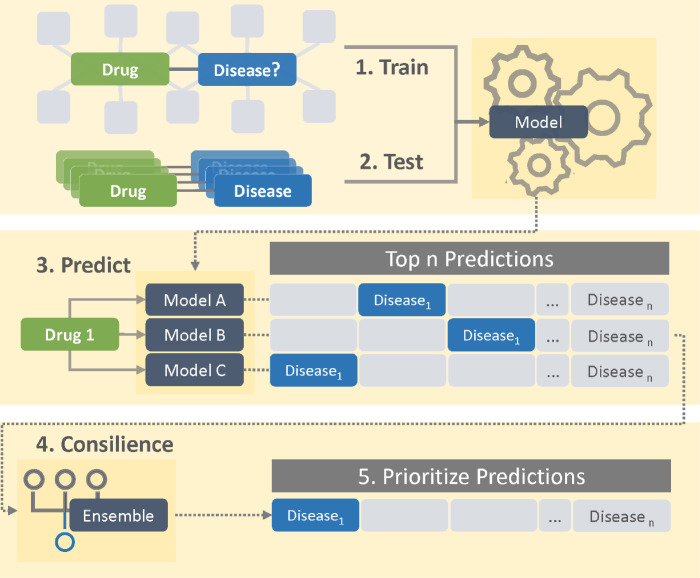
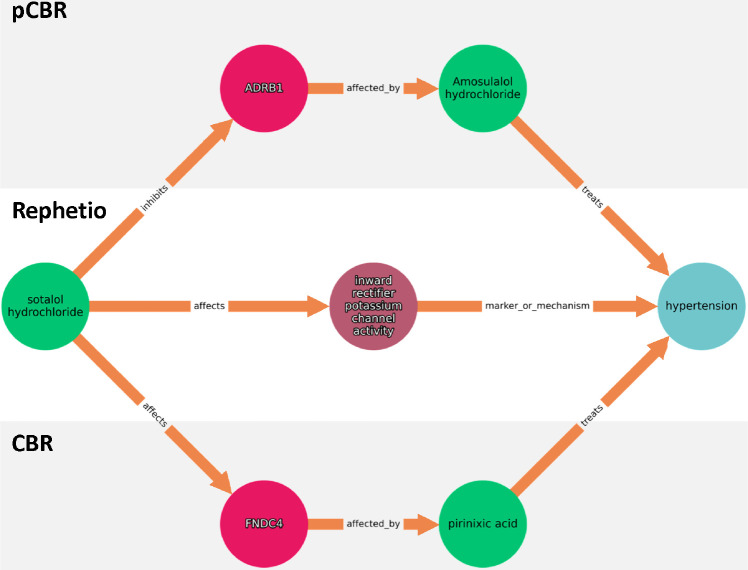
While link prediction methods in knowledge graphs have been increasingly utilized to locate potential associations between compounds and diseases, they suffer from lack of sufficient evidence to explain why a drug and a disease may be indicated. This is especially true for knowledge graph embedding (KGE) based methods where a drug-disease indication is linked only by information gleaned from a vector representation. Complementary pathwalking algorithms can increase the confidence of drug repurposing candidates by traversing a knowledge graph. However, these methods heavily weigh the relatedness of drugs, through their targets, pharmacology or shared diseases. Furthermore, these methods can rely on arbitrarily extracted paths as evidence of a compound to disease indication and lack the ability to make predictions on rare diseases. In this paper, we evaluate seven link prediction methods on a vast biomedical knowledge graph for drug repurposing. We follow the principle of consilience, and combine the reasoning paths and predictions provided by path-based reasoning approaches with those of KGE methods to identify putative drug repurposing indications. Finally, we highlight the utility of our approach through a potential repurposing indication.
虽然知识图谱中的链接预测方法越来越多地用于定位化合物与疾病之间的潜在关联,但它们缺乏足够的证据来解释为什么一种药物和一种疾病可能存在关联。对于基于知识图谱嵌入(KGE)的方法来说尤其如此,在这些方法中,药物-疾病适应症仅通过从向量表示中收集的信息来关联。互补路径行走算法可以通过遍历知识图谱来提高药物重新利用候选药物的可信度。然而,这些方法通过药物的靶点、药理学或共同疾病来严重权衡药物的相关性。此外,这些方法可能依赖于任意提取的路径作为化合物与疾病适应症关联的证据,并且缺乏对罕见疾病进行预测的能力。在本文中,我们在一个庞大的生物医学知识图谱上评估了七种用于药物重新利用的链接预测方法。我们遵循一致性原则,将基于路径的推理方法提供的推理路径和预测与KGE方法的推理路径和预测相结合,以识别假定的药物重新利用适应症。最后,我们通过一个潜在的重新利用适应症突出了我们方法的实用性。