Bianconi Irene, Battisti Laura, Staffler Alex, Giacobazzi Elisabetta, Masi Elisa, Incrocci Elisabetta, Bellutti Marion, Fontana Stefano, Stefanelli Paola, Buttinelli Gabriele, Pagani Elisabetta
Laboratory of Microbiology and Virology, Hospital of Bolzano (SABES-ASDAA), Teaching Hospital of Paracelsus Medical University (PMU), Bolzano-Bozen, Italy.
Division of Paediatrics, Hospital of Bolzano (SABES-ASDAA), Teaching Hospital of Paracelsus Medical University (PMU), Bolzano-Bozen, Italy.
Infection. 2024 Dec;52(6):2501-2506. doi: 10.1007/s15010-024-02315-9. Epub 2024 Aug 16.
Recently, cases of serious illness in newborns infected with Echovirus 11 have been reported in Europe, including Italy. Here, we report the case of a newborn diagnosed with disseminated Echovirus 11 infection, which occurred in October 2023 in the Province of Bolzano, Italy.
A molecular screening, by Real-Time RT-PCR, was employed to analyse the cerebrospinal fluid, blood and stool samples, and nasal swabs. The entire viral genome was sequenced using both Illumina and Nanopore technologies.
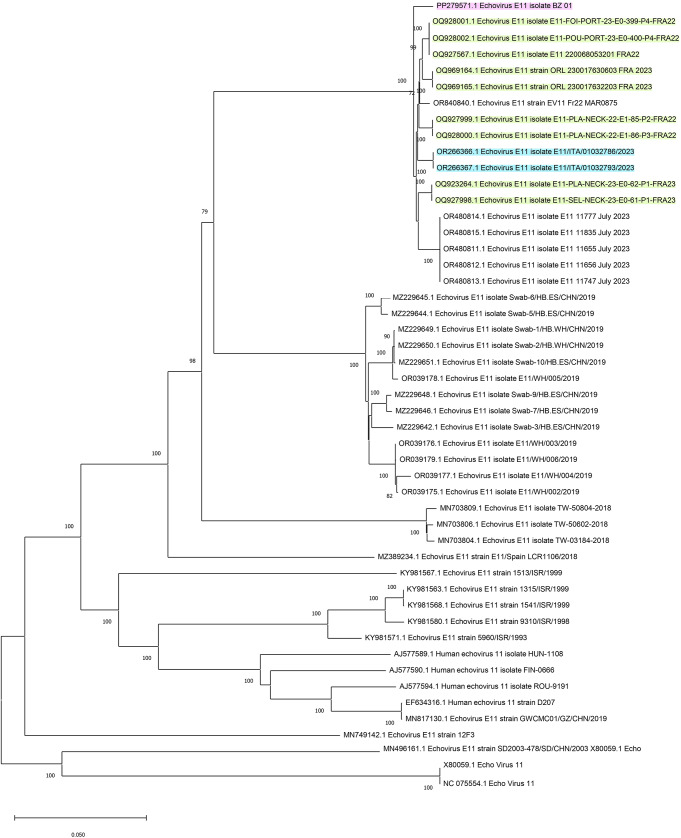
The patient was admitted to hospital due to fever. Molecular testing revealed the presence of enterovirus RNA. Typing confirmed the presence of Echovirus 11. The patient was initially treated with antibiotic therapy and, following the diagnosis of enterovirus infection, also with human immunoglobulins. Over the following days, the patient remained afebrile, with decreasing inflammation indices and in excellent general condition. Genomic and phylogenetic characterization suggested that the strain was similar to strains from severe cases reported in Europe.
Despite the low overall risk for the neonatal population in Europe, recent cases of Echovirus 11 have highlighted the importance of surveillance and complete genome sequencing is fundamental to understanding the phylogenetic relationships of Echovirus 11 variants.
最近,欧洲包括意大利在内报告了感染埃可病毒11型的新生儿重症病例。在此,我们报告一例于2023年10月在意大利博尔扎诺省确诊的播散性埃可病毒11型感染新生儿病例。
采用实时逆转录聚合酶链反应(Real-Time RT-PCR)进行分子筛查,以分析脑脊液、血液、粪便样本及鼻拭子。使用Illumina和纳米孔技术对整个病毒基因组进行测序。
该患者因发热入院。分子检测显示存在肠道病毒RNA。分型确认存在埃可病毒11型。患者最初接受抗生素治疗,在诊断为肠道病毒感染后,还接受了人免疫球蛋白治疗。在接下来的几天里患者体温恢复正常,炎症指标下降,总体状况良好。基因组和系统发育特征表明,该毒株与欧洲报告的重症病例毒株相似。
尽管欧洲新生儿总体风险较低,但近期的埃可病毒11型病例凸显了监测的重要性,完整的基因组测序对于理解埃可病毒11型变体的系统发育关系至关重要。