Department of Radiation Oncology, Seoul National University Hospital, 101, Daehak-ro, Jongno- gu, Seoul, 03080, Republic of Korea.
Institute of Radiation Medicine, Seoul National University Medical Research Center, Seoul, 03080, South Korea.
Radiat Oncol. 2024 Aug 16;19(1):110. doi: 10.1186/s13014-024-02505-7.
Adaptive therapy has been enormously improved based on the art of generating adaptive computed tomography (ACT) from planning CT (PCT) and the on-board image used for the patient setup. Exploiting the ACT, this study evaluated the dose delivered to patients with non-small-cell lung cancer (NSCLC) patients treated with stereotactic ablative radiotherapy (SABR) and derived relationship between the delivered dose and the parameters obtained through the evaluation procedure.
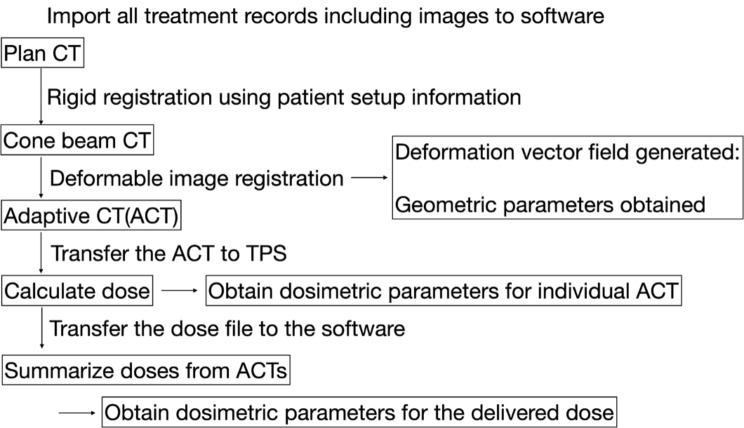
SABR treatment records of 72 patients with NSCLC who were prescribed a dose of 60 Gy (D) to the 95% volume of the planning target volume (PTV) in four fractions were analysed in this retrospective study; 288 ACTs were generated by rigid and deformable registration of a PCT to a cone-beam computed tomography (CBCT) per fraction. Each ACT was sent to the treatment planning system (TPS) and treated as an individual PCT to calculate the dose. Delivered dose to a patient was estimated by averaging four doses calculated from four ACTs per treatment. Through the process, each ACT provided the geometric parameters, such as mean displacement of the deformed PTV voxels (Warp) and Dice similarity coefficient (DSC) from deformation vector field, and dosimetric parameters, e.g. difference of homogeneity index (ΔHI, HI defined as (D-D)/D*100) and mean delivered dose to the PTV (D), obtained from the dose statistics in the TPS. Those parameters were analyzed using multiple linear regression and one-way-ANOVA of SPSS (version 27).
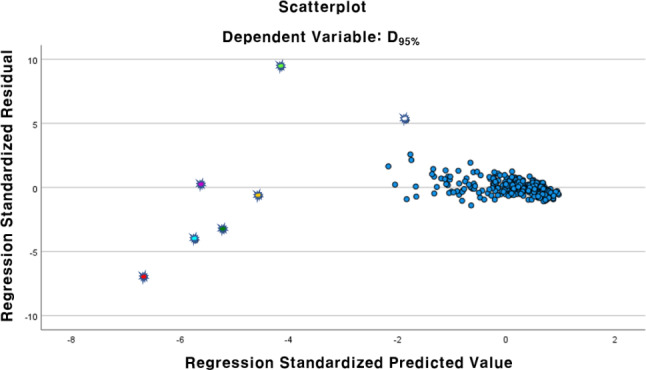
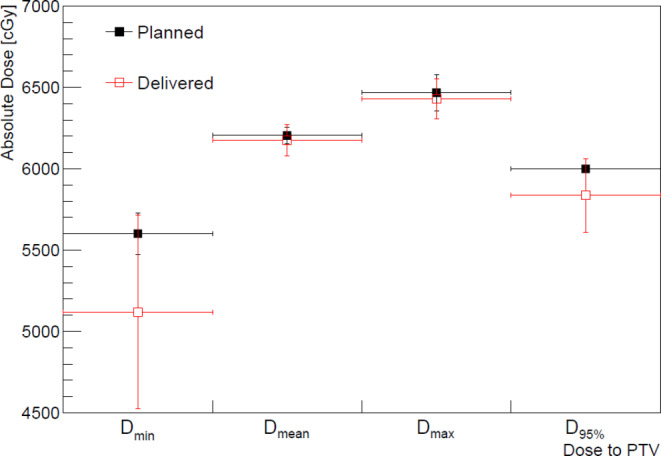
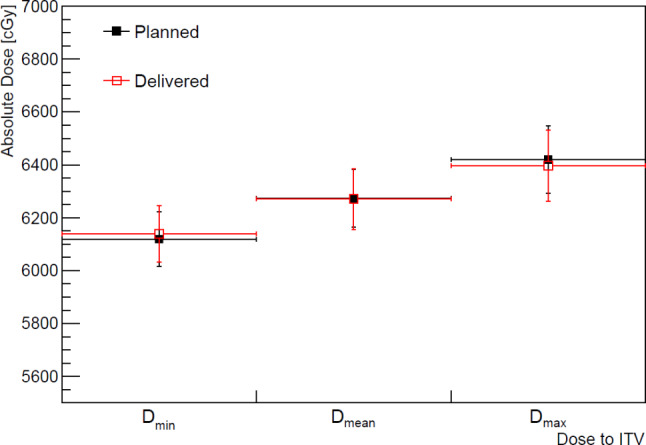
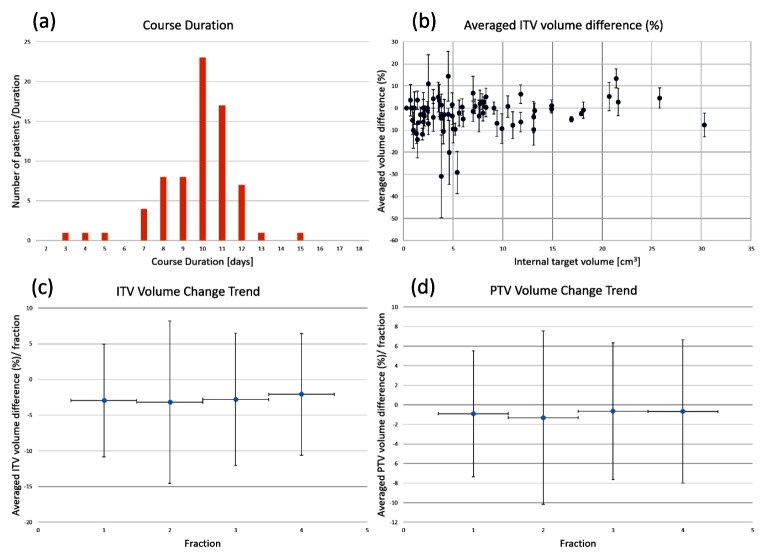
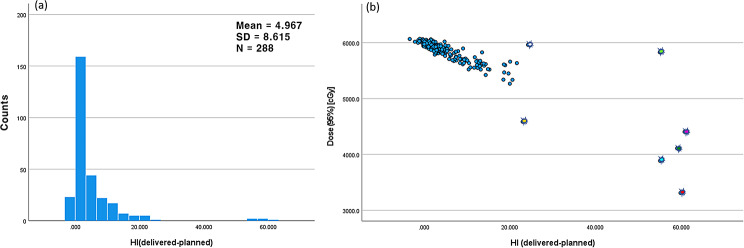
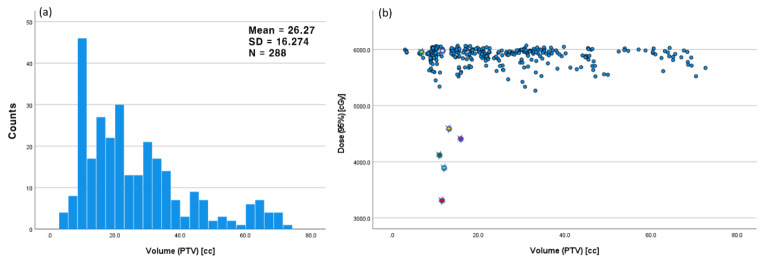
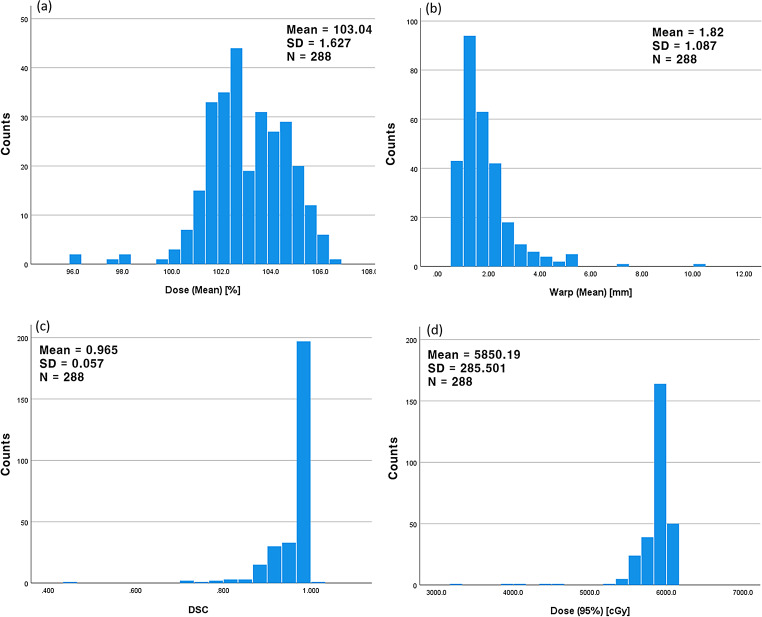
The prescribed dose was confirmed to be fully delivered to internal target volume (ITV) within maximum difference of 1%, and the difference between the planned and delivered doses to the PTV was agreed within 6% for more than 95% of the ACT cases. Volume changes of the ITV during the treatment course were observed to be minor in comparison of their standard deviations. Multiple linear regression analysis between the obtained parameters and the dose delivered to 95% volume of the PTV (D) revealed four PTV parameters [Warp, DSC, ΔHI between the PCT and ACT, D] and the PTV D to be significantly related with P-values < 0.05. The ACT cases of high ΔHI were caused by higher values of the Warp and DSC from the deformable image registration, resulting in lower PTV D delivered. The mean values of PTV D and Warp showed significant differences depending on the lung lobe where the tumour was located.
Evaluation of the dose delivered to patients with NSCLC treated with SABR using ACTs confirmed that the prescribed dose was accurately delivered to the ITV. However, for the PTV, certain ACT cases characterised by high HI deviations from the original plan demonstrated variations in the delivered dose. These variations may potentially arise from factors such as patient setup during treatment, as suggested by the statistical analyses of the parameters obtained from the dose evaluation process.
自适应治疗已经在生成自适应计算机断层扫描(ACT)方面取得了巨大的进步,该技术基于规划 CT(PCT)和用于患者摆位的在线图像。利用 ACT,本研究评估了接受立体定向消融放疗(SABR)治疗的非小细胞肺癌(NSCLC)患者的剂量,并得出了剂量与通过评估过程获得的参数之间的关系。
对 72 名接受 NSCLC 立体定向消融放疗的患者进行了回顾性研究,这些患者的处方剂量为 60Gy(D),分 4 次给予计划靶区(PTV)的 95%体积,每次分割都通过刚性和变形配准将 PCT 与锥形束 CT(CBCT)进行配准,生成 288 个 ACT。每个 ACT 都被发送到治疗计划系统(TPS),并作为一个单独的 PCT 进行计算。通过这个过程,从每个 ACT 计算的 4 个剂量的平均值可以估算出患者的剂量。通过该过程,每个 ACT 提供了几何参数,例如变形后 PTV 体素的平均位移(Warp)和从变形矢量场获得的 Dice 相似系数(DSC),以及剂量学参数,例如均匀性指数(HI)差值(HI 定义为(D-D)/D*100)和 PTV 的平均剂量(D),这些参数是从 TPS 中的剂量统计数据中获得的。使用 SPSS(版本 27)的多元线性回归和单因素方差分析对这些参数进行了分析。
证实了规定剂量完全在最大 1%的差异内输送到内部靶区(ITV),并且超过 95%的 ACT 病例中,计划剂量与 PTV 剂量之间的差异在 6%以内达成一致。与标准偏差相比,观察到 ITV 在治疗过程中的体积变化较小。通过多元线性回归分析,获得的参数与 PTV 95%体积的剂量(D)之间存在显著相关性,其中 4 个 PTV 参数[Warp、DSC、PCT 和 ACT 之间的 HI 差值、D]和 PTV D 的 P 值均<0.05。ACT 中 HI 差值较高的病例是由于变形图像配准的 Warp 和 DSC 值较高,导致 PTV D 输送量较低。PTV D 和 Warp 的平均值根据肿瘤所在的肺叶位置存在显著差异。
使用 ACT 评估接受 SABR 治疗的 NSCLC 患者的剂量,证实了规定剂量准确输送到 ITV。然而,对于 PTV,某些 HI 偏差较大的 ACT 病例显示出剂量输送的变化。这些变化可能是由于治疗期间患者摆位等因素引起的,这一点从通过剂量评估过程获得的参数的统计分析中可以得到印证。