Department of Animal Science, Western Paraná State University, Marechal Cândido Rondon, PR 85960-000, Brazil.
Department of Animal Science, Federal University of Viçosa, Viçosa, MG 36570-900, Brazil.
Poult Sci. 2024 Oct;103(10):104105. doi: 10.1016/j.psj.2024.104105. Epub 2024 Jul 16.
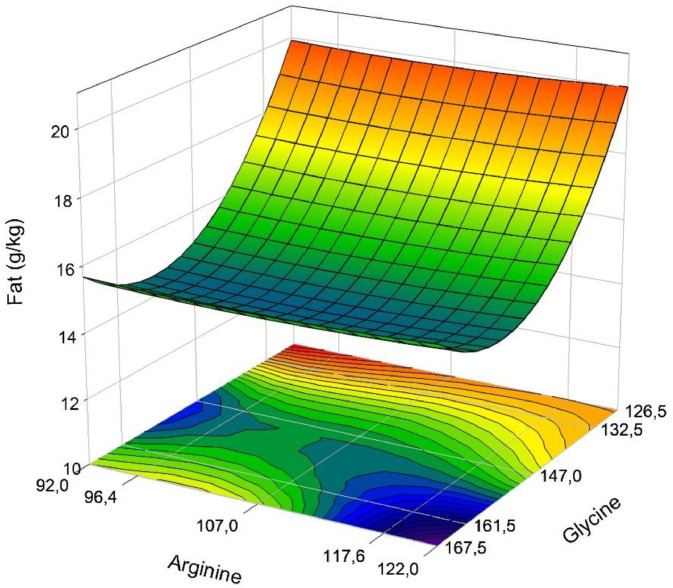
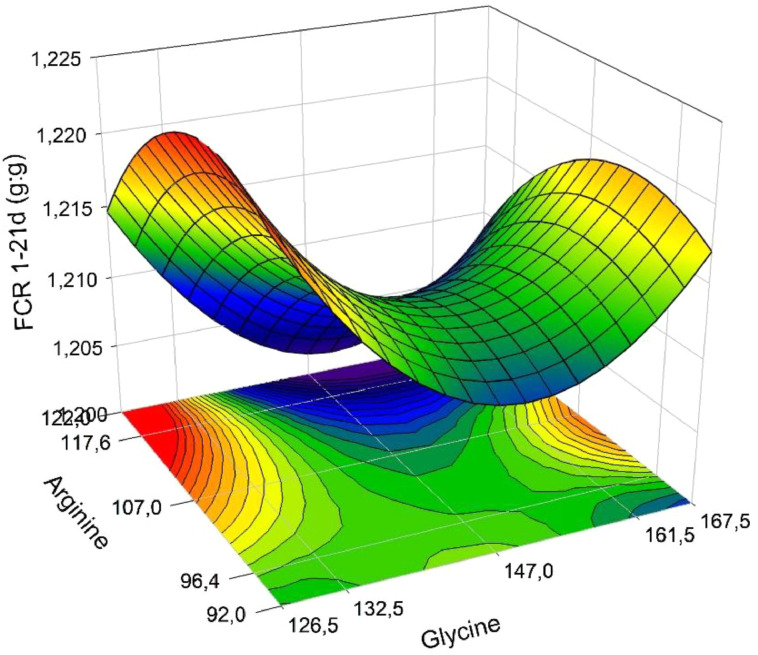
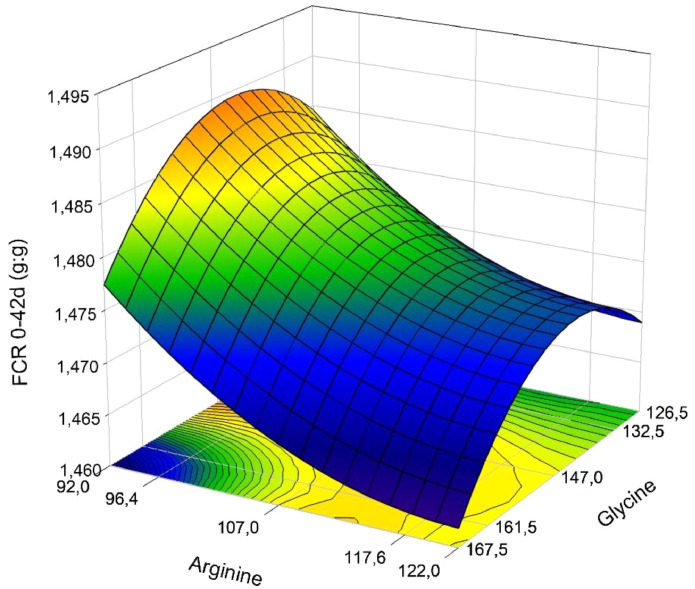
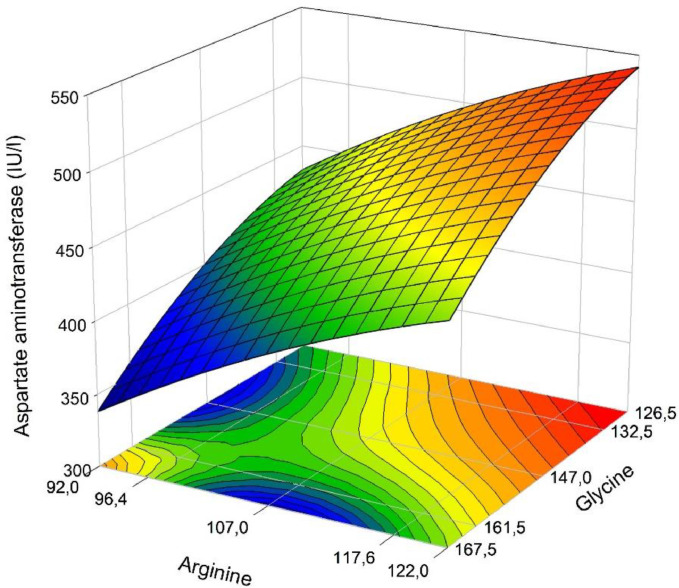
The study investigated guanidinoacetic acid (GAA) supplementation with varying dietary digestible arginine (Arg) and glycine+serine (Gly+Ser) concentrations in the starter phase, exploring respective carry-over effects on growth performance, blood chemistry, incidence of pectoral myopathies and proximate composition in broilers. A total of 2,800 one-day-old male broiler chicks were distributed in a central composite design with 2 factors and double experimental mesh, represented by supplementation or omission of 0.6 g per kg of GAA, with a central point represented by 107% of Arg and 147% of Gly+Ser, 4 factorial points (combinations of Arg/Gly+Ser concentrations: 96.4/132.5%; 117.6/132.5%; 96.4/161.5%, and 117.6/132.5%), and 4 axial points (combinations of axial points estimated for Arg and Gly+Ser, with the central points of 92/147%; 122/147%; 107/126.5, and 107/167.5%), totaling 18 treatments, 4 repetitions to factorial and axial points, 24 replicates to the central point, and 25 birds per pen. Feed conversion ratio (FCR) from d 1 to 10 had a linear response (P = 0.009) for the decreasing Arg content and a quadratic response (P = 0.047) for Gly+Ser concentrations. Broilers supplemented GAA had lower FCR compared with nonsupplemented groups from d 1 to 10 (P = 0.048) and d 1 to 42 (P = 0.026). Aspartate aminotransferase (AST) exhibited increasing and decreasing linear effects as a function of Arg (P = 0.008) and Gly+Ser (P = 0.020) concentrations, respectively. Guanidinoacetic acid decreased serum AST (P = 0.028). Guanidinoacetic acid reduced moderate + severe (P = 0.039) and mild (P = 0.015) Wooden Breast scores. The occurrence of normal White Striping increased (P = 0.002), while severe score was reduced (P = 0.029) with GAA supplementation. In conclusion, increased digestible Arg:Lys and 14% and 6% above the recommendations (107% and 147%), respectively, provided improved FCR during the starter phase. Dietary GAA supplementation (0.6 g per kg) improved FCR, reduced severity of breast myopathies and appears to have reduced muscle damage in broilers fed plant-based diets.
该研究调查了胍基乙酸(GAA)补充剂在起始阶段不同的可消化精氨酸(Arg)和甘氨酸+丝氨酸(Gly+Ser)浓度对肉鸡生长性能、血液化学、胸肌病发病率和体成分的影响。总共 2800 只 1 日龄雄性肉鸡雏鸡分布在一个中央复合设计中,有 2 个因素和双实验网格,分别代表 0.6 克/千克的 GAA 补充或不补充,中心点代表 107%的 Arg 和 147%的 Gly+Ser,4 个因子点(Arg/Gly+Ser 浓度组合:96.4/132.5%;117.6/132.5%;96.4/161.5%,和 117.6/132.5%),和 4 个轴向点(Arg 和 Gly+Ser 估计的轴向点组合,中心点为 92/147%;122/147%;107/126.5 和 107/167.5%),总计 18 种处理,因子和轴向点重复 4 次,中心点重复 24 次,每笼 25 只鸡。从第 1 天到第 10 天的饲料转化率(FCR)对 Arg 含量的降低呈线性反应(P = 0.009),对 Gly+Ser 浓度呈二次反应(P = 0.047)。与不补充 GAA 的组相比,补充 GAA 的肉鸡从第 1 天到第 10 天(P = 0.048)和第 1 天到第 42 天(P = 0.026)的 FCR 更低。天冬氨酸氨基转移酶(AST)表现出 Arg(P = 0.008)和 Gly+Ser(P = 0.020)浓度的增加和减少的线性效应。胍基乙酸降低了血清 AST(P = 0.028)。胍基乙酸降低了中度+严重(P = 0.039)和轻度(P = 0.015)木胸评分。正常白条纹的发生率增加(P = 0.002),而严重程度评分降低(P = 0.029)与 GAA 补充有关。总之,在起始阶段,可消化 Arg:Lys 增加 14%,比推荐量(107%和 147%)分别增加 6%,提高了 FCR。日粮 GAA 补充(0.6 克/千克)可提高 FCR,降低胸肌病的严重程度,似乎可减少植物性日粮喂养肉鸡的肌肉损伤。