South Texas Veterans Healthcare System, Division of Pulmonary Diseases/Critical Care Medicine, University of Texas Health, 111 E 7400 Merton Minter Blvd, San Antonio, TX, 78229, USA.
Boehringer Ingelheim Inc, Ridgefield, CT, USA.
BMC Pulm Med. 2024 Aug 17;24(1):395. doi: 10.1186/s12890-024-03194-4.
Prompt and effective management with maintenance therapy (single or dual bronchodilator therapy) is recommended after the initial diagnosis of chronic obstructive pulmonary disease (COPD) to maintain lung function and prevent exacerbations. Contrary to guideline-based recommendations, most patients are not prescribed maintenance treatment at initial diagnosis. The current study assessed the pharmacologic treatment patterns and outcomes of newly diagnosed patients with COPD in the USA.
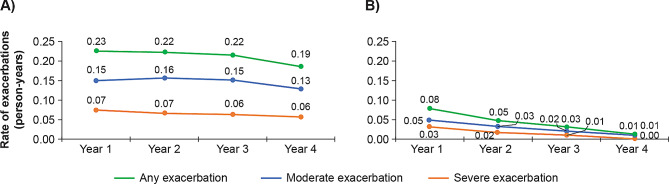
This retrospective, noninterventional study used de-identified data from the Inovalon Insights' database (Commercial, Medicaid Managed Care, and Medicare Advantage-insured individuals) between January 1, 2015, and December 31, 2021. The "patient journey" from initial diagnosis was followed over a 4-year period. The primary outcome measure was the number of moderate or severe exacerbations. Secondary outcome measures included the cumulative incidence of exacerbations, mean cumulative count of moderate and severe exacerbations, rates of moderate and severe exacerbations in patients who remained untreated after diagnosis in 12-month time periods for 4 years, sociodemographic and clinical characteristics, and pharmacologic treatment patterns.
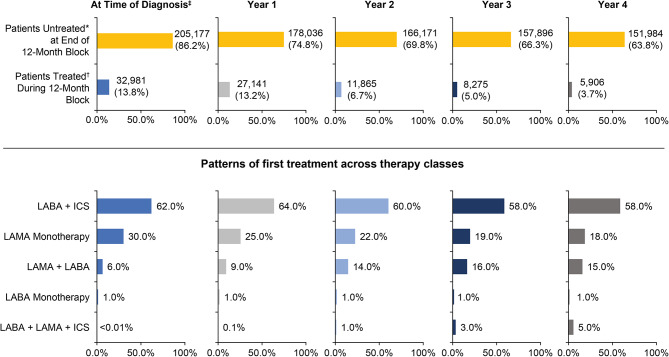
The cohort consisted of 238,158 newly diagnosed patients with COPD (female [52.9%]; mean age 63.8 years). The majority of patients with COPD had Medicaid as their primary insurance (46.2%). Overall, during the 4-year follow-up period, 32.9% of the patients had at least one moderate or severe exacerbation, and 25.8% and 13.8% experienced moderate and severe exacerbations, respectively. At diagnosis, 86.2% of the patients were untreated and most remained untreated by the end of the follow-up (63.8%). Most patients (62.0%) received long-acting beta-agonist (LABA)/inhaled corticosteroids (ICS) as their initial treatment at diagnosis, and LABA/ICS continued to be the most common initial treatment during the 4-year period (64.0% at year 1; 58.0% at year 4).
Most patients with COPD were not treated at initial diagnosis and remained untreated during follow-up. Our data highlight a lack of adherence to recommendations for clinical practice.
建议在慢性阻塞性肺疾病(COPD)初始诊断后采用及时有效的维持治疗(单药或双支气管扩张剂治疗)来维持肺功能并预防加重。与基于指南的建议相反,大多数患者在初始诊断时并未开具维持治疗药物。本研究评估了美国新诊断 COPD 患者的药物治疗模式和结局。
这是一项回顾性、非干预性研究,使用了 Inovalon Insights 数据库(商业保险、管理式医疗 Medicaid、医疗保险优势计划 insured 人群)2015 年 1 月 1 日至 2021 年 12 月 31 日期间的去标识数据。在 4 年的时间里,对患者从初始诊断开始的“病程”进行了随访。主要结局指标是中重度加重的发生次数。次要结局指标包括加重的累积发生率、中重度加重的累积次数均值、4 年中 12 个月时间内诊断后未治疗患者的中重度加重发生率、社会人口统计学和临床特征以及药物治疗模式。
该队列包括 238158 名新诊断的 COPD 患者(女性[52.9%];平均年龄 63.8 岁)。大多数 COPD 患者的主要保险是 Medicaid(46.2%)。总体而言,在 4 年的随访期间,32.9%的患者至少发生了一次中重度加重,分别有 25.8%和 13.8%的患者发生了中重度加重。在诊断时,86.2%的患者未接受治疗,在随访结束时大多数患者(63.8%)仍未接受治疗。大多数患者(62.0%)在初始诊断时接受了长效β激动剂(LABA)/吸入性皮质激素(ICS)治疗,并且在 4 年期间,LABA/ICS 一直是最常见的初始治疗(第 1 年为 64.0%;第 4 年为 58.0%)。
大多数 COPD 患者在初始诊断时未接受治疗,在随访期间也未接受治疗。我们的数据突显了对临床实践建议的不遵从。