Department of Neonatology, Jiangxi Hospital Affiliated to Children's Hospital of Chongqing Medical University, Nanchang, 330103, People's Republic of China.
Key Laboratory of Pediatrics in Chongqing, Chongqing International Science and Technology Cooperation Center for Child Development and Disorders, Neonatal Diagnosis and Treatment Center, Children's Hospital of Chongqing Medical University, Chongqing, 400014, People's Republic of China.
Sci Rep. 2024 Aug 17;14(1):19098. doi: 10.1038/s41598-024-70351-4.
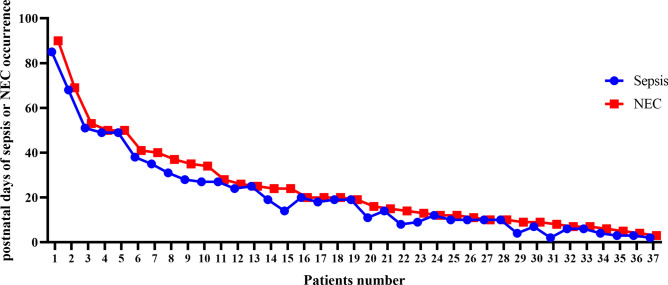
Few studies have focused on the risk factors for necrotizing enterocolitis (NEC) in small for gestational age (SGA) infants. The aim of this study was to identify the risk factors for NEC in SGA newborns. This study included consecutive SGA neonates admitted to a tertiary hospital in Jiangxi Province, China from Jan 2008 to Dec 2022. Patients with NEC (Bell's stage ≥ II) were assigned to the NEC group. Gestational age- and birth weight-matched non-NEC infants born during the same period at the same hospital were assigned to the control group. The risk factors associated with NEC were analyzed with univariate and logistic regression models. During the study period, 2,912 SGA infants were enrolled, 150 (5.15%) of whom developed NEC. In total, 143 patients and 143 controls were included in the NEC and control groups, respectively. Logistic regression analysis revealed that sepsis (OR 2.399, 95% CI 1.271-4.527, P = 0.007) and anemia (OR 2.214, 95% CI 1.166-4.204, P = 0.015) might increase the incidence of NEC in SGA infants and that prophylactic administration of probiotics (OR 0.492, 95% CI 0.303-0.799, P = 0.004) was a protective factor against NEC. Therefore, sepsis, anemia and a lack of probiotic use are independent risk factors for NEC in SGA infants.
本研究旨在探讨小于胎龄儿(SGA)发生坏死性小肠结肠炎(NEC)的危险因素。该研究纳入了 2008 年 1 月至 2022 年 12 月期间在中国江西省一家三级医院住院的连续 SGA 新生儿。将患有 NEC(Bell 分期≥Ⅱ期)的患儿归入 NEC 组,同期在同一家医院出生、胎龄和出生体重相匹配、未患 NEC 的患儿归入对照组。采用单因素和逻辑回归模型分析与 NEC 相关的危险因素。研究期间共纳入 2912 例 SGA 患儿,其中 150 例(5.15%)发生 NEC。共有 143 例 NEC 患儿和 143 例对照组患儿分别纳入 NEC 组和对照组。逻辑回归分析显示,败血症(OR 2.399,95%CI 1.271-4.527,P=0.007)和贫血(OR 2.214,95%CI 1.166-4.204,P=0.015)可能增加 SGA 患儿 NEC 的发生率,而预防性使用益生菌(OR 0.492,95%CI 0.303-0.799,P=0.004)是 NEC 的保护因素。因此,败血症、贫血和缺乏益生菌的使用是 SGA 患儿 NEC 的独立危险因素。