Walton Richard E, Moorhouse Heather L, Roberts Lucy R, Salgado Jorge, Ladd Cai Jt, Do Nga Thu, Panizzo Virginia N, Van Pham Dang Tri, Downes Nigel K, Trinh Duc Anh, McGowan Suzanne, Taylor Sarah, Henderson Andrew Cg
Newcastle University, UK.
Earthwatch Europe, UK.
Anthropocene Rev. 2024 Aug;11(2):442-462. doi: 10.1177/20530196231204334. Epub 2023 Oct 9.
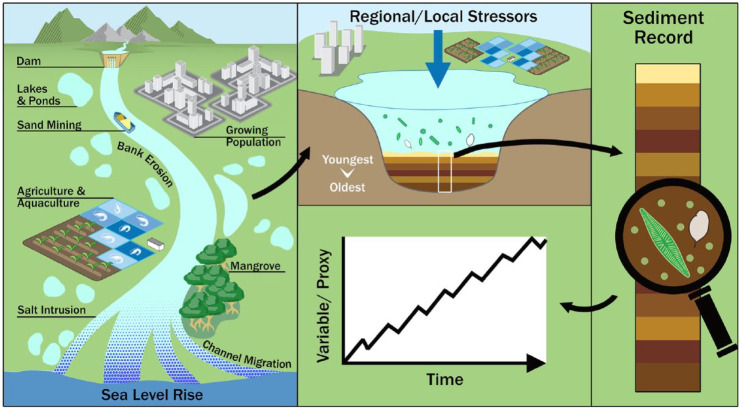
Tropical river deltas, and the social-ecological systems they sustain, are changing rapidly due to anthropogenic activity and climatic change. Baseline data to inform sustainable management options for resilient deltas is urgently needed and palaeolimnology (reconstructing past conditions from lake or wetland deposits) can provide crucial long-term perspectives needed to identify drivers and rates of change. We review how palaeolimnology can be a valuable tool for resource managers using three current issues facing tropical delta regions: hydrology and sediment supply, salinisation and nutrient pollution. The unique ability of palaeolimnological methods to untangle multiple stressors is also discussed. We demonstrate how palaeolimnology has been used to understand each of these issues, in other aquatic environments, to be incorporated into policy. Palaeolimnology is a key tool to understanding how anthropogenic influences interact with other environmental stressors, providing policymakers and resource managers with a 'big picture' view and possible holistic solutions that can be implemented.
由于人为活动和气候变化,热带河流三角洲及其所维持的社会生态系统正在迅速变化。迫切需要基线数据来为适应力强的三角洲的可持续管理方案提供信息,而古湖沼学(从湖泊或湿地沉积物重建过去的状况)可以提供确定变化驱动因素和变化速率所需的关键长期视角。我们利用热带三角洲地区目前面临的三个问题:水文和沉积物供应、盐碱化和营养物污染,来审视古湖沼学如何能成为资源管理者的宝贵工具。还讨论了古湖沼学方法解开多重压力源的独特能力。我们展示了古湖沼学如何被用于理解其他水生环境中的这些问题,并将其纳入政策。古湖沼学是理解人为影响如何与其他环境压力源相互作用的关键工具,为政策制定者和资源管理者提供一个“全景”视角以及可以实施的可能的整体解决方案。