Sezer Hasan Basri, Bohu Yoann, Hardy Alexandre, Coughlan Adam, Lefevre Nicolas
Chirurgie du Sport, Clinique du Sport Paris V, Paris, France.
Orthop J Sports Med. 2024 Aug 16;12(8):23259671241258505. doi: 10.1177/23259671241258505. eCollection 2024 Aug.
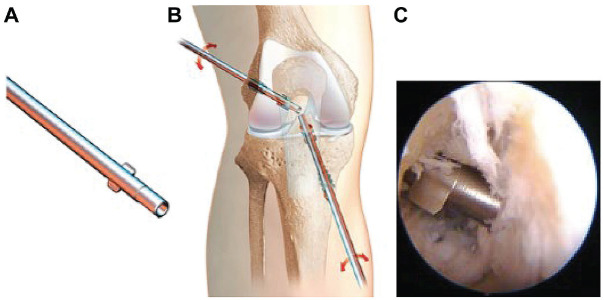
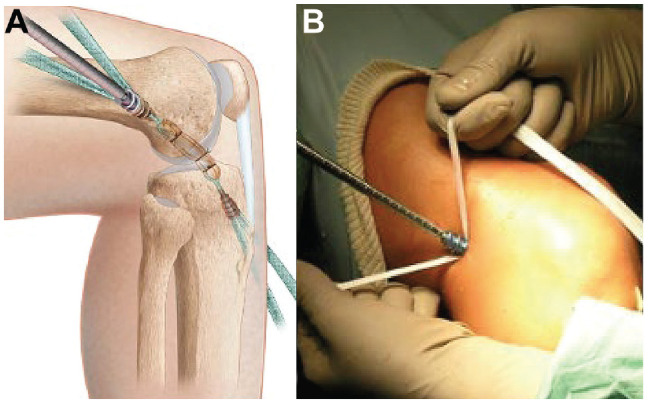
Screws for graft fixation are available in 3 different materials for anterior cruciate ligament reconstruction (ACLR) with the Tape Locking Screw (TLS) technique: titanium, poly-l-lactic acid bioabsorbable, and polyetheretherketone (PEEK).
To compare the effect of the 3 different fixation materials on graft and implant survival after ACLR with the TLS technique.
Cohort study; Level of evidence, 3.
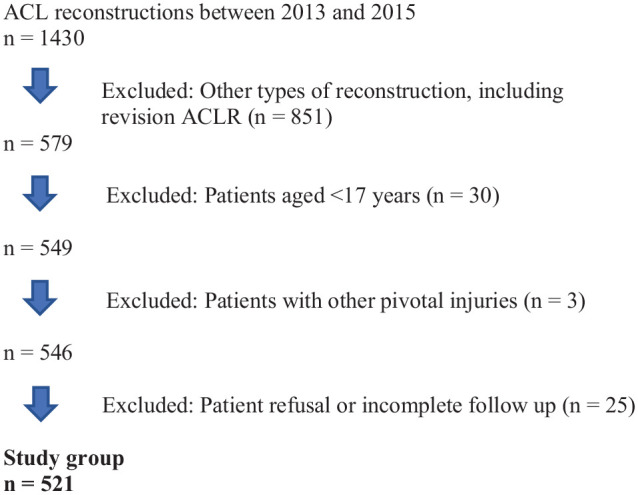
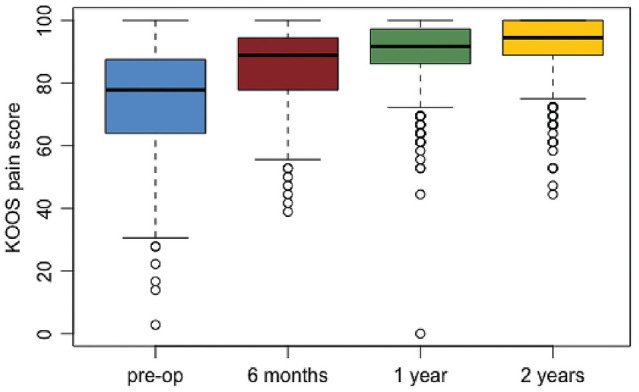
Included were 521 patients from the French Prospective ACL Study (FAST) cohort who underwent primary surgical ACLR with the TLS technique. Patients were divided into 3 groups depending on the type of screw material used: titanium (TLS-T group), poly-l-lactic acid bioabsorbable (TLS-B group), or PEEK (TLS-P group). The primary endpoint was a retear within 2 years after ACLR. The secondary endpoints were complication rate, return to sports rate, and functional scores. Objective and subjective functional scores-including the International Knee Documentation Committee, the Knee injury and Osteoarthritis Outcome Score (KOOS), and the Lysholm score-were evaluated preoperatively and at the 2-year follow-up. Pain was assessed with the KOOS-Pain subscore recorded pre- and postoperatively every 6 months up to 2 years. Patient satisfaction was recorded at the 2-year follow-up.
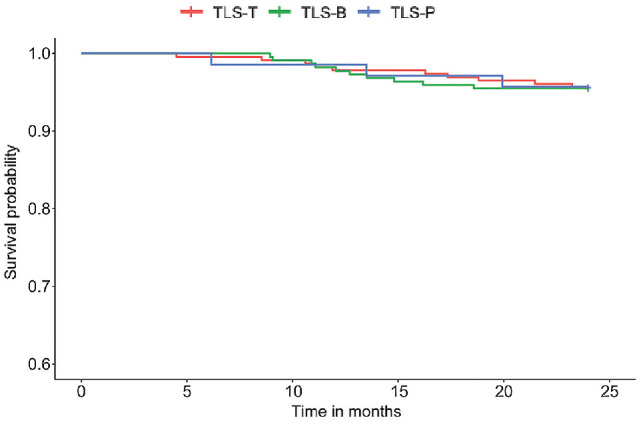
No significant differences between the study groups were found in retear rates (4.4%, 4.5%, and 4.3% in the TLS-T, TLS-P, and TLS-B groups 2 years after surgery) or subjective and objective outcomes. The TLS-T group had the lowest rate of intraoperative implant-related complications (0.9%) compared with the TLS-P (4.3%) and TLS-B (7.7%) groups. Young age was a significant risk factor for retear in the TLS-T ( = .03) and TLS-B ( = .0001) groups, while a high level of sports was found to be a significant risk factor in the TLS-P ( = .04) group. All functional scores improved significantly at the 2-year follow-up ( < .0001), with no significant group difference. The KOOS-Pain subscore improved continuously with no significant group difference. The rate of return to preinjury sports was between 43.4% and 58.6%. The rate of highly satisfied patients at the final follow-up was between 86.2% and 91.8%.
There was no difference in retear rate or objective and subjective functional scores between implant materials for TLS ACLR in this study.
在采用带锁钉技术(TLS)进行前交叉韧带重建(ACLR)时,用于移植物固定的螺钉有3种不同材料:钛合金、聚-L-乳酸生物可吸收材料和聚醚醚酮(PEEK)。
比较3种不同固定材料在采用TLS技术进行ACLR后对移植物和植入物存活率的影响。
队列研究;证据等级,3级。
纳入法国前瞻性前交叉韧带研究(FAST)队列中的521例接受初次手术TLS技术ACLR的患者。根据所用螺钉材料类型将患者分为3组:钛合金(TLS-T组)、聚-L-乳酸生物可吸收材料(TLS-B组)或PEEK(TLS-P组)。主要终点是ACLR后2年内的再撕裂。次要终点是并发症发生率、恢复运动率和功能评分。术前及2年随访时评估客观和主观功能评分,包括国际膝关节文献委员会评分、膝关节损伤和骨关节炎转归评分(KOOS)以及Lysholm评分。采用KOOS疼痛子评分评估疼痛,术前及术后每6个月记录一次,直至2年。在2年随访时记录患者满意度。
研究组之间在再撕裂率(术后2年TLS-T组、TLS-P组和TLS-B组分别为4.4%、4.5%和4.3%)或主观和客观结果方面未发现显著差异。与TLS-P组(4.3%)和TLS-B组(7.7%)相比,TLS-T组术中植入物相关并发症发生率最低(0.9%)。年轻是TLS-T组(P = 0.03)和TLS-B组(P = 0.0001)再撕裂的显著危险因素,而高水平运动是TLS-P组(P = 0.04)再撕裂的显著危险因素。所有功能评分在2年随访时均显著改善(P < 0.0001),组间无显著差异。KOOS疼痛子评分持续改善,组间无显著差异。恢复伤前运动的比例在43.4%至58.6%之间。最终随访时高度满意患者的比例在86.2%至91.8%之间。
本研究中,TLS ACLR的植入材料在再撕裂率或客观和主观功能评分方面无差异。