Peez Christian, Greßmann Marvin, Raschke Michael J, Glasbrenner Johannes, Briese Thorben, Frank Andre, Herbst Elmar, Kittl Christoph
Department of Trauma, Hand and Reconstructive Surgery, University Hospital Münster, Münster, Germany.
Orthop J Sports Med. 2023 Jan 6;11(1):23259671221143478. doi: 10.1177/23259671221143478. eCollection 2023 Jan.
The tibial fixation site is considered the weak link in anterior cruciate ligament (ACL) reconstruction, and conflicting results regarding the biomechanical properties of various fixation methods have been reported.
To examine knots tied over a bone bridge and its biomechanical properties as a suitable tibial fixation method in ACL reconstruction.
Controlled laboratory study.
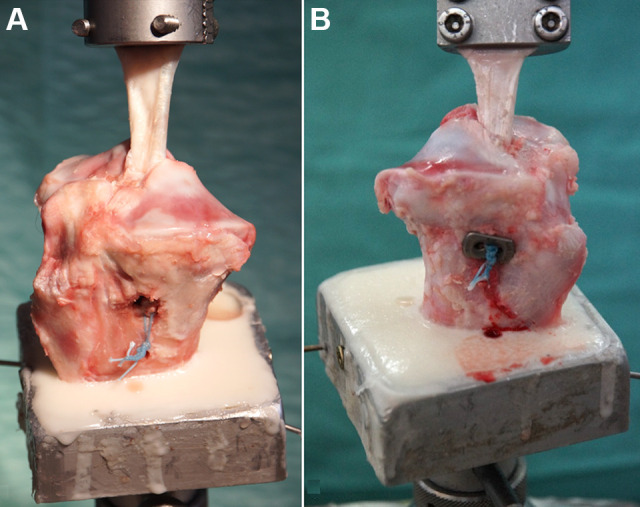
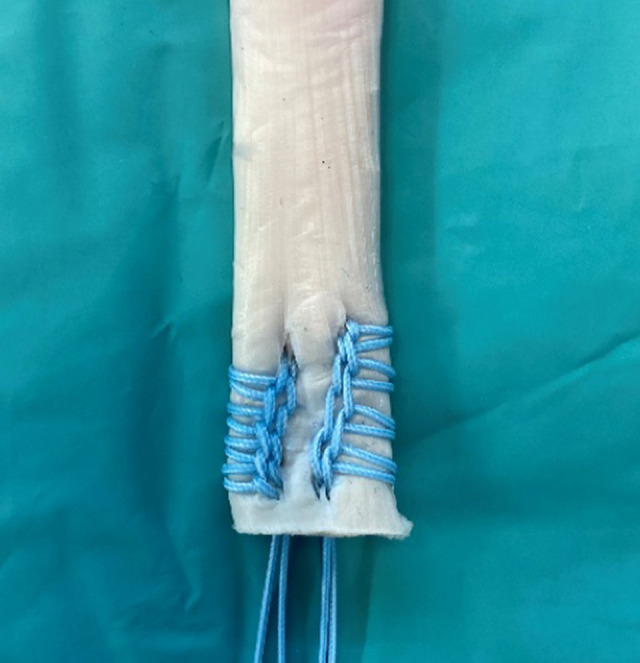
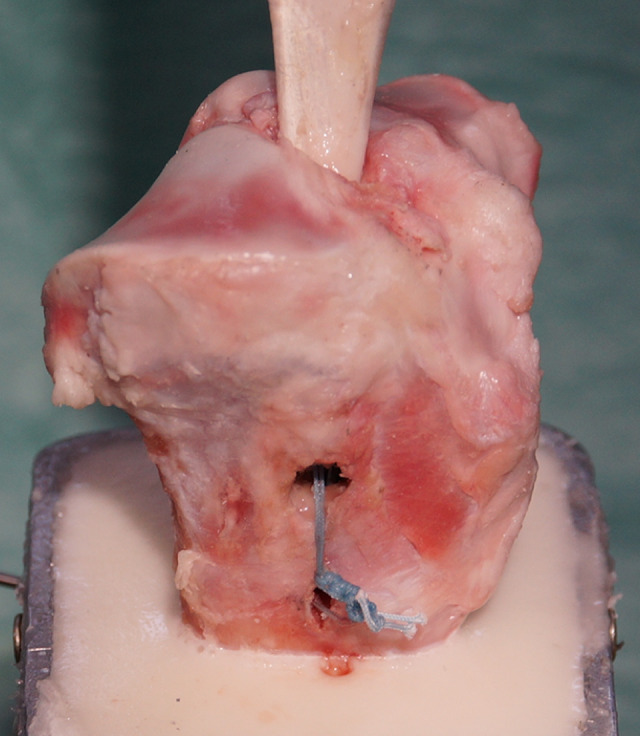
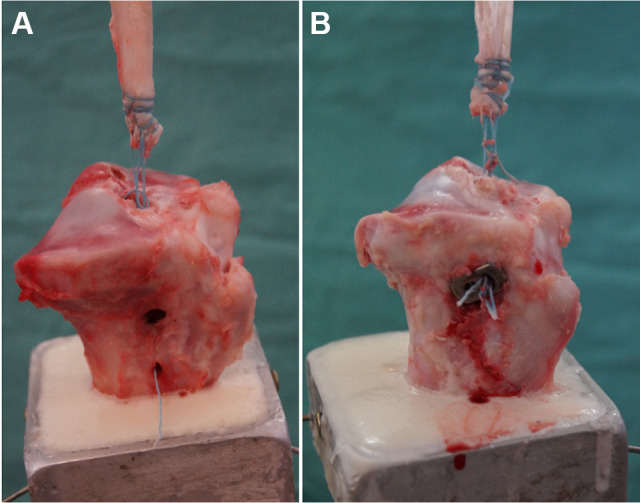
We divided 40 fresh-frozen porcine tibiae into 4 equal groups to evaluate flexor tendon grafts set with standard tibial fixation techniques: (1) bone bridge (BB group), (2) suspension button (SB group), (3) combined interference screw and bone bridge (IFS/BB group), and (4) combined interference screw and suspension button (IFS/SB group). Each construct was subjected to cyclic loading (1500 cycles, 50-250 N, 1 Hz) with a servohydraulic materials testing machine to measure elongation; load-to-failure testing (displacement rate: 25 mm/s) was then performed. Load to failure, stiffness, and yield load were compared between constructs using 1-way analysis of variance.
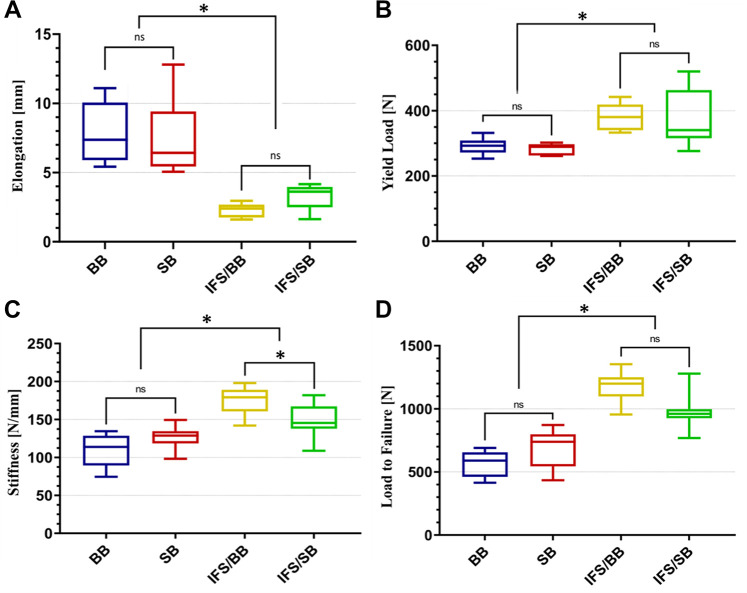
The hybrid fixation constructs (IFS/BB and IFS/SB groups) showed significantly better biomechanical properties than the isolated extracortical fixation constructs (BB and SB groups) ( < .05 for all). There were no differences between the isolated extracortical fixation constructs or between the hybrid fixation constructs in elongation or load to failure; however, stiffness of the IFS/BB group was significantly higher than that of the IFS/SB group (175.3 ± 16.6 vs 144.9 ± 20.1 N/mm, respectively; < .05). Stiffness between the SB and BB groups was not significantly different.
Hybrid fixation had superior biomechanical performance compared with isolated extracortical fixation. However, tibial graft fixation using a bone bridge either as isolated extracortical fixation or combined with an interference screw for hybrid fixation showed equivalent biomechanical properties compared with suspension button-based graft fixation.
The clinical use of a bone bridge for tibial graft fixation could reduce the cost for ACL reconstruction and lower the rate of implant-associated issues.
胫骨固定部位被认为是前交叉韧带(ACL)重建中的薄弱环节,关于各种固定方法生物力学特性的研究结果存在争议。
研究在骨桥上打结及其生物力学特性,作为ACL重建中一种合适的胫骨固定方法。
对照实验室研究。
我们将40根新鲜冷冻的猪胫骨平均分为4组,以评估采用标准胫骨固定技术的屈肌腱移植物:(1)骨桥组(BB组),(2)悬吊纽扣组(SB组),(3)干涉螺钉与骨桥联合组(IFS/BB组),(4)干涉螺钉与悬吊纽扣联合组(IFS/SB组)。使用伺服液压材料试验机对每个构建体进行循环加载(1500次循环,50 - 250 N,1 Hz)以测量伸长量;然后进行破坏载荷测试(位移速率:25 mm/s)。使用单因素方差分析比较各构建体之间的破坏载荷、刚度和屈服载荷。
混合固定构建体(IFS/BB组和IFS/SB组)的生物力学特性明显优于单纯皮质外固定构建体(BB组和SB组)(所有比较P <.05)。单纯皮质外固定构建体之间或混合固定构建体之间在伸长量或破坏载荷方面无差异;然而,IFS/BB组的刚度明显高于IFS/SB组(分别为175.3±16.6与144.9±20.1 N/mm;P <.05)。SB组和BB组之间的刚度无显著差异。
与单纯皮质外固定相比,混合固定具有更好的生物力学性能。然而,单独使用骨桥进行皮质外固定或与干涉螺钉联合用于混合固定时,与基于悬吊纽扣的移植物固定相比,胫骨移植物固定显示出相当的生物力学特性。
骨桥用于胫骨移植物固定的临床应用可降低ACL重建的成本并降低植入物相关问题的发生率。