Department of Experimental and Clinical Medicine, Magna Græcia University, Catanzaro, Italy.
Computational Biology Research Centre, Human Technopole, Milan, Italy.
Blood. 2024 Oct 17;144(16):1705-1721. doi: 10.1182/blood.2023021991.
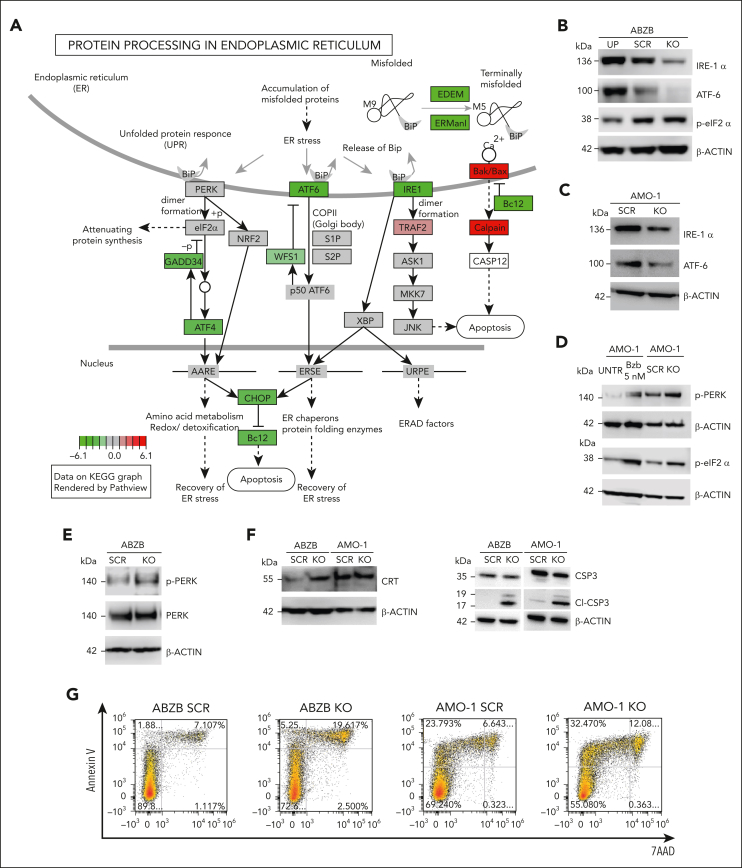
Multiple myeloma (MM) is an incurable malignancy characterized by altered expression of coding and noncoding genes promoting tumor growth and drug resistance. Although the crucial role of long noncoding RNAs (lncRNAs) in MM is clearly established, the function of the noncoding RNAome, which might allow the design of novel therapeutics, is largely unknown. We performed an unbiased CRISPR-Cas9 loss-of-function screen of 671 lncRNAs in MM cells and their bortezomib (BZB)-resistant derivative. To rank functionally and clinically relevant candidates, we designed and used a bioinformatic prioritization pipeline combining functional data from cellular screens with prognostic and transcriptional data from patients with MM. With this approach, we unveiled and prioritized 8 onco-lncRNAs essential for MM cell fitness, associated with high expression and poor prognosis in patients with MM. The previously uncharacterized RP11-350G8.5 emerged as the most promising target, irrespective of BZB resistance. We (1) demonstrated the anti-tumoral effect obtained by RP11-350G8.5 inhibition in vitro and in vivo; (2) highlighted a modulation of the unfolded protein response and the induction of immunogenic cell death triggered by the RP11-350G8.5 knockout, via RNA sequencing and molecular studies; (3) characterized its cytoplasmic homing through RNA fluorescence in situ hybridization; and (4) predicted its 2-dimensional structure and identified 2 G-quadruplex and 3 hairpin-forming regions by biophysical assays, including thioflavin T, 1H nuclear magnetic resonance, and circular dichroism, to pave the way to the development of novel targeted therapeutics. Overall, we provided innovative insights about unexplored lncRNAs in MM and identified RP11-350G8.5 as an oncogenic target for treatment-naïve and BZB-resistant patients with MM.
多发性骨髓瘤(MM)是一种不可治愈的恶性肿瘤,其特征是编码和非编码基因的表达改变,促进肿瘤生长和耐药性。尽管长非编码 RNA(lncRNA)在 MM 中的关键作用已得到明确证实,但非编码 RNA 组的功能(可能为设计新型治疗方法提供依据)在很大程度上仍是未知的。我们在 MM 细胞及其硼替佐米(BZB)耐药衍生物中进行了无偏 CRISPR-Cas9 敲低功能筛选,以鉴定 671 个 lncRNA。为了对具有功能和临床相关性的候选 lncRNA 进行排名,我们设计并使用了一种生物信息学优先级排序策略,将细胞筛选的功能数据与 MM 患者的预后和转录数据相结合。通过这种方法,我们发现并确定了 8 个对 MM 细胞活力至关重要的致癌 lncRNA,这些 lncRNA在 MM 患者中表达水平较高且预后不良。以前未被表征的 RP11-350G8.5 成为最有前途的靶点,与 BZB 耐药性无关。我们:(1)证明了抑制 RP11-350G8.5 在体外和体内的抗肿瘤作用;(2)通过 RNA 测序和分子研究,突出了未折叠蛋白反应的调节和免疫原性细胞死亡的诱导;(3)通过 RNA 荧光原位杂交证实了其细胞质归巢;(4)预测了其 2 维结构,并通过生物物理测定法鉴定了 2 个 G-四联体和 3 个发夹形成区域,包括硫代黄素 T、1H 核磁共振和圆二色性,为开发新型靶向治疗方法铺平了道路。总之,我们为 MM 中未被探索的 lncRNA 提供了创新性的见解,并将 RP11-350G8.5 确定为治疗初治和 BZB 耐药 MM 患者的致癌靶点。