Center for Clinical & Translational Research, Seattle Children's Research Institute, Seattle, Washington.
Department of Psychosocial Oncology & Palliative Care, Dana-Farber Cancer Institute, Boston, Massachusetts.
JAMA Netw Open. 2024 Aug 1;7(8):e2428287. doi: 10.1001/jamanetworkopen.2024.28287.
Type 1 diabetes (T1D) requires demanding self-management health behaviors, and adolescents with T1D are at risk for poor psychosocial and medical outcomes. Developing resilience skills may help adolescents with T1D and elevated distress navigate common stressors and achieve positive outcomes.
To test the efficacy of the Promoting Resilience in Stress Management (PRISM) intervention on levels of hemoglobin A1c (HbA1c), diabetes distress, self-management behaviors, resilience, and quality of life among adolescents.
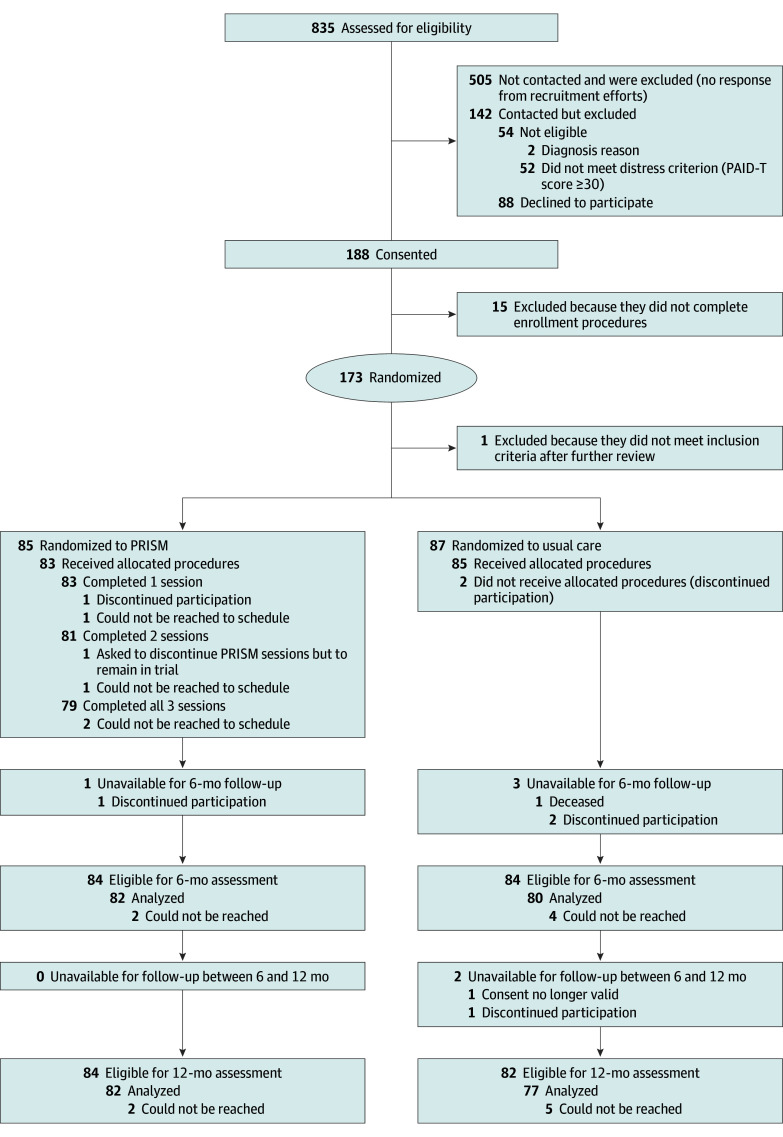
DESIGN, SETTING, AND PARTICIPANTS: This phase 3, parallel, 1:1 randomized clinical trial that followed up 172 participants for 12 months was conducted from January 1, 2020, to November 30, 2022, at each of 2 children's hospitals, in Seattle, Washington, and Houston, Texas. Participants were ages 13 to 18 years with T1D for at least 12 months and elevated diabetes distress.
PRISM, a manualized, skills-based, individual intervention program that teaches stress management, goal setting, reframing, and meaning-making, facilitated by a coach and accompanied by a digital app, was delivered in three 30- to 60-minute sessions approximately 2 weeks apart.
The 2 primary outcomes, diabetes distress and HbA1c levels, and 3 secondary outcomes, resilience, quality of life, and engagement in self-management behaviors, were assessed at baseline and 6 and 12 months after baseline. Linear mixed-effects regression models were used to evaluate associations between PRISM or usual care (UC) and these outcomes at both time points for the intention-to-treat population.
Among 172 adolescents (mean [SD] age, 15.7 [1.6] years), 96 were female (56%), and their baseline mean (SD) HbA1c level was 8.7% (2.0%). No differences were evident between PRISM and UC recipients in HbA1c levels (β, -0.21 [95% CI, -0.65 to 0.22]; P = .33) or diabetes distress (β, -2.71 [95% CI, -6.31 to 0.90]; P = .14) or any participant-reported outcome (eg, β, 2.25 [95% CI, -0.30 to 4.80]; P = .08 for self-management behaviors) at 6 months. At 12 months, there was no statistically significant difference between arms in HbA1c levels (β, -0.26 [95% CI, -0.72 to 0.19]; P = .25); however, PRISM recipients reported significantly greater amelioration of diabetes distress (β, -4.59 [95% CI, -8.25 to -0.94]; P = .01) and improvement in self-management behaviors (β, 3.4 [95% CI, 0.9 to 5.9]; P = .01) compared with UC recipients.
The findings in this randomized clinical trial of psychosocial and behavioral improvements associated with PRISM at 12 months illustrate the value of a strengths-based intervention. Integrating resilience skills-building with traditional diabetes care may be a promising approach for improving outcomes among adolescents with T1D and elevated diabetes distress.
ClinicalTrials.gov number: NCT03847194.
1 型糖尿病(T1D)需要严格的自我管理健康行为,而 T1D 青少年面临着较差的心理社会和医疗结果的风险。培养适应力技能可能有助于 T1D 和焦虑水平升高的青少年应对常见压力源并取得积极成果。
测试促进应激管理中的适应力(PRISM)干预对血红蛋白 A1c(HbA1c)水平、糖尿病困扰、自我管理行为、适应力和生活质量的影响,该研究纳入了 172 名参与者,随访时间为 12 个月。
设计、设置和参与者:这是一项 3 期、平行、1:1 随机临床试验,于 2020 年 1 月 1 日至 2022 年 11 月 30 日在西雅图华盛顿和休斯顿德克萨斯的 2 家儿童医院进行,共纳入了 172 名参与者,年龄在 13 至 18 岁之间,患有 T1D 至少 12 个月且有较高的糖尿病困扰。
PRISM 是一种基于手册的、技能为基础的个体化干预方案,由教练教授应激管理、目标设定、重新框架和寻找意义,并附有数字应用程序,共进行 3 次 30 至 60 分钟的课程,间隔约 2 周。
2 项主要结果(糖尿病困扰和 HbA1c 水平)和 3 项次要结果(适应力、生活质量和自我管理行为的参与度)在基线和基线后 6 个月和 12 个月进行评估。线性混合效应回归模型用于评估 PRISM 或常规护理(UC)与这些结果之间的关联,意向治疗人群的这两个时间点均进行了评估。
在 172 名青少年(平均[标准差]年龄为 15.7[1.6]岁)中,96 名(56%)为女性,他们的基线平均(标准差)HbA1c 水平为 8.7%(2.0%)。PRISM 和 UC 组在 HbA1c 水平(β,-0.21 [95%CI,-0.65 至 0.22];P=0.33)或糖尿病困扰(β,-2.71 [95%CI,-6.31 至 0.90];P=0.14)或任何参与者报告的结果(例如,β,2.25 [95%CI,-0.30 至 4.80];P=0.08 用于自我管理行为)在 6 个月时均无显著差异。在 12 个月时,两组之间在 HbA1c 水平上没有统计学上的显著差异(β,-0.26 [95%CI,-0.72 至 0.19];P=0.25);然而,与 UC 组相比,PRISM 组报告的糖尿病困扰(β,-4.59 [95%CI,-8.25 至 -0.94];P=0.01)和自我管理行为(β,3.4 [95%CI,0.9 至 5.9];P=0.01)的改善更为显著。
这项关于 PRISM 在 12 个月时与心理社会和行为改善相关的随机临床试验结果表明,基于优势的干预措施具有价值。将适应力技能培养与传统的糖尿病护理相结合,可能是改善 T1D 和焦虑水平升高的青少年的一种有前途的方法。
ClinicalTrials.gov 编号:NCT03847194。