Reproductive Medicine Center, Henan Provincial People's Hospital, People's Hospital of Zhengzhou University, Zhengzhou, China.
Sci Rep. 2024 Aug 19;14(1):19216. doi: 10.1038/s41598-024-70249-1.
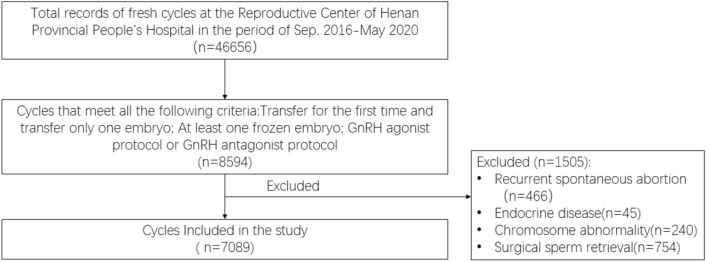
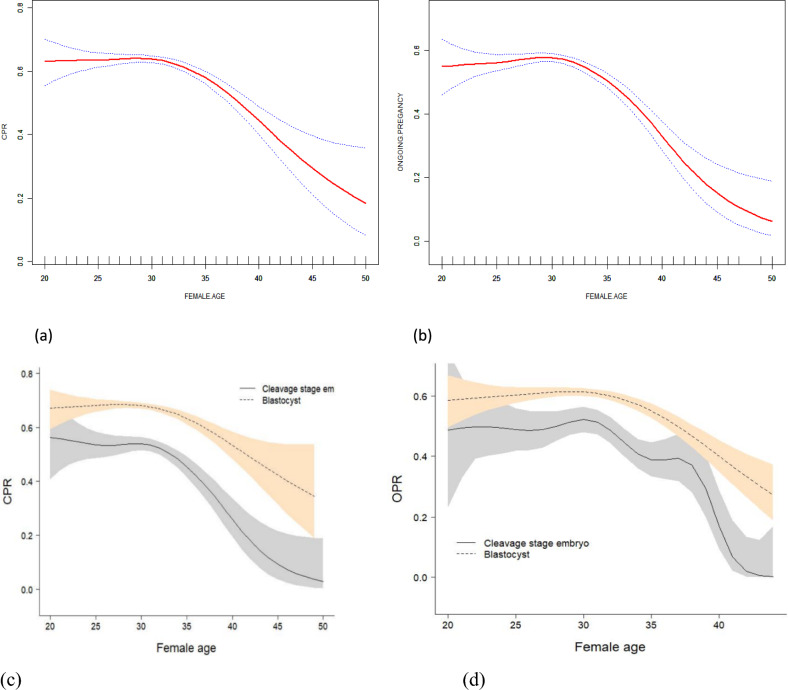
This study aimed to explore the relationship between female age and pregnancy outcomes in patients undergoing their first elective single embryo transfer (eSET) of in vitro fertilization (IVF) cycles. The retrospective cohort study encompassed 7089 IVF/intracytoplasmic sperm injection (ICSI) patients of the Reproductive Medicine Center, Henan Provincial Peoples' Hospital of China, from September 1, 2016, to May 31, 2022. Patients all received the first eSET in their IVF/ICSI cycles. A generalized additive model (GAM) was employed to examine the the dose-response correlation between age and pregnancy outcomes, namely the clinical pregnancy rate (CPR) and ongoing pregnancy rate (OPR). Logistic regression model was employed to ascertain the correlation between the CPR/OPR and age. The study cohort has an average age of 30.74; 3843 patients got clinical pregnancy rate of 61.40% and ongoing pregnancy rate of 54.21%. The multiple pregnancy rate of is 1.24%. For patients aged 34 and above, the CPR decreased by 10% for every 1-year increase in age (adjusted OR 0.90, 95% CI 0.84-0.96, p < 0.0001). Similarly, the OPR decreased by 16% for every 1-year increase in age (adjusted OR 0.84, 95% CI 0.81-0.88, p < 0.0001). Patients aged 35-37 years had an acceptable OPR of 52.4% after eSET, with a low multiple pregnancy rate (1.1%). Pregnancy outcomes were significantly better in blastocyst cycles compared to cleavage embryo cycles, and this trend was more pronounced in older patients. There was a non-linear relationship between female age and pregnancy outcomes in patients undergoing their first eSET cycles. The clinical pregnancy rate and ongoing pregnancy rate decreased significantly with age, especially in women older than 34 years. For patients under 37 years old, single embryo transfer should be prioritized. For patients over 38 years old with available blastocysts, eSET is also recommended.
本研究旨在探讨行体外受精(IVF)/卵胞浆内单精子注射(ICSI)周期首次选择性单胚胎移植(eSET)的患者中,女性年龄与妊娠结局的关系。该回顾性队列研究纳入了 2016 年 9 月 1 日至 2022 年 5 月 31 日期间中国河南省人民医院生殖医学中心的 7089 例 IVF/ICSI 患者。所有患者均在 IVF/ICSI 周期中接受首次 eSET。采用广义加性模型(GAM)分析年龄与妊娠结局(临床妊娠率[CPR]和持续妊娠率[OPR])之间的剂量-反应关系。采用 logistic 回归模型确定 CPR/OPR 与年龄之间的相关性。研究队列的平均年龄为 30.74 岁,3843 例患者获得 61.40%的临床妊娠率和 54.21%的持续妊娠率,多胎妊娠率为 1.24%。对于 34 岁及以上的患者,年龄每增加 1 岁,CPR 降低 10%(调整后的 OR 0.90,95%CI 0.84-0.96,p<0.0001)。同样,年龄每增加 1 岁,OPR 降低 16%(调整后的 OR 0.84,95%CI 0.81-0.88,p<0.0001)。35-37 岁的患者 eSET 后可获得可接受的 OPR 为 52.4%,且多胎妊娠率较低(1.1%)。与卵裂期胚胎周期相比,囊胚周期的妊娠结局显著更好,且这一趋势在年龄较大的患者中更为明显。女性年龄与首次 eSET 周期患者的妊娠结局呈非线性关系。随着年龄的增长,临床妊娠率和持续妊娠率显著下降,尤其是 34 岁以上的女性。对于 37 岁以下的患者,应优先进行单胚胎移植。对于有可用囊胚且年龄超过 38 岁的患者,也推荐进行 eSET。