Center for Reproductive Medicine and Obstetrics and Gynecology, Drum Tower Clinic Medical College of Nanjing Medical University, Nanjing, 210008, China.
BMC Pregnancy Childbirth. 2024 Mar 14;24(1):199. doi: 10.1186/s12884-024-06398-y.
The objective of this research was to elucidate the association between the length of infertility and the outcomes of intrauterine insemination (IUI) in women of varying ages - a topic that has been the subject of investigation for numerous years, yet lacks a definitive consensus.
A retrospective cohort investigation involving 5268 IUI cycles was undertaken at the Reproductive Medicine Center of Nanjing Drum Tower Hospital from 2016 to 2022. Utilizing the smooth fitting curve along with threshold and saturation effect analysis, the correlation between infertility duration and IUI clinical pregnancy rates was discerned. Moreover, patients were bifurcated into two cohorts based on their respective infertility durations. A secondary examination was also performed employing propensity-score matching to mitigate the impact of confounding variables. Subsequent threshold and saturation effect analysis was carried out across various subgroups, segmented on the basis of age differentiation.
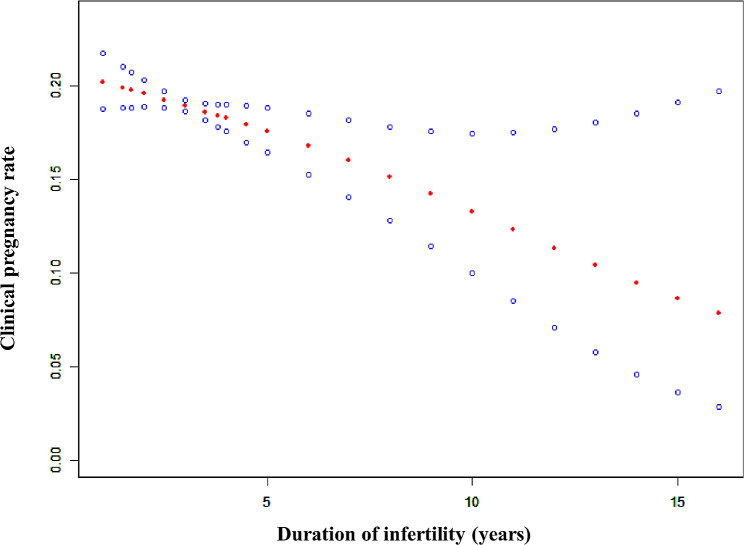
When the duration of infertility was more than 5 years, the clinical pregnancy rate decreased with the increase of infertility duration (aOR: 0.894, 95%CI: 0.817-0.991, p = 0.043). The multivariate regression analysis suggested that longer duration of infertility (≥ 5 years) was significantly correlated with the lower clinical pregnancy rate (aOR: 0.782, 95% CI: 0.643-0.950, p = 0.01). After the propensity-score matching, the clinical pregnancy rate of women with longer infertility duration were also higher. When the duration of infertility was more than 5 years, the clinical pregnancy rate of women younger than 35 years old decreased with the increase of infertility duration (aOR: 0.906, 95%CI: 0.800-0.998, p = 0.043).
The clinical pregnancy rate and live birth rate of IUI in young women (< 35 years old) who have been infertile for more than 5 years significantly decrease with the prolongation of infertility time. Therefore, for young women who have been infertile for more than 5 years, IUI may not be the best choice.
本研究旨在阐明不孕时间长短与不同年龄段女性宫腔内人工授精(IUI)结局之间的关系,这是一个多年来备受关注但尚无定论的话题。
对 2016 年至 2022 年期间在南京鼓楼医院生殖医学中心接受 5268 个 IUI 周期的患者进行回顾性队列研究。采用平滑拟合曲线、阈值和饱和效应分析,研究不孕时间与 IUI 临床妊娠率之间的相关性。此外,根据不孕时间将患者分为两组。还采用倾向评分匹配进行二次检查,以减轻混杂因素的影响。然后,根据年龄分层对各亚组进行阈值和饱和效应分析。
当不孕时间超过 5 年时,临床妊娠率随不孕时间的增加而降低(OR:0.894,95%CI:0.817-0.991,p=0.043)。多变量回归分析表明,不孕时间较长(≥5 年)与临床妊娠率较低显著相关(OR:0.782,95%CI:0.643-0.950,p=0.01)。在进行倾向评分匹配后,不孕时间较长的女性的临床妊娠率也较高。当不孕时间超过 5 年时,35 岁以下年轻女性的临床妊娠率随不孕时间的增加而降低(OR:0.906,95%CI:0.800-0.998,p=0.043)。
对于不孕时间超过 5 年的年轻女性(<35 岁),IUI 的临床妊娠率和活产率随不孕时间的延长显著下降。因此,对于不孕时间超过 5 年的年轻女性,IUI 可能不是最佳选择。