Center to Improve Veteran Involvement in Care (CIVIC), VA Portland Health Care System, 3710 SW US Veterans Hospital Rd., Portland, OR, 97239, USA.
Oregon Health & Science University - Portland State University School of Public Health, Portland, OR, USA.
BMC Health Serv Res. 2024 Aug 19;24(1):943. doi: 10.1186/s12913-024-11421-1.
Research suggests an association between COVID-19 infection and certain financial hardships in the shorter term and among single-state and privately insured samples. Whether COVID-19 is associated with financial hardship in the longer-term or among socially vulnerable populations is unknown. Therefore, we examined whether COVID-19 was associated with a range of financial hardships 18 months after initial infection among a national cohort of Veterans enrolled in the Veterans Health Administration (VHA)-the largest national integrated health system in the US. We additionally explored the association between Veteran characteristics and financial hardship during the pandemic, irrespective of COVID-19.
We conducted a prospective, telephone-based survey. Out of 600 Veterans with COVID-19 from October 2020 through April 2021 who were invited to participate, 194 Veterans with COVID-19 and 194 matched comparators without a history of infection participated. Financial hardship outcomes included overall health-related financial strain, two behavioral financial hardships (e.g., taking less medication than prescribed due to cost), and seven material financial hardships (e.g., using up most or all savings). Weighted generalized estimating equations were used to estimate risk ratios (RR) and 95% confidence intervals (CI) of financial hardship by COVID-19 status, and to assess the relationship between infection and Veteran age, VHA copay status, and comorbidity score, irrespective of COVID-19 status.
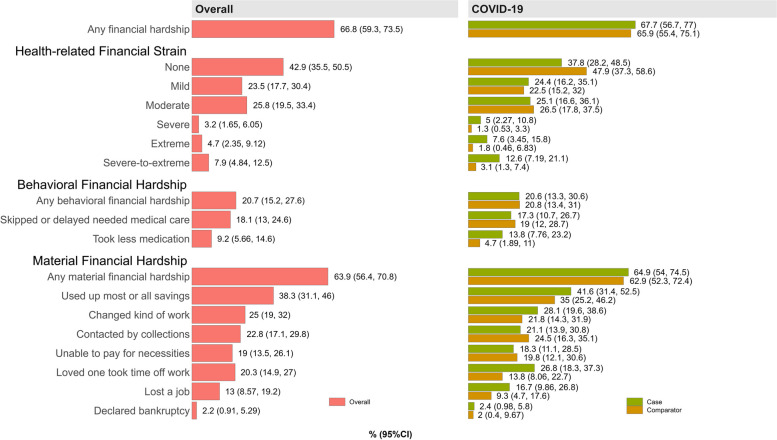
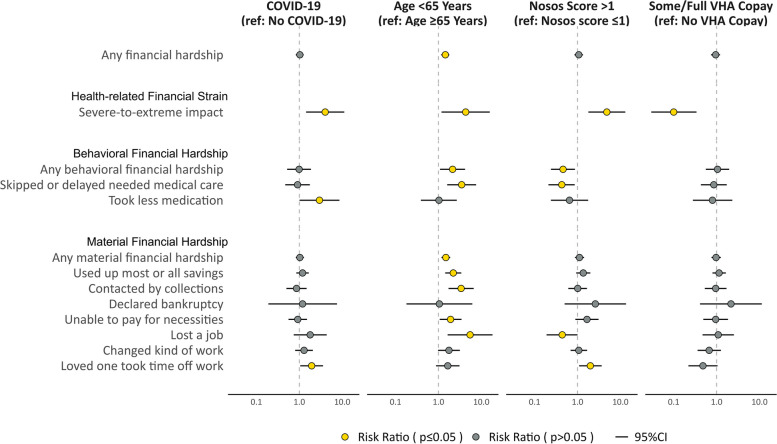
Among 388 respondents, 67% reported at least one type of financial hardship since March 2020, with 21% reporting behavioral hardships and 64% material hardships; 8% reported severe-to-extreme health-related financial strain. Compared with uninfected matched comparators, Veterans with a history of COVID-19 had greater risks of severe-to-extreme health-related financial strain (RR: 4.0, CI: 1.4-11.2), taking less medication due to cost (RR: 2.9, 95% CI: 1.0-8.6), and having a loved one take time off work to care for them (RR: 1.9, CI: 1.1-3.6). Irrespective of COVID-19 status, Veterans aged < 65 years had a greater risk of most financial hardships compared with Veterans aged ≥ 65 years.
Health-related financial hardships such as taking less medication due to cost and severe-to-extreme health-related financial strain were more common among Veterans with a history of COVID-19 than among matched comparators. Strategies are needed to address health-related financial hardship after COVID-19.
NCT05394025, registered 05-27-2022.
研究表明,COVID-19 感染与短期的某些经济困难以及单一州和私人保险样本之间存在关联。COVID-19 是否与长期或社会弱势群体的经济困难有关尚不清楚。因此,我们研究了在退伍军人健康管理局(VHA)的全国退伍军人队列中,COVID-19 感染后 18 个月内 COVID-19 是否与一系列经济困难有关,VHA 是美国最大的国家综合卫生系统。我们还探讨了在大流行期间,无论 COVID-19 状况如何,退伍军人特征与经济困难之间的关联。
我们进行了一项前瞻性的电话调查。从 2020 年 10 月至 2021 年 4 月期间,邀请了 600 名 COVID-19 退伍军人参加,其中 194 名 COVID-19 退伍军人和 194 名未感染的匹配对照者参加了调查。经济困难的结果包括与健康相关的整体经济压力、两种行为经济困难(例如,由于费用而减少规定的药物用量)和七种物质经济困难(例如,用尽大部分或全部储蓄)。使用加权广义估计方程来估计 COVID-19 状态下经济困难的风险比(RR)和 95%置信区间(CI),并评估感染与退伍军人年龄、VHA 共付额状况和合并症评分之间的关系,无论 COVID-19 状况如何。
在 388 名受访者中,67%的人自 2020 年 3 月以来报告了至少一种经济困难,其中 21%报告了行为困难,64%报告了物质困难;8%的人报告了严重到极端的与健康相关的经济压力。与未感染的匹配对照者相比,患有 COVID-19 的退伍军人发生严重到极端的与健康相关的经济压力的风险更高(RR:4.0,95%CI:1.4-11.2),由于费用而减少药物用量的风险更高(RR:2.9,95%CI:1.0-8.6),以及有亲人请假照顾他们的风险更高(RR:1.9,CI:1.1-3.6)。无论 COVID-19 状况如何,与≥65 岁的退伍军人相比,<65 岁的退伍军人发生大多数经济困难的风险更高。
与未感染的匹配对照者相比,患有 COVID-19 的退伍军人更常见的是因药物费用而减少药物用量和严重到极端的与健康相关的经济压力等与健康相关的经济困难。需要制定策略来解决 COVID-19 后的与健康相关的经济困难。
NCT05394025,2022 年 5 月 27 日注册。