Kishi Noriko, Matsuo Yukinori
Department of Radiation Oncology and Image-Applied Therapy, Graduate School of Medicine, Kyoto University, Kyoto, Japan.
Department of Radiation Oncology, Kindai University Faculty of Medicine, Osaka, Japan.
Mediastinum. 2024 Jan 10;8:40. doi: 10.21037/med-23-38. eCollection 2024.
Thymic epithelial tumors (TETs), including thymomas and thymic carcinomas, are rare mediastinal tumors. Surgical resection is the treatment strategy for resectable TETs, and postoperative radiotherapy (PORT) is administered to improve local control in patients with a high risk of recurrence. The rarity of TETs has led to a lack of randomized controlled trials, and the current indications for PORT rely largely on retrospective studies. This review analyzes the literature on TETs, highlighting PORT, to guide current research and future investigations.
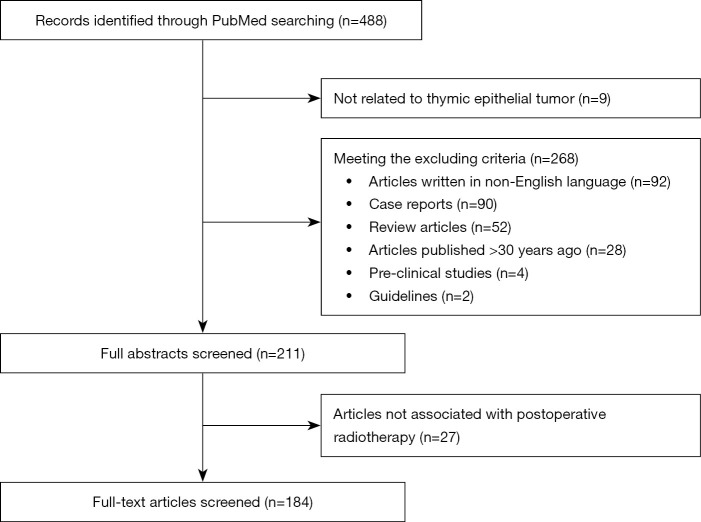
Studies that focused on TETs, addressed topics on PORT, and had English abstracts accessible online were eligible for inclusion in our review. We excluded case reports or review articles, articles written in languages other than English, articles published >30 years ago, and articles concerning thymic neuroendocrine tumors.
Masaoka or Masaoka-Koga staging, World Health Organization (WHO) histological subtype, and resection status indicate PORT in resected TETs. Current literature suggests that PORT does not improve overall survival in stage I-IIA TETs, with inconsistent results for stage IIB-III TETs. Patients with a higher risk, such as carcinomas or WHO type B, might benefit from PORT if they do not develop distant metastasis. Determining which patients will benefit most from PORT requires further investigation. For recurrent TETs, the significance of applying PORT is unclear because available data are limited. Given the long-term survival of TETs, late toxicities, including radiation pneumonitis, radiation-induced cardiotoxicities, and secondary malignancies, must be addressed. Proton beam radiotherapy might reduce toxicities by sparing organs at risk compared to conventional photon beam radiotherapy. The use of high-precision radiation therapy, along with emerging immunotherapy, targeted therapy, and minimally invasive surgery, could improve TET outcomes.
This review consolidates the literature on PORT for TETs, factoring in the Masaoka-Koga staging, WHO histological subtypes, and resection status. Varying results regarding PORT efficacy have led to an undefined strategy for stage IIB-III TETs. Although advanced radiotherapy techniques promise to reduce radiation-induced toxicities, further research is needed to investigate the efficacy of PORT and combination therapy.
胸腺上皮肿瘤(TETs),包括胸腺瘤和胸腺癌,是罕见的纵隔肿瘤。手术切除是可切除TETs的治疗策略,术后放疗(PORT)用于改善复发风险高的患者的局部控制。TETs的罕见性导致缺乏随机对照试验,目前PORT的适应证很大程度上依赖于回顾性研究。本综述分析了关于TETs的文献,重点关注PORT,以指导当前研究和未来调查。
专注于TETs、涉及PORT主题且有在线英文摘要的研究符合纳入本综述的条件。我们排除了病例报告或综述文章、非英文撰写的文章、30多年前发表的文章以及关于胸腺神经内分泌肿瘤的文章。
Masaoka或Masaoka-Koga分期、世界卫生组织(WHO)组织学亚型和切除状态提示在切除的TETs中进行PORT。当前文献表明,PORT不能改善I-IIA期TETs的总生存期,IIB-III期TETs的结果不一致。风险较高的患者,如癌或WHO B型患者,如果未发生远处转移,可能从PORT中获益。确定哪些患者将从PORT中获益最大需要进一步研究。对于复发性TETs,应用PORT的意义尚不清楚,因为现有数据有限。鉴于TETs的长期生存,必须解决晚期毒性,包括放射性肺炎、放射性心脏毒性和继发性恶性肿瘤。与传统光子束放疗相比,质子束放疗可能通过 sparing organs at risk 减少毒性。高精度放疗与新兴的免疫疗法、靶向疗法和微创手术的联合应用可能改善TETs的治疗结果。
本综述整合了关于TETs的PORT的文献,考虑了Masaoka-Koga分期、WHO组织学亚型和切除状态。关于PORT疗效的不同结果导致IIB-III期TETs的策略不明确。尽管先进的放疗技术有望降低放射性毒性,但仍需要进一步研究来调查PORT和联合治疗的疗效。