Texier Blanche, Hémon Cédric, Queffélec Adélie, Dowling Jason, Bessieres Igor, Greer Peter, Acosta Oscar, Boue-Rafle Adrien, de Crevoisier Renaud, Lafond Caroline, Castelli Joël, Barateau Anaïs, Nunes Jean-Claude
Univ. Rennes, CLCC Eugène Marquis, INSERM, LTSI - UMR 1099, F-35000 Rennes, France.
CSIRO Australian e-Health Research Centre, Herston, Queensland, Australia.
Phys Imaging Radiat Oncol. 2024 Jul 19;31:100612. doi: 10.1016/j.phro.2024.100612. eCollection 2024 Jul.
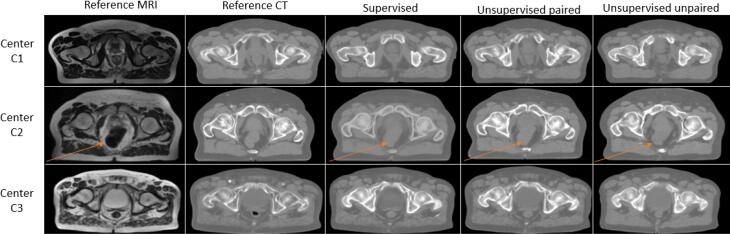
Magnetic resonance imaging (MRI)-to-computed tomography (CT) synthesis is essential in MRI-only radiotherapy workflows, particularly through deep learning techniques known for their accuracy. However, current supervised methods are limited to specific center's learnings and depend on registration precision. The aim of this study was to evaluate the accuracy of unsupervised and supervised approaches in the context of prostate MRI-to-CT generation for radiotherapy dose calculation.
CT/MRI image pairs from 99 prostate cancer patients across three different centers were used. A comparison between supervised and unsupervised conditional Generative Adversarial Networks (cGAN) was conducted. Unsupervised training incorporates a style transfer method with. Content and Style Representation for Enhanced Perceptual synthesis (CREPs) loss. For dose evaluation, the photon prescription dose was 60 Gy delivered in volumetric modulated arc therapy (VMAT). Imaging endpoint for sCT evaluation was Mean Absolute Error (MAE). Dosimetric endpoints included absolute dose differences and gamma analysis between CT and sCT dose calculations.
The unsupervised paired network exhibited the highest accuracy for the body with a MAE at 33.6 HU, the highest MAE was 45.5 HU obtained with unsupervised unpaired learning. All architectures provided clinically acceptable results for dose calculation with gamma pass rates above 94 % (1 % 1 mm 10 %).
This study shows that multicenter data can produce accurate sCTs via unsupervised learning, eliminating CT-MRI registration. The sCTs not only matched HU values but also enabled precise dose calculations, suggesting their potential for wider use in MRI-only radiotherapy workflows.
磁共振成像(MRI)与计算机断层扫描(CT)合成在仅使用MRI的放射治疗工作流程中至关重要,特别是通过以准确性著称的深度学习技术。然而,当前的监督方法仅限于特定中心的学习,并且依赖于配准精度。本研究的目的是在前列腺MRI到CT生成用于放射治疗剂量计算的背景下,评估无监督和监督方法的准确性。
使用来自三个不同中心的99例前列腺癌患者的CT/MRI图像对。对监督式和无监督式条件生成对抗网络(cGAN)进行了比较。无监督训练采用了一种风格迁移方法,并结合了用于增强感知合成的内容和风格表示(CREPs)损失。对于剂量评估,光子处方剂量为60 Gy,通过容积调强弧形治疗(VMAT)给予。sCT评估的成像终点是平均绝对误差(MAE)。剂量学终点包括CT和sCT剂量计算之间的绝对剂量差异和伽马分析。
无监督配对网络在身体部位表现出最高的准确性,MAE为33.6 HU,无监督非配对学习获得的最高MAE为45.5 HU。所有架构在剂量计算方面都提供了临床可接受的结果,伽马通过率高于94%(1% 1毫米 10%)。
本研究表明,多中心数据可以通过无监督学习产生准确的sCT,无需CT-MRI配准。sCT不仅匹配HU值,还能实现精确的剂量计算,表明它们在仅使用MRI的放射治疗工作流程中具有更广泛应用的潜力。