Lapuente-Santana Óscar, Sturm Gregor, Kant Joan, Ausserhofer Markus, Zackl Constantin, Zopoglou Maria, McGranahan Nicholas, Rieder Dietmar, Trajanoski Zlatko, da Cunha Carvalho de Miranda Noel Filipe, Eduati Federica, Finotello Francesca
Department of Biomedical Engineering and Institute for Complex Molecular Systems, Eindhoven University of Technology, 5612 AZ Eindhoven, the Netherlands.
Bioinformatics Unit, Spanish National Cancer Research Centre (CNIO), 28029 Madrid, Spain.
iScience. 2024 Jul 15;27(8):110529. doi: 10.1016/j.isci.2024.110529. eCollection 2024 Aug 16.
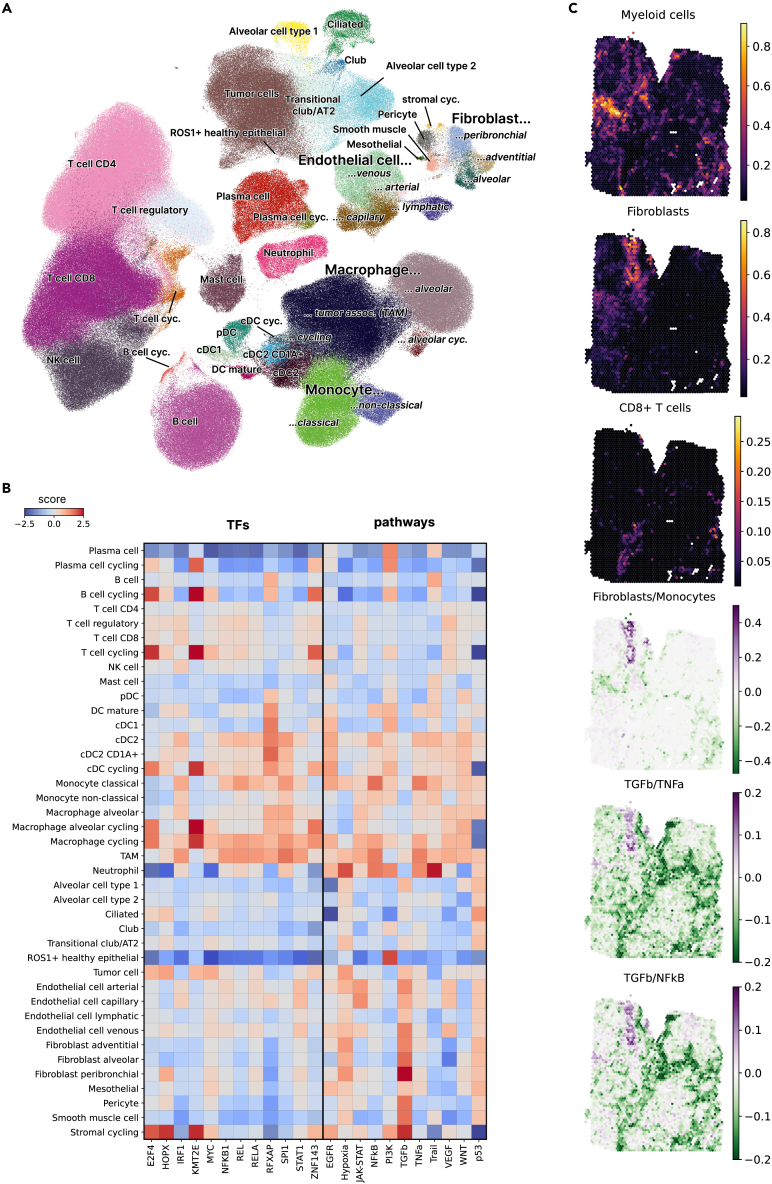
The cellular and molecular heterogeneity of tumors is a major obstacle to cancer immunotherapy. Here, we use a systems biology approach to derive a signature of the main sources of heterogeneity in the tumor microenvironment (TME) from lung cancer transcriptomics. We demonstrate that this signature, which we called , is conserved in different cancers and associated with antitumor immunity. Through analysis of single-cell and spatial transcriptomics data, we trace back the cellular origin of the variability explaining the iHet signature. Finally, we demonstrate that iHet has predictive value for cancer immunotherapy, which can be further improved by disentangling three major determinants of anticancer immune responses: activity of immune cells, immune infiltration or exclusion, and cancer-cell foreignness. This work shows how transcriptomics data can be integrated to derive a holistic representation of the phenotypic heterogeneity of the TME and to predict its unfolding and fate during immunotherapy with immune checkpoint blockers.
肿瘤的细胞和分子异质性是癌症免疫治疗的主要障碍。在此,我们采用系统生物学方法,从肺癌转录组学中推导肿瘤微环境(TME)中异质性主要来源的特征。我们证明,这个我们称为iHet的特征在不同癌症中是保守的,并且与抗肿瘤免疫相关。通过对单细胞和空间转录组学数据的分析,我们追溯了解释iHet特征的变异性的细胞起源。最后,我们证明iHet对癌症免疫治疗具有预测价值,通过解开抗癌免疫反应的三个主要决定因素可以进一步提高预测价值:免疫细胞活性、免疫浸润或排除以及癌细胞的异质性。这项工作展示了如何整合转录组学数据,以获得TME表型异质性的整体表征,并预测其在免疫检查点阻断免疫治疗期间的演变和结局。