Faculty of Medicine and Health, University Health Care Research Center, Örebro University, Örebro, Sweden.
Department of Molecular and Clinical Medicine, Institute of Medicine, University of Gothenburg, Gothenburg, Sweden.
PLoS One. 2024 Aug 20;19(8):e0306341. doi: 10.1371/journal.pone.0306341. eCollection 2024.
An increasing number of patients receive ambulance care without being conveyed to a definitive care provider. This process has been described as complex, challenging, and lacking in guideline support by EMS clinicians. The use of quality- and outcome measures among non-conveyed patients is an understudied phenomenon.
To identify current quality- and outcome measures for the general population of non-conveyed patients in order to describe major trends and knowledge gaps.
A scoping review of peer-reviewed original articles was conducted to identify quality- and outcome measures for non-conveyance within emergency medical services. The Preferred Reporting Items for Systematic Reviews and Meta-Analyses extension for Scoping Reviews statement (PRISMA-ScR) was followed. The PROSPERO and OSF database were checked for pending reviews or protocols. PubMed, CINAHL, Scopus, Web of Science and the Cochrane Library database were searched for relevant articles. Searches were performed in November 2023.
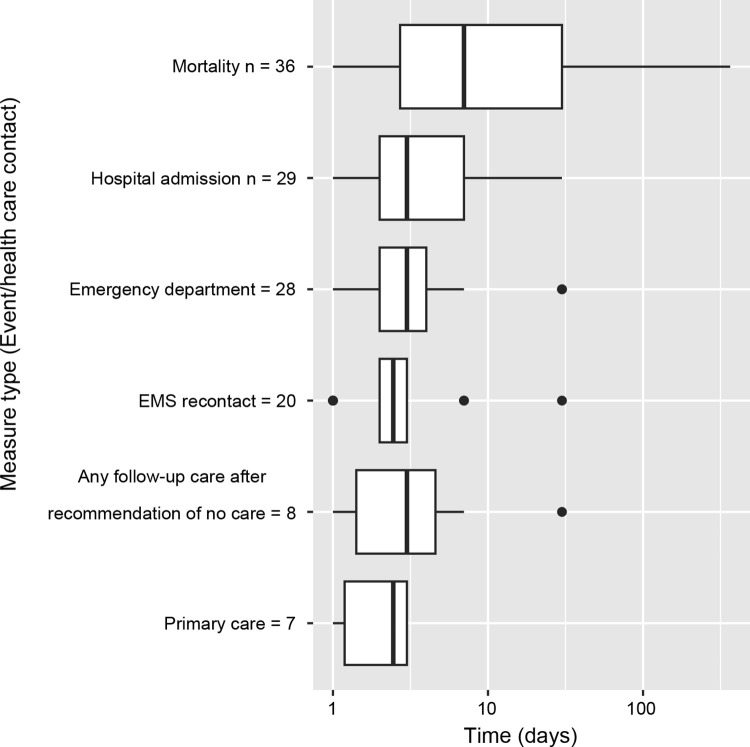
Thirty-six studies fulfilled the inclusion criteria and were included in the review. Mortality was the most used outcome measure, reported in 24 (67%) of the articles. Emergency department attendance and hospital admission were the following most used outcome measures. Follow-up durations varied substantially between both measures and studies. Mortality rates were found to have the longest follow-up times, with a median follow-up duration a little bit over one week.
This scoping review shows that studies report a wide range of quality and outcome measures in the ambulance setting to measure non-conveyance. Reported quality and outcome measures were also heterogeneous with regard to their follow-up timeframe. The variety of approaches to evaluate non-conveyance poses challenges for future research and quality improvement. A more uniform approach to reporting and measuring non-conveyance is needed to enable comparisons between contexts and formal meta-analysis.
越来越多的患者在接受救护车护理后并未被送往确定性医疗机构。这一过程被 EMS 临床医生描述为复杂、具有挑战性且缺乏指南支持。在未转院的患者中使用质量和结果测量方法是一个研究不足的现象。
确定未转院的普通患者人群中当前的质量和结果测量方法,以描述主要趋势和知识空白。
对同行评议的原始文章进行了范围综述,以确定紧急医疗服务中非转院的质量和结果测量方法。遵循了系统评价和荟萃分析扩展的首选报告项目声明(PRISMA-ScR)。在 PROSPERO 和 OSF 数据库中检查了待审查或协议。在 2023 年 11 月,在 PubMed、CINAHL、Scopus、Web of Science 和 Cochrane Library 数据库中搜索了相关文章。
36 项研究符合纳入标准并被纳入综述。死亡率是最常用的结果测量指标,在 24 篇(67%)文章中报告。急诊科就诊和住院是下一个最常用的结果测量指标。随访时间在两个指标和研究之间差异很大。死亡率的随访时间最长,中位随访时间略超过一周。
本范围综述表明,研究报告了在救护车环境中测量非转院的广泛质量和结果测量方法。报告的质量和结果测量方法在其随访时间框架方面也存在异质性。评估非转院的各种方法为未来的研究和质量改进带来了挑战。需要更统一的报告和测量非转院方法,以便能够在不同背景下进行比较并进行正式的荟萃分析。