Marmol-Perez Andres, Ubago-Guisado Esther, Gil-Cosano Jose J, Llorente-Cantarero Francisco J, Pascual-Gázquez Juan Francisco, Muñoz-Torres Manuel, Martinez-Vizcaino Vicente, Ness Kirsten K, Ruiz Jonatan R, Gracia-Marco Luis
Department of Physical Education and Sports, Faculty of Sport Sciences, Sport and Health University Research Institute (iMUDS), University of Granada, Granada, Spain.
Department of Epidemiology and Cancer Control, St. Jude Children's Research Hospital, Memphis, Tennessee, USA.
J Cachexia Sarcopenia Muscle. 2024 Oct;15(5):2156-2163. doi: 10.1002/jcsm.13563. Epub 2024 Aug 20.
Sarcopenia and low areal bone mineral density (aBMD) are prevalent musculoskeletal complications after paediatric cancer treatment. However, their relationship has not been examined in young paediatric cancers survivors. This study aimed to evaluate aBMD differences according to sarcopenia status and the risk of low aBMD Z-score in young paediatric cancer survivors with sarcopenia confirmed/probable.
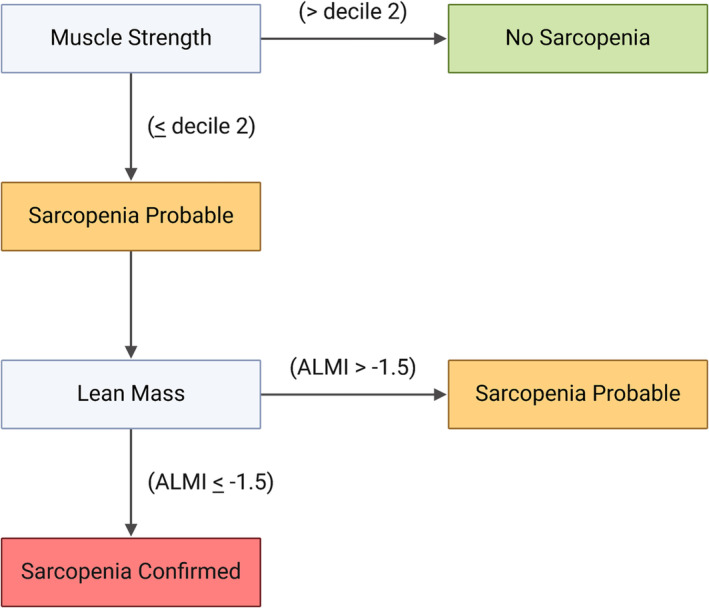
This cross-sectional study included 116 paediatric cancer survivors (12.1 ± 3.3 years old; 42.2% female). Handgrip strength was used to assessed muscle strength. Dual-energy X-ray absorptiometry estimated aBMD (g/cm) and appendicular lean mass index (ALMI, kg/m). 'No sarcopenia' was defined when muscle strength was >decile 2. 'Sarcopenia probable' was defined when muscle strength was ≤ decile 2 and ALMI Z-score was > -1.5 standard deviation (SD). 'Sarcopenia confirmed' was defined when muscle strength was ≤ decile 2 and ALMI Z-score ≤ -1.5 SD. Analysis of covariance and logistic regression, adjusted for time from treatment completion, radiotherapy exposure, calcium intake, and physical activity, was used to evaluate aBMD and estimate the odds ratios (ORs) of low aBMD (aBMD Z-score < -1.0).
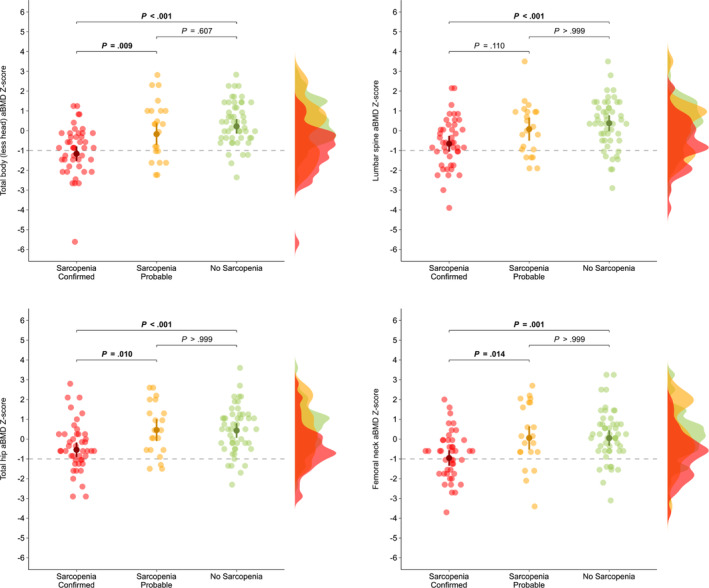
Survivors with sarcopenia confirmed had significantly lower aBMD than those without sarcopenia at total body (-1.2 [95% CI: -1.5 to -0.8] vs. 0.2 [-0.2 to 0.6], P < 0.001), lumbar spine (-0.7 [-1.1 to -0.3] vs. 0.4 [0.0 to 0.8], P < 0.001), total hip (-0.5 [-0.9 to -0.2] vs. 0.4 [0.1 to 0.8], P < 0.001), and femoral neck (-1.0 [-1.4 to -0.6] vs. 0.1 [-0.3 to 0.4], P = 0.001). Compared with survivors with sarcopenia probable, survivors with sarcopenia confirmed had significantly lower aBMD Z-score at total body (-1.2 [-1.5 to -0.8] vs. -0.2 [-0.7 to 0.4], P = 0.009), total hip (-0.5 [-0.9 to -0.2] vs. 0.5 [-0.1 to 1.0], P = 0.010), and femoral neck (-1.0 [-1.4 to -0.6] vs. 0.1 [-0.5 to 0.7], P = 0.014). Survivors with sarcopenia confirmed were at higher risk of low aBMD Z-score at the total body (OR: 6.91, 95% CI: 2.31-24.15), total hip (OR: 2.98, 1.02-9.54), and femoral neck (OR: 4.72, 1.72-14.19), than those without sarcopenia. Survivors with sarcopenia probable were at higher risk of low aBMD Z-score at the total body (OR: 4.13, 1.04-17.60) than those without sarcopenia.
Young paediatric cancer survivors with sarcopenia present higher risk of low aBMD. Resistance training-based interventions designed to mitigate osteosarcopenia in this population should be implemented at early stages.
肌肉减少症和低骨面积密度(aBMD)是儿童癌症治疗后常见的肌肉骨骼并发症。然而,它们之间的关系尚未在年轻的儿童癌症幸存者中进行研究。本研究旨在评估根据肌肉减少症状态的aBMD差异以及确诊/疑似肌肉减少症的年轻儿童癌症幸存者中低aBMD Z评分的风险。
这项横断面研究纳入了116名儿童癌症幸存者(12.1±3.3岁;42.2%为女性)。使用握力评估肌肉力量。双能X线吸收法估计aBMD(g/cm)和四肢瘦体重指数(ALMI,kg/m)。当肌肉力量>第2十分位数时定义为“无肌肉减少症”。当肌肉力量≤第2十分位数且ALMI Z评分>-1.5标准差(SD)时定义为“疑似肌肉减少症”。当肌肉力量≤第2十分位数且ALMI Z评分≤-1.5 SD时定义为“确诊肌肉减少症”。采用协方差分析和逻辑回归,并对治疗结束时间、放疗暴露、钙摄入量和身体活动进行调整,以评估aBMD并估计低aBMD(aBMD Z评分<-1.0)的比值比(OR)。
确诊肌肉减少症的幸存者在全身(-1.2[95%CI:-1.5至-0.8]对0.2[-0.2至0.6],P<0.001)、腰椎(-0.7[-1.1至-0.3]对0.4[0.0至0.8],P<0.001)、全髋(-0.5[-0.9至-0.2]对0.4[0.1至0.8],P<0.001)和股骨颈(-1.0[-1.4至-0.6]对0.1[-0.3至0.4],P=0.001)的aBMD显著低于无肌肉减少症的幸存者。与疑似肌肉减少症的幸存者相比,确诊肌肉减少症的幸存者在全身(-1.2[-1.5至-0.8]对-0.2[-0.7至0.4],P=0.009)、全髋(-0.5[-0.9至-0.2]对0.5[-0.1至1.0],P=0.010)和股骨颈(-1.0[-1.4至-0.6]对0.1[-0.5至0.7],P=0.014)的aBMD Z评分显著更低。确诊肌肉减少症的幸存者在全身(OR:6.91,95%CI:2.31-24.15)、全髋(OR:2.98,1.02-9.54)和股骨颈(OR:4.72,1.72-14.19)出现低aBMD Z评分的风险高于无肌肉减少症的幸存者。疑似肌肉减少症的幸存者在全身出现低aBMD Z评分的风险高于无肌肉减少症的幸存者(OR:4.13,1.04-17.60)。
患有肌肉减少症的年轻儿童癌症幸存者出现低aBMD的风险更高。应在早期阶段实施基于阻力训练的干预措施,以减轻该人群的骨质疏松性肌肉减少症。