Hassanien Eman Ezzat Youssef, Tolba Zeinab Omar
Fixed Prosthodontics Department, Faculty of Dentistry, Cairo University, Cairo, Egypt.
Conservative Dentistry Department, Faculty of Dentistry, Cairo University, Cairo, Egypt.
BDJ Open. 2024 Aug 20;10(1):66. doi: 10.1038/s41405-024-00251-2.
To assess the micro-shear bond strength of light-cured adhesive resin cement compared to flowable composite to hybrid CAD/CAM ceramics.
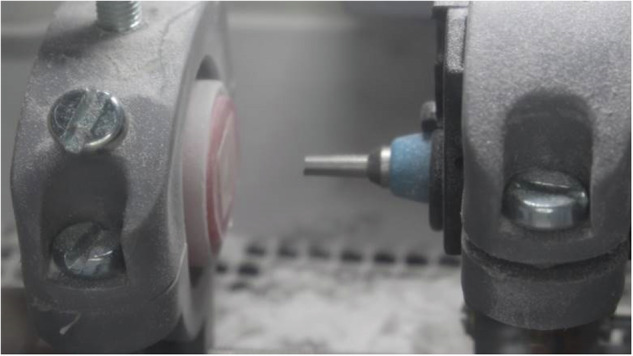
Rectangular discs were obtained from polymer-infiltrated (Vita Enamic; VE) and nano-hybrid resin-matrix (Voco Grandio; GR) ceramic blocks and randomly divided according to the luting agent; light-cured resin cement (Calibra Veneer; C) and flowable composite (Neo Spectra ST flow; F), resulting in four subgroups; VE-C, VE-F, GR-C and GR-F. Substrates received micro-cylinders of the tested luting agents (n = 16). After water storage, specimens were tested for micro-shear bond strength (µSBS) using a universal testing machine at 0.5 mm/min cross-head speed until failure and failure modes were determined. After testing for normality, quantitative data were expressed as mean and standard deviation, whereas, qualitative data were expressed as percentages. Quantitative data were statistically analysed using Student t test at a level of significance (P ≤ 0.05).
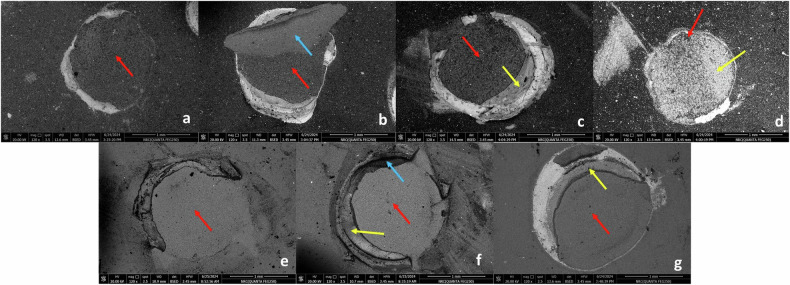
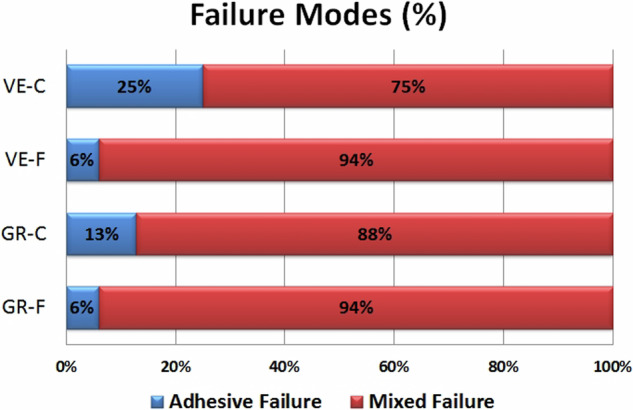
Group GR-F showed the highest µSBS, followed by VE-C, VE-F and GR-C respectively, although statistically insignificant. All groups showed mixed and adhesive failure modes, where VE-F and GR-C showed the highest mixed failures followed by GR-C and VE-C respectively.
After short-term aging, flowable composite and light-cured resin cement showed high comparable bond strength when cementing VE and GR.
评估光固化粘结树脂水门汀与可流动复合树脂相比,对混合式CAD/CAM陶瓷的微剪切粘结强度。
从聚合物渗透陶瓷块(维他耐美瓷;VE)和纳米混合树脂基质陶瓷块(沃克高帝欧;GR)中获取矩形圆盘,并根据粘结剂随机分组;光固化树脂水门汀(卡利布拉贴面;C)和可流动复合树脂(新光谱ST流动树脂;F),形成四个亚组;VE-C、VE-F、GR-C和GR-F。在基底上制备测试粘结剂的微圆柱(n = 16)。储水后,使用万能材料试验机以0.5 mm/min的十字头速度对试件进行微剪切粘结强度(µSBS)测试,直至破坏,并确定破坏模式。经正态性检验后,定量数据以平均值和标准差表示,而定性数据以百分比表示。定量数据采用Student t检验进行统计学分析,显著性水平为(P≤0.05)。
GR-F组的µSBS最高,其次分别是VE-C、VE-F和GR-C组,尽管差异无统计学意义。所有组均表现出混合破坏和粘结破坏模式,其中VE-F组和GR-C组的混合破坏最高,其次分别是GR-F组和VE-C组。
短期老化后,在粘结VE和GR时,可流动复合树脂和光固化树脂水门汀显示出相当高的粘结强度。