Department of Pediatric Surgery, Graduate School of Medicine, Chiba University, 1-8-1 Inohana, Chuo-ku, Chiba, 260-8677, Japan.
Division of Pediatric Surgery, Department of Surgery, Graduate School of Medicine, Jichi Medical University, Shimotsuke, Japan.
Pediatr Surg Int. 2024 Aug 21;40(1):237. doi: 10.1007/s00383-024-05815-9.
To elucidate the clinical significance of sarcopenia in children with neuroblastic tumors (NTs).
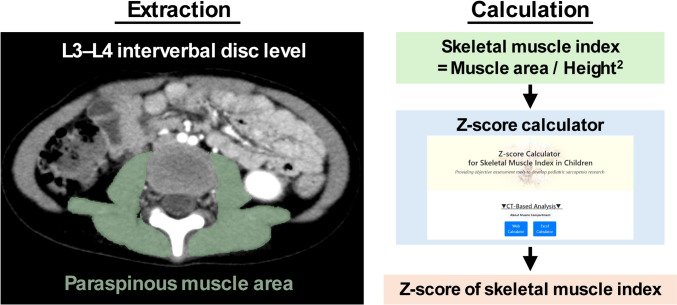
We conducted a retrospective observational study and analyzed the z-scores for height, body weight, body mass index, and skeletal muscle index (HT-z, BW-z, BMI-z, and SMI-z) along with the clinical characteristics of 36 children with NTs. SMI-z was calculated from 138 computed tomography scans at diagnosis, during treatment, and at follow-up. The International Neuroblastoma Risk Group classification was used to identify high-risk groups. We analyzed the data at diagnosis for prognostic analysis and changes over time after diagnosis in the HT-z, BW-z, BMI-z, and SMI-z groups.
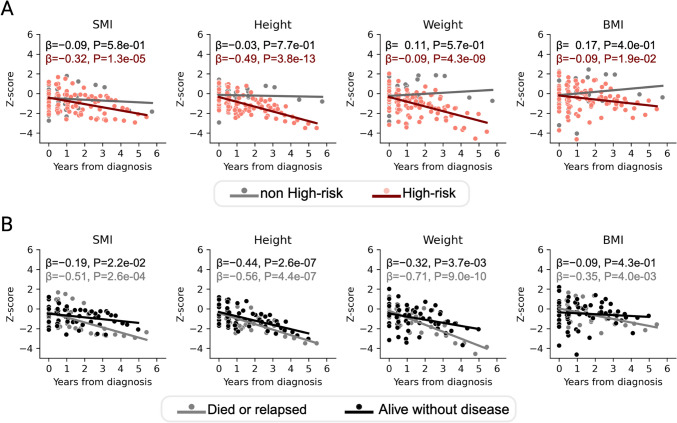
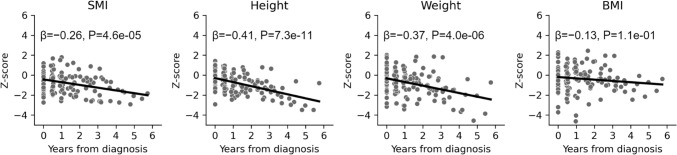
Among the four parameters at diagnosis, only SMI-z predicted overall survival (hazard ratio, 0.58; 95% confidence interval, 0.34-0.99). SMI-z, HT-z, and BW-z significantly decreased over time after diagnosis (P < 0.05), while BMI-z did not (P = 0.11). In surviving high-risk NT cases without disease, SMI-z, HT-z, and BW-z significantly decreased over time (P < 0.05), while BMI-z did not (P = 0.43).
In children with NT, the SMI-z at diagnosis was a significant prognostic factor and decreased during treatment and follow-up along with HT-z and BW-z. Monitoring muscle mass is important because sarcopenia may be associated with growth impairment.
阐明神经母细胞瘤(NTs)患儿中肌肉减少症的临床意义。
我们进行了一项回顾性观察性研究,分析了 36 名 NTs 患儿的身高 z 评分、体重 z 评分、体重指数 z 评分和骨骼肌指数 z 评分(HT-z、BW-z、BMI-z 和 SMI-z)以及临床特征。SMI-z 是根据诊断时、治疗期间和随访时的 138 次计算机断层扫描计算得出的。采用国际神经母细胞瘤危险度分组标准来识别高危组。我们对诊断时的数据进行了预后分析,并对 HT-z、BW-z、BMI-z 和 SMI-z 组诊断后随时间的变化进行了分析。
在诊断时的四个参数中,只有 SMI-z 预测了总生存(危险比,0.58;95%置信区间,0.34-0.99)。诊断后随时间推移,SMI-z、HT-z 和 BW-z 显著降低(P<0.05),而 BMI-z 没有(P=0.11)。在无疾病存活的高危 NT 病例中,SMI-z、HT-z 和 BW-z 随时间推移显著降低(P<0.05),而 BMI-z 没有(P=0.43)。
在 NT 患儿中,诊断时的 SMI-z 是一个显著的预后因素,在治疗和随访过程中会随 HT-z 和 BW-z 降低。监测肌肉量很重要,因为肌肉减少症可能与生长受损有关。