Section of Translational Breast Cancer Research and Department of Breast Medical Oncology, The University of Texas MD Anderson Cancer Center, Houston, TX, USA.
Cancer Biology and Therapeutics, University of Hawai'I Cancer Center, 701 Ilalo Street, Room 622, Honolulu, HI, 96813, USA.
J Exp Clin Cancer Res. 2024 Aug 21;43(1):236. doi: 10.1186/s13046-024-03143-3.
Anti-HER2 therapies, including the HER2 antibody-drug conjugates (ADCs) trastuzumab emtansine (T-DM1) and trastuzumab deruxtecan (T-DXd), have led to improved survival outcomes in patients with HER2-overexpressing (HER2+) metastatic breast cancer. However, intrinsic or acquired resistance to anti-HER2-based therapies remains a clinical challenge in these patients, as there is no standard of care following disease progression. The purpose of this study was to elucidate the mechanisms of resistance to T-DM1 and T-DXd in HER2+ BC patients and preclinical models and identify targets whose inhibition enhances the antitumor activity of T-DXd in HER2-directed ADC-resistant HER2+ breast cancer in vitro and in vivo.
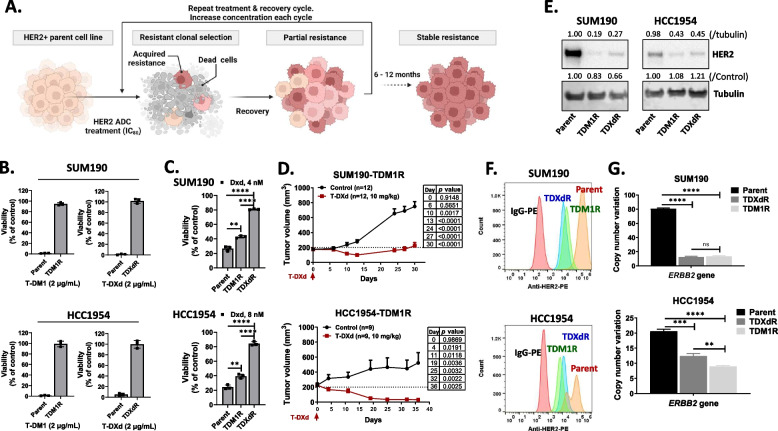
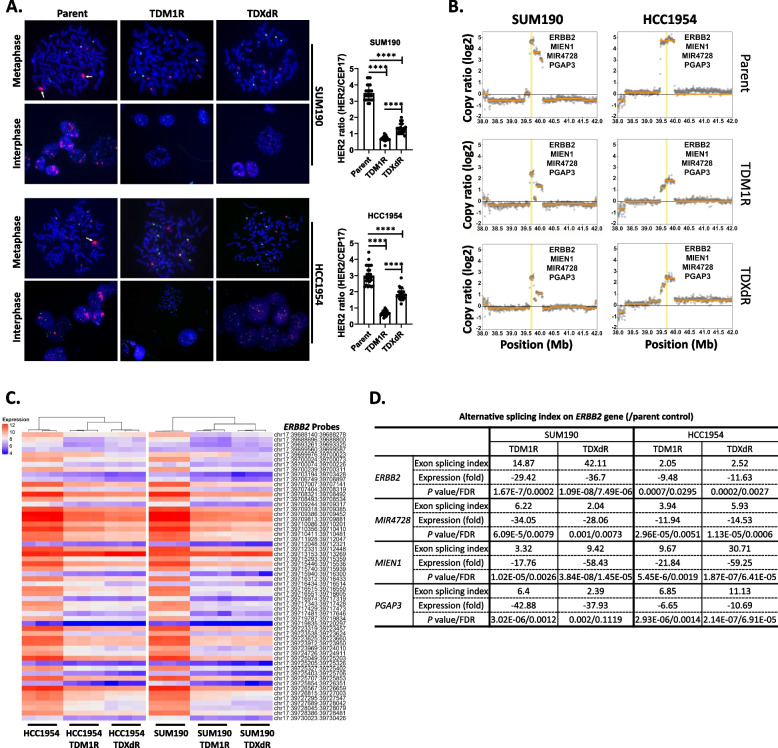
Targeted DNA and whole transcriptome sequencing were performed in breast cancer patient tissue samples to investigate genetic aberrations that arose after anti-HER2 therapy. We generated T-DM1 and T-DXd-resistant HER2+ breast cancer cell lines. To elucidate their resistance mechanisms and to identify potential synergistic kinase targets for enhancing the efficacy of T-DXd, we used fluorescence in situ hybridization, droplet digital PCR, Western blotting, whole-genome sequencing, cDNA microarray, and synthetic lethal kinome RNA interference screening. In addition, cell viability, colony formation, and xenograft assays were used to determine the synergistic antitumor effect of T-DXd combinations.
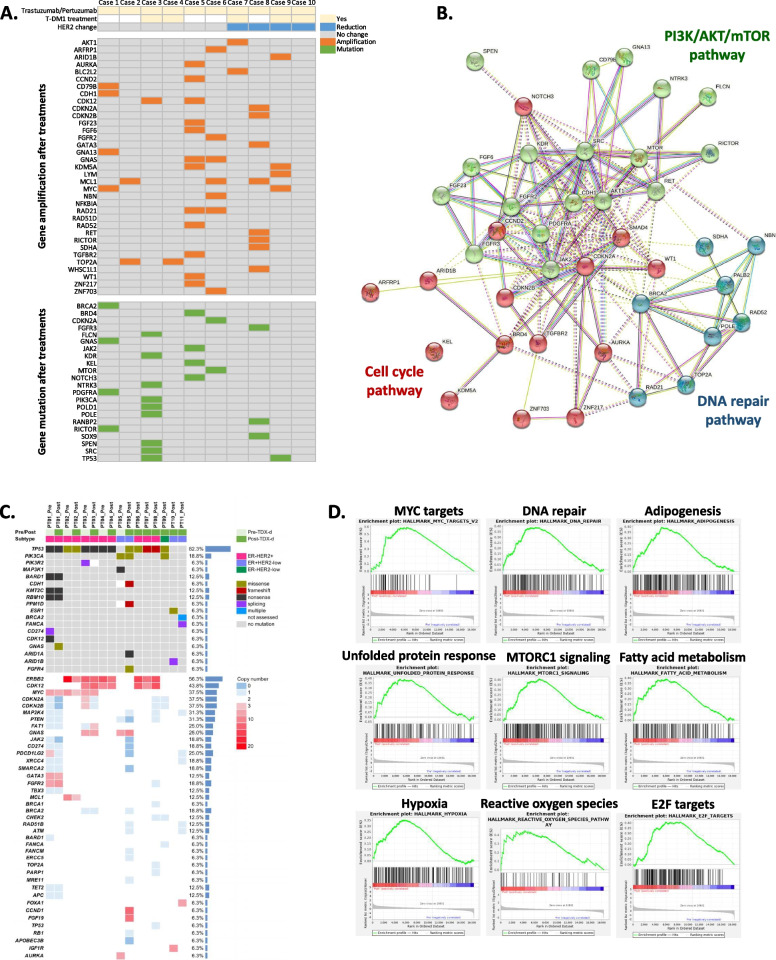
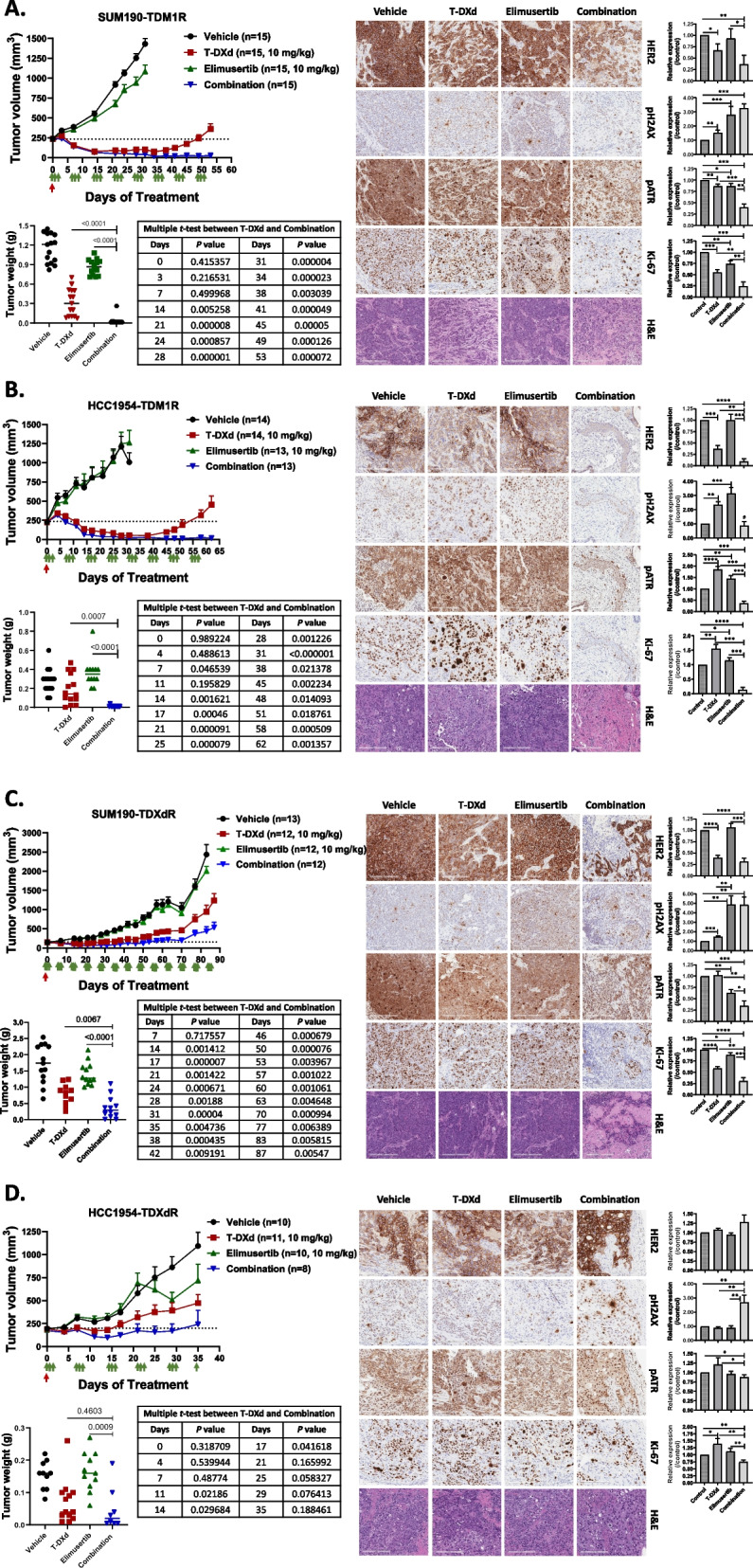
We found reduced HER2 expression in patients and amplified DNA repair-related genes in patients after anti-HER2 therapy. Reduced ERBB2 gene amplification in HER2-directed ADC-resistant HER2+ breast cancer cell lines was through DNA damage and epigenetic mechanisms. In HER2-directed ADC-resistant HER2+ breast cancer cell lines, our non-biased RNA interference screening identified the DNA repair pathway as a potential target within the canonical pathways to enhance the efficacy of T-DXd. We validated that the combination of T-DXd with ataxia telangiectasia and Rad3-related inhibitor, elimusertib, led to significant breast cancer cell death in vitro (P < 0.01) and in vivo (P < 0.01) compared to single agents.
The DNA repair pathways contribute to HER2-directed ADC resistance. Our data justify exploring the combination treatment of T-DXd with DNA repair-targeting drugs to treat HER2-directed ADC-resistant HER2+ breast cancer in clinical trials.
抗 HER2 治疗,包括 HER2 抗体药物偶联物(ADC)曲妥珠单抗emtansine(T-DM1)和曲妥珠单抗deruxtecan(T-DXd),已导致 HER2 过表达(HER2+)转移性乳腺癌患者的生存结果得到改善。然而,在这些患者中,对基于抗 HER2 治疗的内在或获得性耐药仍然是一个临床挑战,因为在疾病进展后没有标准的治疗方法。本研究的目的是阐明 HER2+BC 患者和临床前模型中对 T-DM1 和 T-DXd 耐药的机制,并确定抑制哪些靶标可增强体外和体内 HER2 定向 ADC 耐药的 HER2+乳腺癌中 T-DXd 的抗肿瘤活性。
对乳腺癌患者组织样本进行靶向 DNA 和全转录组测序,以研究抗 HER2 治疗后出现的遗传异常。我们生成了 T-DM1 和 T-DXd 耐药的 HER2+乳腺癌细胞系。为了阐明它们的耐药机制,并确定潜在的协同激酶靶标以增强 T-DXd 的疗效,我们使用荧光原位杂交、液滴数字 PCR、Western blot、全基因组测序、cDNA 微阵列和合成致死激酶 RNA 干扰筛选。此外,细胞活力、集落形成和异种移植测定用于确定 T-DXd 组合的协同抗肿瘤作用。
我们发现患者的 HER2 表达降低,抗 HER2 治疗后患者的 DNA 修复相关基因扩增。HER2 定向 ADC 耐药的 HER2+乳腺癌细胞系中 ERBB2 基因扩增减少是通过 DNA 损伤和表观遗传机制实现的。在 HER2 定向 ADC 耐药的 HER2+乳腺癌细胞系中,我们的无偏 RNA 干扰筛选确定 DNA 修复途径是增强 T-DXd 疗效的潜在靶点之一。我们验证了 T-DXd 与共济失调毛细血管扩张症和 Rad3 相关抑制剂 elimusertib 的联合使用可导致体外(P<0.01)和体内(P<0.01)乳腺癌细胞死亡明显增加与单药治疗相比。
DNA 修复途径有助于 HER2 定向 ADC 耐药。我们的数据证明了探索 T-DXd 与靶向 DNA 修复药物联合治疗用于临床试验中治疗 HER2 定向 ADC 耐药的 HER2+乳腺癌的合理性。