Li Ning, Yang Lu, Zhao Zixuan, Du Tian, Liang Gehao, Li Na, Tang Jun
Department of Breast Oncology, State Key Laboratory of Oncology in South China, Guangdong Provincial Clinical Research Center for Cancer, Sun Yat-sen University Cancer Center, Guangzhou, 510060, China.
Department of Radiotherapy, Cancer Center, Guangdong Provincial People's Hospital, Guangdong Academy of Medical Sciences, Southern Medical University, Guangzhou, 510080, China.
Exp Hematol Oncol. 2025 Mar 20;14(1):41. doi: 10.1186/s40164-025-00632-9.
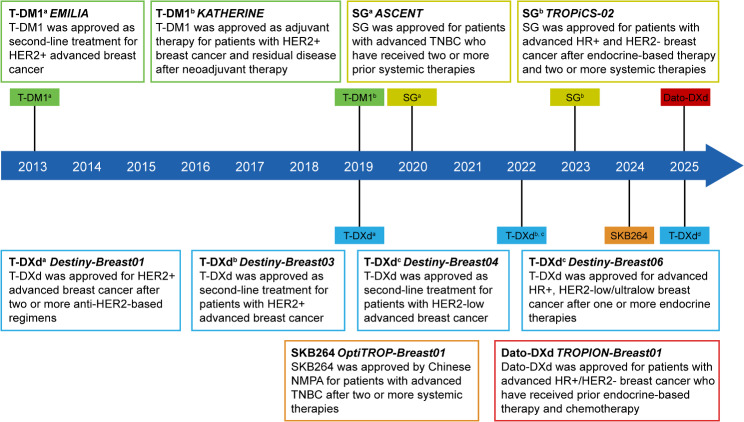
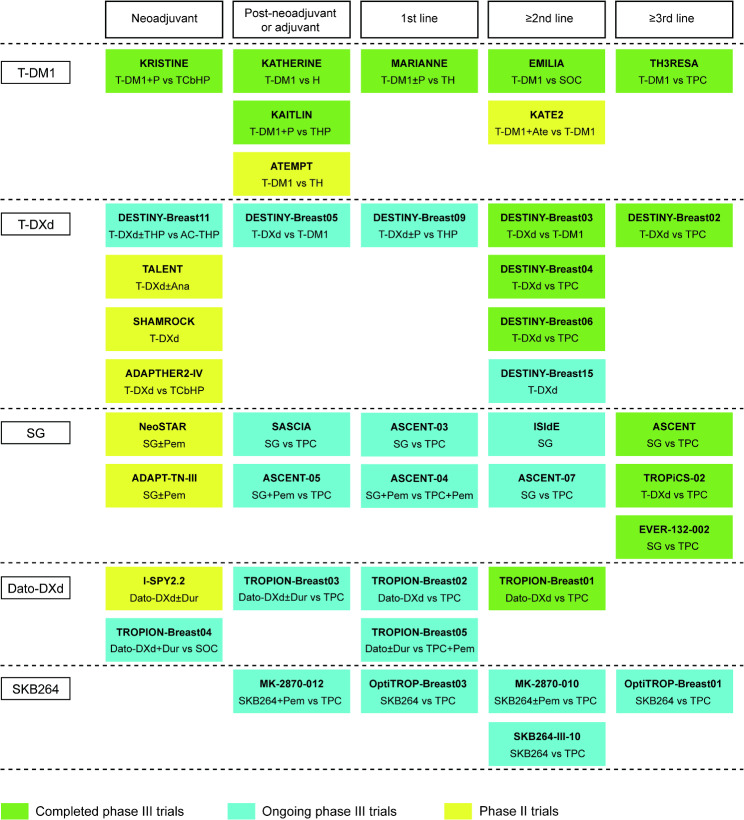
Antibody-drug conjugates (ADCs) are a rapidly evolving class of antitumor drugs and have already revolutionized the treatment strategy of many hematologic and solid cancers. So far, trastuzumab emtansine (T-DM1), trastuzumab deruxtecan (T-DXd), sacituzumab govitecan (SG) and datopotamab deruxtecan (Dato-DXd) are the four ADCs that have been approved by US food and drug administration (FDA) in treatment of breast cancer, and SKB264 has been approved by Chinese national medical products administration (NMPA). Many ADCs for treatment of breast cancer are currently being tested in late-phase clinical trials, with several encouraging results achieved recently. However, major issues arise during the use of ADCs, including emergence of acquired resistance, occurrence of treated-related toxicities, and identification of biomarkers of response and resistance. ADCs are being increasingly tested in combination with other agents, and novel next-generation ADC development is progressing rapidly. A better understanding of the design and development of ADCs will promote ADC development for cancer treatment. In this review, we aim to provide a broad overview of the design and the recent advances of ADCs in breast cancer. We also propose several notable future directions of ADCs in treatment of breast cancer.
抗体药物偶联物(ADCs)是一类快速发展的抗肿瘤药物,已经彻底改变了许多血液系统癌症和实体癌的治疗策略。到目前为止,曲妥珠单抗恩美曲妥珠单抗(T-DM1)、曲妥珠单抗德曲妥珠单抗(T-DXd)、戈沙妥珠单抗(SG)和达泊妥珠单抗德曲妥珠单抗(Dato-DXd)是已被美国食品药品监督管理局(FDA)批准用于治疗乳腺癌的四种ADC,而SKB264已被中国国家药品监督管理局(NMPA)批准。目前,许多用于治疗乳腺癌的ADC正在进行晚期临床试验,最近取得了一些令人鼓舞的结果。然而,在ADC的使用过程中出现了一些主要问题,包括获得性耐药的出现、治疗相关毒性的发生以及反应和耐药生物标志物的识别。ADC与其他药物联合使用的试验越来越多,新型下一代ADC的开发进展迅速。更好地了解ADC的设计和开发将促进其在癌症治疗中的发展。在本综述中,我们旨在对乳腺癌中ADC的设计和最新进展进行广泛概述。我们还提出了ADC在乳腺癌治疗中未来几个值得关注的方向。