Flores Sergio E, Manatrakul Rawee, Anigwe Christopher, Ngarmsrikam Chotigar, Feeley Brian T, Ma C Benjamin, Link Thomas M, Lansdown Drew A
Department of Orthopaedic Surgery, University of California, San Francisco, San Francisco, CA, USA.
Department of Radiology, University of California, San Francisco, San Francisco, CA, USA.
Orthop J Sports Med. 2024 Aug 19;12(8):23259671241263648. doi: 10.1177/23259671241263648. eCollection 2024 Aug.
Repair of posterior medial meniscus root (PMMR) tears has demonstrated favorable outcomes and may prevent rapid progression of knee osteoarthritis; however, there is a paucity of data regarding prognostic factors affecting postoperative outcomes.
PURPOSE/HYPOTHESIS: The purpose of this study was to identify factors on preoperative magnetic resonance imaging (MRI) that predict postoperative outcomes after PMMR repair. It was hypothesized that patients with increasing levels of degenerative changes as evaluated through semiquantitative preoperative MRI scans would have worse postoperative patient-reported outcome (PRO) scores.
Cohort study; Level of evidence, 3.
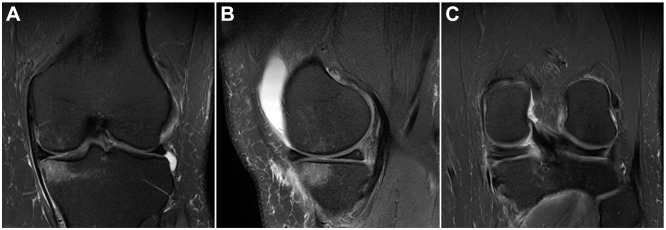
Patients who underwent PMMR repair between 2012 and 2020 and had minimum 2-year follow-up data were enrolled. Pre- and postoperative visual analog scale pain scores and postoperative PRO surveys including the Patient-Reported Outcomes Measurement Information System-Physical Function, Lysholm knee score, and Knee injury and Osteoarthritis Outcome Score (KOOS) were collected. Patients who achieved the Patient Acceptable Symptom State (PASS) on the KOOS subscales were reported. Two fellowship-trained musculoskeletal radiologists reviewed preoperative MRIs and calculated the Whole-Organ Magnetic Resonance Imaging Score for meniscus, cartilage, bone marrow edema-like lesions (BMELL), and meniscal extrusion. Statistical analysis was performed using the 2-sample test, Mann-Whitney test, and Fisher exact test for categorical variables.
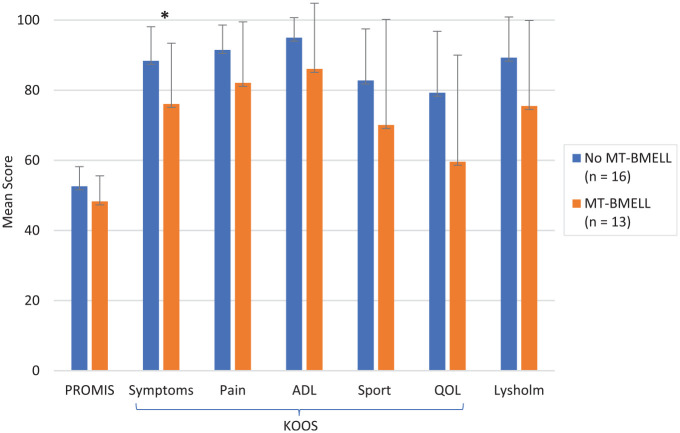
A total of 29 knees in 29 patients were evaluated (22 female, 7 male; mean age at surgery, 52.3 ± 9.9 years; body mass index, 27.6 ± 5.6 kg/m; mean follow-up, 59.6 ± 26.5 months). Visual analog scale for pain scores decreased significantly from preoperatively (4.9 ± 2.0) to final follow-up (1.6 ± 1.9) ( < .001), and the percentage of patients meeting the PASS ranged from 44.8% for KOOS Sport and Recreation to 72.4% for KOOS Pain and KOOS Quality of Life. Patients with medial tibial BMELL (MT-BMELL) had significantly lower KOOS Symptoms scores (76.1 ± 17.3 vs 88.4 ± 9.7 without MT-BMELL; = .032). Cartilage quality and presence of meniscal extrusion were not associated with outcomes.
Patients with MT-BMELL on their preoperative MRI in the setting of PMMR tear were found to have worse KOOS Symptoms scores after PMMR repair.
后内侧半月板根部(PMMR)撕裂的修复已显示出良好的效果,并且可能预防膝关节骨关节炎的快速进展;然而,关于影响术后结果的预后因素的数据却很匮乏。
目的/假设:本研究的目的是确定术前磁共振成像(MRI)上预测PMMR修复术后结果的因素。假设通过术前半定量MRI扫描评估的退变改变程度增加的患者,其术后患者报告结局(PRO)评分会更差。
队列研究;证据等级,3级。
纳入2012年至2020年间接受PMMR修复且有至少2年随访数据的患者。收集术前和术后视觉模拟量表疼痛评分以及术后PRO调查结果,包括患者报告结局测量信息系统-身体功能、Lysholm膝关节评分和膝关节损伤与骨关节炎结局评分(KOOS)。报告在KOOS子量表上达到患者可接受症状状态(PASS)的患者情况。两名经过专科培训的肌肉骨骼放射科医生回顾术前MRI,并计算半月板、软骨、骨髓水肿样病变(BMELL)和半月板挤压的全器官磁共振成像评分。对分类变量使用双样本t检验、Mann-Whitney检验和Fisher精确检验进行统计分析。
共评估了29例患者的29个膝关节(22例女性,7例男性;手术时平均年龄52.3±9.9岁;体重指数27.6±5.6kg/m²;平均随访59.6±26.5个月)。疼痛的视觉模拟量表评分从术前的(4.9±2.0)显著降至最终随访时的(1.6±l.9)(P<0.001),达到PASS的患者百分比范围从KOOS运动与娱乐方面的44.8%到KOOS疼痛和KOOS生活质量方面的72.4%。存在内侧胫骨BMELL(MT-BMELL)的患者KOOS症状评分显著更低(76.1±17.3,而无MT-BMELL者为88.4±9.7;P=0.032)。软骨质量和半月板挤压的存在与结局无关。
发现在PMMR撕裂情况下术前MRI存在MT-BMELL的患者,PMMR修复术后KOOS症状评分更差。