Kobayashi Hironori, Otsuki Ayumu, Ikeda Sadakatsu, Nakashima Kei, Oyama Yu
Medical Oncology, Kameda Medical Center, Kamogawa, JPN.
Pulmonology, Kameda Medical Center, Kamogawa, JPN.
Cureus. 2024 Aug 20;16(8):e67307. doi: 10.7759/cureus.67307. eCollection 2024 Aug.
Atezolizumab, bevacizumab, carboplatin, and paclitaxel (ABCP) combination therapy has a potential efficacy in a specific subset of non-squamous non-small cell lung cancer (NSCLC) patients with epidermal growth factor receptor () mutations following tyrosine kinase inhibitor (TKI) treatment. However, there is a dearth of investigations on the effectiveness of ABCP therapy as the primary outcome of -TKI use.
A single-center retrospective analysis was performed on 24 cases of stage IV -positive non-squamous NSCLC patients who received one or more lines of -TKI therapy and subsequently initiated ABCP therapy within the timeframe of April 1, 2019, to April 30, 2023. This study assessed overall survival and progression-free survival associated with ABCP therapy, further analyzing the overall survival data based on subgroups.
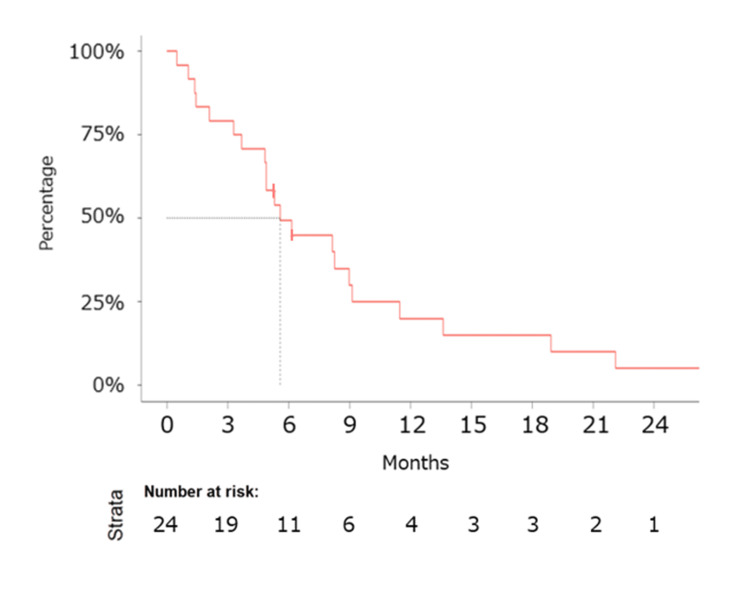
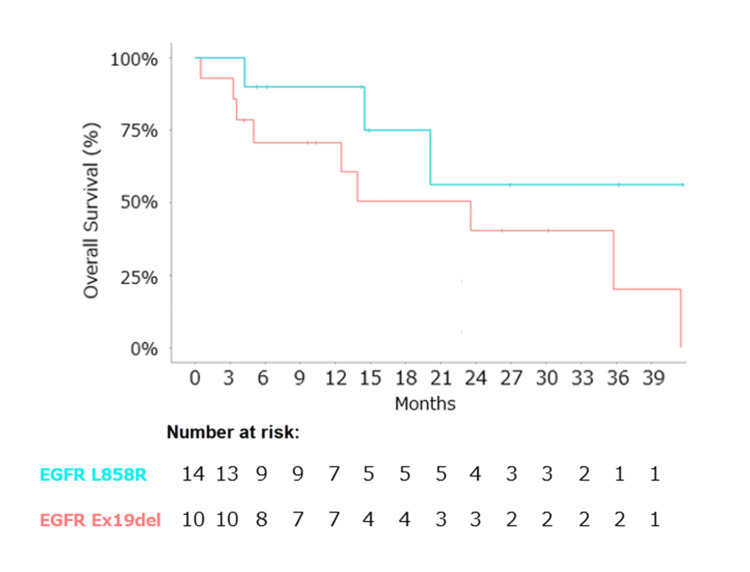
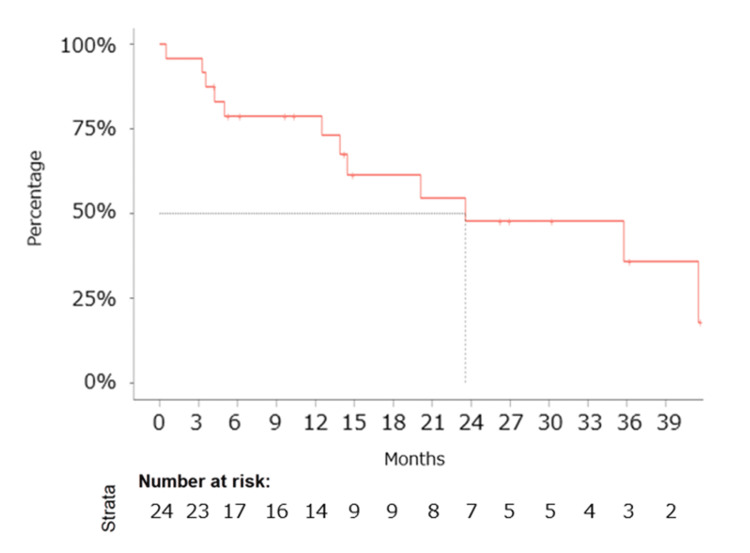
The mean age of the cohort was 65 ± 9 years with 14 females (58%). The performance status (PS) was recorded as 0 in 13 out of 24 patients (54%) and 1 in 11 out of 24 patients (46%). Thirteen (54%) patients had a history of smoking. Adenocarcinoma histology was prevalent in all cases. The mutations included Ex19del in 14 patients (58%) and L858R in 10 (42%) patients. At ABCP therapy initiation, liver metastases were evident in three cases (13%) and brain metastases in eight (33%). Programmed death ligand 1 (22C3) expression levels varied, with <1%, 1-49%, and ≥50% observed in five, 11, and five cases, respectively, while data were missing for three cases. The median follow-up duration was 14.1 months, with median overall survival estimated at 23.6 months (95% CI: 14.5 months - not reached) and median progression-free survival at 5.6 months (95% CI: 4.9-11.5 months). The L858R mutation showed a favorable trend in overall survival compared with the Ex19del mutation (not evaluated vs. 23.6 months).
ABCP therapy for -positive non-squamous NSCLC is a promising option, similar to immune checkpoint inhibitor-free platinum-based combination therapy. Therefore, prospective trials are necessary to confirm the efficacy of these treatments.
阿替利珠单抗、贝伐珠单抗、卡铂和紫杉醇(ABCP)联合疗法对特定亚组的非鳞状非小细胞肺癌(NSCLC)患者在酪氨酸激酶抑制剂(TKI)治疗后出现表皮生长因子受体()突变时具有潜在疗效。然而,关于ABCP疗法作为-TKI使用的主要结局的有效性的研究却很匮乏。
对24例IV期-阳性非鳞状NSCLC患者进行单中心回顾性分析,这些患者接受了一线或多线-TKI治疗,并随后于2019年4月1日至2023年4月30日期间开始ABCP治疗。本研究评估了与ABCP疗法相关的总生存期和无进展生存期,并基于亚组进一步分析了总生存期数据。
该队列的平均年龄为65±9岁,女性14例(58%)。24例患者中有13例(54%)的体力状况(PS)记录为0,24例患者中有11例(46%)记录为1。13例(54%)患者有吸烟史。所有病例中腺癌组织学占主导。突变包括14例(58%)患者的Ex19del和10例(42%)患者的L858R。在开始ABCP治疗时,3例(13%)有肝转移,8例(33%)有脑转移。程序性死亡配体1(22C3)表达水平各不相同,分别在5例、11例和5例中观察到<1%、1 - 49%和≥50%,3例数据缺失。中位随访时间为14.1个月,中位总生存期估计为23.6个月(95%CI:14.5个月 - 未达到),中位无进展生存期为5.6个月(95%CI:4.9 - 11.5个月)。与Ex19del突变相比,L858R突变在总生存期方面显示出有利趋势(未评估对23.6个月)。
ABCP疗法用于-阳性非鳞状NSCLC是一种有前景的选择,类似于不含免疫检查点抑制剂的铂类联合疗法。因此,有必要进行前瞻性试验以证实这些治疗方法的疗效。